
Q 1 :

Correct Bernoulli's equation is (symbols have their usual meaning)              [2024]

  • P+ρgh+12ρv2=constant


  • P+ρgh+ρv2=constant


  • P+mgh+12mv2=constant


  • P+12ρgh+12ρv2=constant


(1)    

         P+ρgh+12ρv2=constant

          Energy per unit volume is conserved.


Q 2 :

The reading of pressure metre attached with a closed pipe is 4.5×10⁴N/m2. On opening the valve, water starts flowing and the reading of pressure metre falls to 2.0×10⁴N/m2. The velocity of water is found to be Vm/s. The value of V is ___________ .            [2024]


(50)      Change in pressure=12ρv2

             4.5×10⁴-2×104=12×103×v2

             2.5×104=12×103×v2

             v2=50

             v=50


Q 3 :

A plane is in level flight at constant speed and each of its two wings has an area of 40 m2. If the speed of the air is 180 km/h over the lower wing surface and 252 km/h over the upper wing surface, the mass of the plane is __________ kg.

(Take air density to be 1kg m-3 and g=10 ms-2)                             [2024]


(9600)      By Bernoulli's equation

                P1+12ρv12=P2+12ρv22

               12×ρ×[4900-2500]=mgA

              12×1×2400=m×1080

               m=9600kg


Q 4 :

Given below are two statements:

Statement I: When speed of liquid is zero everywhere, pressure difference at any two points depends on equation P1-P2=ρg(h2-h1).

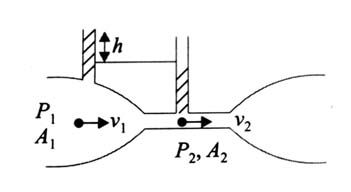
Statement II: In venturi tube shown, 2gh=v12-v22

In the light of the above statements, choose the most appropriate answer from the options given below.      [2024]

  • Both Statement I and Statement II are correct.


  • Both Statement I and Statement II are incorrect.


  • Statement I is correct but Statement II is incorrect.


  • Statement I is incorrect but Statement II is correct.


(3)

From Bernoulli’s equation

P1+ρgh1+12ρv12=P2+ρgh2+12ρv22

[h1 and h2 are height of points from any reference level]

For statement 1:

When speed of liquid is zero everywhere, v1=v2=0

 P1-P2=ρg(h2-h1), Hence, statement I is correct.

For statement 2, h1=h2

P1+12ρv12=P2+12ρv22P1-P2=12ρ(v22-v12)

But, P1-P2=ρghρgh=12ρ(v22-v12)

Hence, 2gh=v22-v12, Hence statement II is incorrect.


Q 5 :

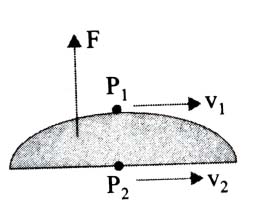
In a test experiment on a model aeroplane in a wind tunnel, the flow speeds on the upper and lower surfaces of the wings are 70 ms-1 and 65 ms-1 respectively. If the wing area is 2 m2 the lift of the wing is ______ N.

(Given density of air = 1.2 kg m-1)                   [2024]


(810)

F=12ρ(v12-v22)A

F=12×1.2×(702-652)×2=810 N


Q 6 :

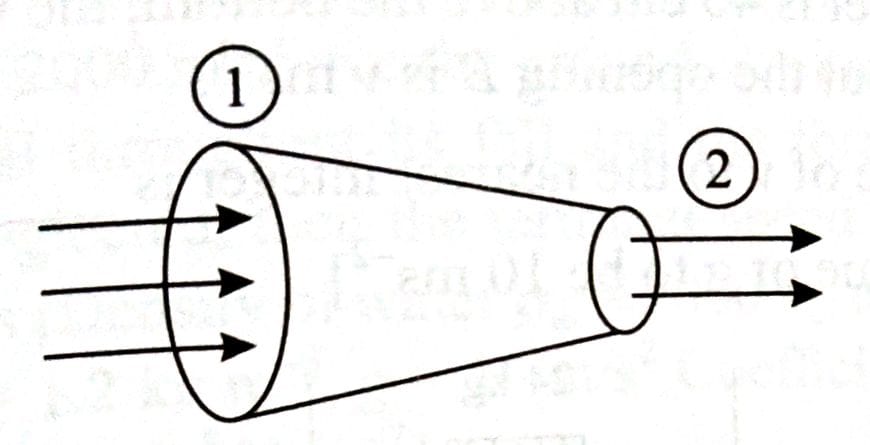
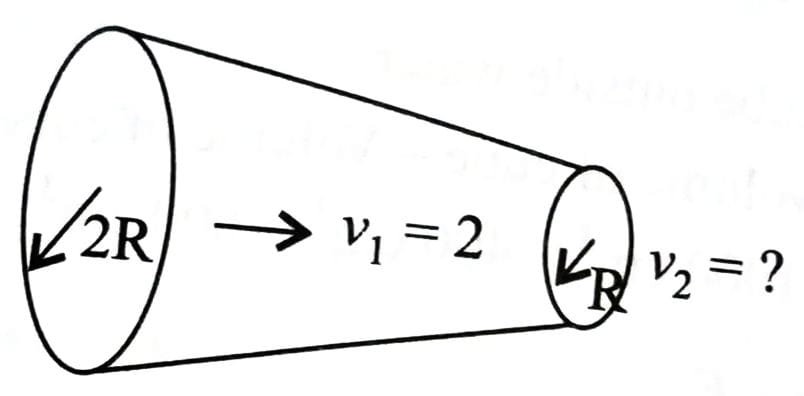
A tube of length L is shown in the figure. The radius of cross section at the point (1) is 2 cm and at the point (2) is 1 cm, respectively. If the velocity of water entering at point (1) is 2 m/s, then velocity of water leaving the point (2) will be:          [2025]

  • 2 m/s


  • 4 m/s


  • 6 m/s


  • 8 m/s


(4)

A1V1=A2V2

 2π(2R)2=V2πR2

  V2=8 m/s


Q 7 :

Water flows in a horizontal pipe whose one end is closed with a valve. The reading of the pressure guage attached to the pipe is P1. The reading of the pressure gauge falls to P2 when the valve is opened. The speed of water flowing in the pipe is proportional to         [2025]

  • P1P2


  • (P1P2)2


  • (P1P2)4


  • P1P2


(1)

Using Bernoulli's theorem

P1P2=12ρv2

vP1P2


Q 8 :

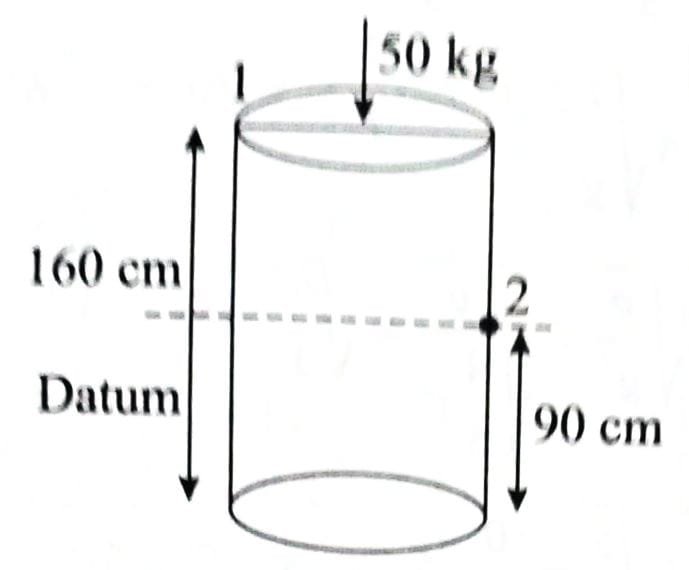
Consider a completely full cylindrical water tank of height 1.6 m and cross-sectional area 0.5 m2. It has a small hole in its side at a height 90 cm from the bottom. Assume, the cross-sectional area of the hole to be negligibly small as compared to that of the water tank. If a load 50 kg is applied at the top surface of the water in the tank them the velocity of the water coming out at the instant when the hole is opened is: (g=10 m/s2)          [2025]

  • 3 m/s


  • 5 m/s


  • 2 m/s


  • 4 m/s


(4)

Apply Bernoulli equation between points 1 and 2

P1+12ρv12+ρgh=P2+12ρv22+0

P0+mgA+ρg70100=P0+12ρv22

As the tank area is large v1 is negligible compared to v2

50005+103×1070100=12×103v22

103+103×7=1032v22  v22=16

 v2=4 m/s


Q 9 :

A fully loaded Boing aircraft has a mass of 5.4×10⁵ kg. Its total wing area is 500 m2. It is in level flight with a speed of 1080 km/h. If the density of air ρ is 1.2 kg m-3, the fractional increase in the speed of the air on the upper surface of the wing relative to the lower surface in percentage will be (g=10 m/s2)         [2023]

  • 16


  • 6


  • 8


  • 10


(4)

P2A-P1A=5.0×10⁵×g

P2-P1=5.4×106500=5.4×2×102×10=10.8×10³

P2+0+12ρV22=P1+0+12ρV12

P2-P1=12ρ(V12-V22)=12ρ(V1-V2)(V1+V2)

10.8×103=12×1.2(V1-V2)×2×3×102

10.8×10=3.6(V1-V2)

V1-V2=30

(V1-V2V)×100=30300×100=10%


Q 10 :

The figure shows a liquid of given density flowing steadily in a horizontal tube of varying cross-section. Cross-sectional areas at A is 1.5 cm2, and B is 25 mm2. If the speed of liquid at B is 60 cm/s, then (PA-PB) is

(Given PA and PB are liquid pressures at A and B points. Density ρ=1000 kg m3.  

A and B are on the axis of the tube                                              [2023]

  • 175 Pa


  • 27 Pa


  • 135 Pa


  • 36 Pa


(1)

From continuity theorem A1V1=A2V2

1.5×V1=25×10-2×60

V1=25×60×10-2×101.5=10 cm/s

By Bernoulli's theorem

P1+12×1000×(0.1)2=P2+12×1000×(0.6)2

P1+5=P2+12×1000×36×10-2

  P1-P2=175 Pa


Q 11 :

The surface of water in a water tank of cross-sectional area 750 cm2 on the top of a house is h m above the tap level. The speed of water coming out through the tap of cross-sectional area 500 mm2 is 30 cm/s.  At that instant, dhdt is x×10-3 m/s. The value of x will be _______.             [2023]


(2)

a1v1=a2v2

750×10-4v1=500×10-6×0.3

v1=500×3×10-3750m/s=2×10-3 m/s

dhdt=-2×10⁻³ m/s


Q 12 :

Figure below shows a liquid being pushed out of the tube by a piston having area of cross section 2.0 cm2. The area of cross section at the outlet is 10 mm2. If the piston is pushed at a speed of 4 cm s-1, the speed of outgoing fluid is _________ cm s-1.              [2023]


(80)

By equation of continuity

A1V1=A2V2

V2=2×410×10-2=80 cm/s


Q 13 :

Glycerine of density 1.25×10³ kg m-3 is flowing through the conical section of a pipe. The area of cross-section of the pipe at its ends is 10 cm2 and 5 cm2 and the pressure drop across its length is 3 N m-2. The rate of flow of glycerine through the pipe is x×10-5 m3 s-1. The value of x is _________.              [2023]


(4)

ΔP=P1-P2=3 N/m2  (given)

By continuity eqnA1v1=A2v2

 v1=A2A1v2                                       ...(i)

By Bernoulli's eqn,

P1+12ρv12=P2+12ρv22

P1-P2=12ρ(v22-v12)

ΔP=12ρ[1-(A2A1)2]v22

3=12×1.25×103[1-(510)2]v22

 v2=8×10⁻² m/s

So discharge rate =A2v2=5×10-4×8×10-2=4×10⁻⁵ m3/s

Correct answer is x=4


Q 14 :

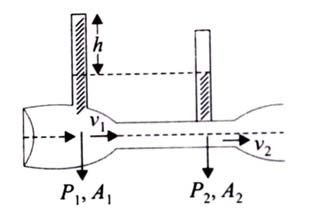
Water flows through a horizontal tube as shown in the figure. The difference in height between the water columns in vertical tubes is 5 cm and the area of cross-sections at A and B are 6cm2 and 3cm2 respectively. The rate of flow will be ______ cm3/s. (take g = 10 m/s²)      [2026]

  • 2003


  • 1003


  • 2003


  • 2006


(3)

From continuity equation

AAVA=ABVB6VA=3VBVB=2VA

Applying Bernoulli's equation between A & B,

          PA+12ρVA2=PB+12ρVB2

ρg×0.05=12ρ[VB2-VA2]=12ρ(3VA2)

VA=2g×0.053 m/s=13 m/s=1003 cm/s

Volume flow rate=AAVA=6×1003cm3/sec

        =2003 cm3/sec