

Q 1 :

The value of Rydberg constant (RH) is 2.18×10⁻¹⁸ J. The velocity of electron having mass 9.1×10⁻³¹ kg in Bohr's first orbit of hydrogen atom = _____ ×105ms-1 (nearest integer)                    [2024]


(22)             Velocity (v) of electron in nth Bohr orbit of a single electron specie with atomic no. Z is given by:

                     ν=2.18×10⁸Zncm/s

                     For hydrogen atom, Z = 1 and for first orbit n = 1.

                     ν=2.18×108×11cm/s=2.18×106m/s22×105m/s


Q 2 :

For hydrogen atom, energy of an electron in first excited state is -3.4 eV, K.E. of the same electron of hydrogen atom is x eV. Value of x is _________ ×10-1 eV. (Nearest integer)                  [2024]


(34)               For an electron present in a single electron species in any of the orbits,

                      Total energy : kinetic energy : potential energy = -1 : +1 : -2

                       Thus if total energy is -3.4 eV, then kinetic energy is +3.4 eV = 34×10-1 eV.


Q 3 :

Radius of the first excited state of Helium ion is given as: a0 radius of first stationary state of hydrogen atom.             [2025]

  • r=2a0


  • r=4a0


  • r=a02


  • r=a04


(1)

r=a0n2Z

For He+ ion, Z = 2 and for first excited state, n = 2.

r=a0222=2a0


Q 4 :

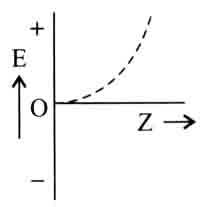
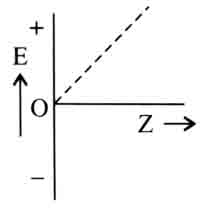
For hydrogen like species, which of the following graphs provides the most appropriate representation of E vs Z plot for a constant n ?

[E : Energy of the stationary state, Z : atomic number, n : principal quantum number]                  [2025]

  •  

  •  

  •  

  •  

(4)

E=-2.18×10⁻¹⁸(Z2n2)J


Q 5 :

According to Bohr’s model of hydrogen atom, which of the following statement is incorrect?           [2025]

  • Radius of 3rd orbit is nine times larger than that of 1st orbit.


  • Radius of 8th orbit is four times larger than that of 4th orbit.


  • Radius of 6th orbit is three times larger than that of 4th orbit.


  • Radius of 4th orbit is four times larger than that of 2nd orbit.


(3)

Radius (r) of nth shell of a single electron specie with atomic number Z is given by:

r=52.9n2Zpm

Thus, r6r4=6242=94


Q 6 :

The energy of an electron in first Bohr orbit of H-atom is –13.6 eV. The magnitude of energy value of electron in the first excited state of Be3+ is ______ eV. (nearest integer value)        [2025]


(54)

E=-13.6Z2n2eV

For Be3+, Z = 4. For first excited state, n = 2.

E=-13.64222eV=-54.4eV


Q 7 :

The shortest wavelength of hydrogen atom in Lyman series is λ. The longest wavelength in Balmer series of He+ is              [2023]

  • 9λ5


  • 36λ5


  • 5λ9


  • 59λ


(1)

(1) For Hydrogen atom (Z=1):

       (1λ)H=RH(1)2[112-12]Last line

(2) For He+ atom (Z=2):

      (1λ)He+=RH(2)2[122-132]=RH[1-49]

      =RH(59)first line

       From (1) and (2)

λHe+λH=95

λHe+=9λH5


Q 8 :

Which transition in the hydrogen spectrum would have the same wavelength as the Balmer-type transition from n=4 to n=2 of the He+ spectrum?           [2023]

  • n=1 to n=3


  • n=1 to n=2


  • n=2 to n=1


  • n=3 to n=4


(3)

λH=λHe+

RH×(1)2(1n12-1n22)=RH×(2)2(1(2)2-1(4)2)

(1n12-1n22)=(44)-(416)

1n12-1n22=11-14

n1=1,n2=2 for H-atom


Q 9 :

If wavelength of the first line of the Paschen series of hydrogen atom is 720 nm, then the wavelength of the second line of this series is ________ nm. (Nearest integer)
     [2023]


(492)

1λ=RH×[1n12-1n22]×(Z)2

For 1st line of Paschen series: n1=3, n2=4

1720=1λ1=RH×(Z)2×[1(3)2-1(4)2]                             ...(i)

1720=59×16×RH×(Z)2

For IInd line of Paschen series: n1=3, n2=5

1λ2=RH×(Z)2×[1(3)2-1(5)2]                                 ...(2)

Dividing (1) by (2)

λ2720=79×16×9×2516

λ2=492 nm


Q 10 :

The number of the following statement/s which is/are incorrect is ________.                  [2023]

(A) Line emission spectra are used to study the electronic structure.

(B) The emission spectra of atoms in the gas phase show a continuous spread of wavelength from red to violet.

(C) An absorption spectrum is like the photographic negative of an emission spectrum.

(D) The element helium was discovered in the sun by spectroscopic method.


(1)

Emission spectrum of an atom is discrete spectrum.