

Q 1 :

Match List I with List II.


List I

(Alkali Metal)


List II

(Emission Wavelength in nm)

A. Li I. 589.2
B. Na II. 455.5
C. Rb III. 670.8
D. Cs IV. 780.0


Choose the correct answer from the options given below:               [2024]

  • (A)-(III), (B)-(I), (C)-(IV), (D)-(II)


  • (A)-(IV), (B)-(II), (C)-(I), (D)-(III)


  • (A)-(II), (B)-(IV), (C)-(III), (D)-(I)


  • (A)-(I), (B)-(IV), (C)-(III), (D)-(II)


(1)                     

Alkali metal Emission wavelength (in nm)
(A)   Li (III)    670.8
(B)   Na (I)      589.2
(C)   Rb (IV)   780.0
(D)   Cs (II)    455.5


Q 2 :

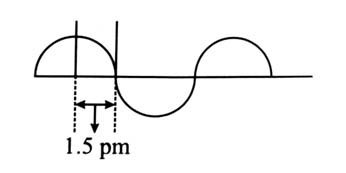
A hypothetical electromagnetic wave is shown below. 

The frequency of the wave is x×1019Hz.x=________ (nearest integer)           [2024]


(5)

Wavelength(λ)=4×1.5pm=6×10-12pm

Frequency(ν)=cλ=3×10⁸m/s6×10-12m=5×1019s-1


Q 3 :

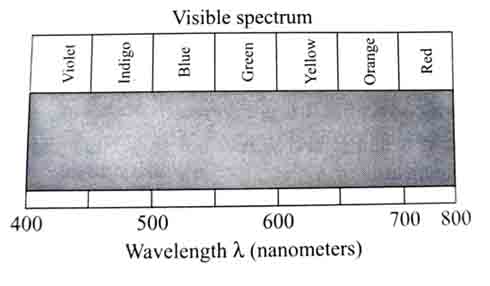
Which of the following statements are correct, if the threshold frequency of caesium is 5.16×10¹⁴Hz ?

A. When Cs is placed inside a vacuum chamber with an ammeter connected to it and yellow light is focused on Cs, the ammeter shows the presence of current.

B. When the brightness of the yellow light is dimmed, the value of the current in the ammeter is reduced.

C. When a red light is used instead of the yellow light, the current produced is higher with respect to the yellow light.

D. When a blue light is used, the ammeter shows the formation of current.

E. When a white light is used, the ammeter shows formation of current.

Choose the correct answer from the options given below:                                 [2025]

  • A, D and E Only


  • B, C and D Only


  • A, C, D and E Only


  • A, B, D and E Only


(4)

Threshold wavelength of Caesium (λ0) =cν0=3×1085.16×1014m
=0.58139×10⁻⁶m=581.39nm

Photoelectric effect is observed if λ<λ0.  

(A) λyellow<λ0(581.39 nm), so yellow light shows photoelectric effect.

(B) When photoelectric effect is observed, then current is directly proportional to intensity of light. So when brightness of yellow light is reduced, the value of current in ammeter gets reduced.

(C) λred<λ0(581.39 nm), so the red light does not show photoelectric effect.

(D) λblue<λ0(581.39 nm), so the blue light shows photoelectric effect.

(E) White light has all frequencies. So, it has those wavelengths for which λ<λ0 and it shows photoelectric effect.


Q 4 :

The radius of the 2nd orbit of Li2+ is x. The expected radius of the 3rd orbit of Be3+ is             [2023]

  • 1627x


  • 49x


  • 94x


  • 2716x


(4)

R=0.529×n2Z

(rLi2+)n=2=0.529×(2)23=x

(rBe3+)n=3=0.529×(3)24

(rLi2+)n=2(rBe3+)n=3=r0×(2)23r0×(3)24

x(rBe3+)n=3=1627

(rBe3+)n=3=27x16


Q 5 :

It is observed that characteristic X-ray spectra of elements show regularity. What frequency to the power n i.e., νn of X-ray emitted is plotted against atomic number “Z”, following graph is obtained. The value of n is                     [2023]

  • 2


  • 3


  • 1


  • 12


(4)

vnZ

v=a(Z-b)

  n=12


Q 6 :

Given below are two statements, one is labelled as Assertion A and the other is labelled as Reason R.

Assertion A: Loss of electron from hydrogen atom results in nucleus of ~1.5×10⁻³ pm size.

Reason R: Proton (H+) always exists in combined form.

In the light of the above statements, choose the most appropriate answer from the options given below:             [2023]

  • A is correct but R is not correct


  • Both A and R are correct but R is NOT the correct explanation of A


  • Both A and R are correct and R is the correct explanation of A


  • A is not correct but R is correct


(2)

Fact based


Q 7 :

If the radius of the first orbit of hydrogen atom is a0, then de Broglie's wavelength of electron in 3rd orbit is          [2023]

  • πa03


  • πa06


  • 3πa0


  • 6πa0


(4)

rn=a0×n2, for 3rd orbit r3=9a0

mV=3h2πr3=3h2π9a0=h6πa0

and λ=hmV=hh6πa0=6πa0


Q 8 :

The energy of an electron in the first Bohr orbit of hydrogen atom is -2.18×10⁻¹⁸J. Its energy in the third Bohr orbit is ________ .           [2023]

  • Three times of this value


  • 19th of this value


  • One third of this value


  • 127 of this value


(2)

(EH)n=1=-2.18×10⁻¹⁸J

(EH)nth=(EH)n=1×1n2

(EH)n=3=(EH)n=1×19


Q 9 :

Given below are two statements:

Statement I: According to Bohr’s model of hydrogen atom, the angular momentum of an electron in a given stationary state is quantised.

Statement II: The concept of electron in Bohr’s orbit violates the Heisenberg uncertainty principle.

In the light of the above statements, choose the most appropriate answer from the options given below:                [2023]

  • Both Statement I and Statement II are correct


  • Statement I is correct but Statement II is incorrect


  • Statement I is incorrect but Statement II is correct


  • Both Statement I and Statement II are incorrect


(1)

According to Bohr's model, orbital angular momentum of stationary orbit is quantized, which is equal to nh2π(n=No. of orbit). Heisenberg's uncertainty principle explains the orbital concept, which depends on the probability of finding an electron.


Q 10 :

Assume that the radius of the first Bohr orbit of hydrogen atom is 0.6Å. The radius of the third Bohr orbit of He+ is _______ picometer. (Nearest integer)         [2023]


(270)

rn=r0n2Z

(r1)H=r0(1)21=0.6Å

(r3)He+=r0n2Z

              =0.6(32)2=0.6×92=2.7Å=270 picometer.