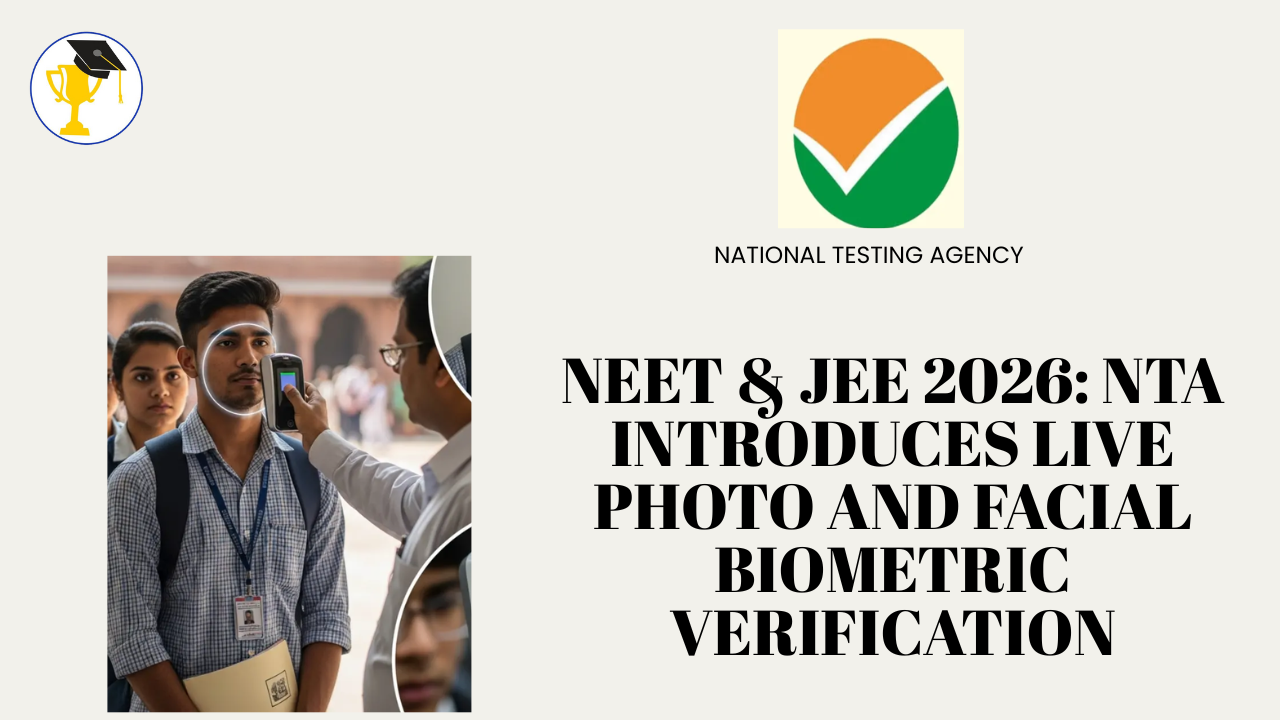


The National Testing Agency (NTA) has announced that it will introduce facial biometric verification and mandatory live photograph capture for candidates appearing in major national entrance examinations from 2026, officials confirmed.
The new identity verification system will be implemented across key exams conducted by the NTA, including JEE (Main) and NEET-UG, with the rollout beginning from JEE (Main) January 2026.
“This will be implemented from January, starting with JEE (Main). The objective is to ensure real-time identity verification at multiple stages of the examination process and curb impersonation and other unfair practices,” a senior NTA official said.
Successful Pilot During NEET-UG 2025
The decision follows a successful proof of concept conducted during NEET-UG 2025, where Aadhaar-based facial authentication was tested at select examination centres in Delhi.
The pilot project was carried out in collaboration with the Unique Identification Authority of India (UIDAI) and supported by digital systems developed by the National Informatics Centre (NIC). The facial verification technology was integrated with NTA’s existing examination protocols.
Officials said the pilot demonstrated the effectiveness of facial authentication in preventing impersonation and strengthening exam security.
Two-Photo Verification at Application Stage
Under the new framework, candidates will be required to upload two photographs while filling out the application form:
A recent scanned photograph in JPG or JPEG format
A live photograph, captured in real time using a webcam or mobile phone
“This dual verification ensures that the person applying for the exam is the same individual who appears at the test centre. Older photographs will no longer be accepted,” the official added.
How Facial Biometric Verification Will Work
Facial biometric verification analyses unique facial features—such as the distance between the eyes, facial contours, and nose structure—to generate a digital facial template using AI-driven systems.
At examination centres, real-time facial scans will be matched with stored application data before candidates are allowed to enter the examination hall. Officials indicated that authentication may also be conducted at multiple stages, including registration and counselling.
Reforms After Exam Integrity Concerns
The move is part of a broader effort to strengthen exam integrity following heightened scrutiny of national-level entrance exams after alleged paper leak incidents, particularly during NEET-UG 2024.
The changes are based on recommendations of the Radhakrishnan Committee, a seven-member panel appointed by the Centre to review the conduct of entrance examinations. The committee is headed by former ISRO chairman R Radhakrishnan.
Committee Recommendations
Short-term:
Revamp of the NTA
Multi-level biometric verification at registration, exam centres, and counselling
Long-term:
Creation of a “Digi-Exam” platform
Biometric-enabled digital exams on the lines of DigiYatra
JEE Main 2026 First to Implement New Measures
According to the NTA calendar, JEE (Main) 2026 will be the first examination to feature the new security measures and is scheduled to be held from January 21 to January 30, 2026.
Established in 2017, the NTA conducts several high-stakes entrance exams, including JEE (Main) for engineering admissions, NEET-UG for medical courses, and CUET for undergraduate and postgraduate admissions to central universities.
What This Means for Aspirants
Live photo capture will be mandatory
Older photographs will be rejected
Aadhaar-linked facial authentication may become standard
Stronger safeguards against impersonation and exam malpractice