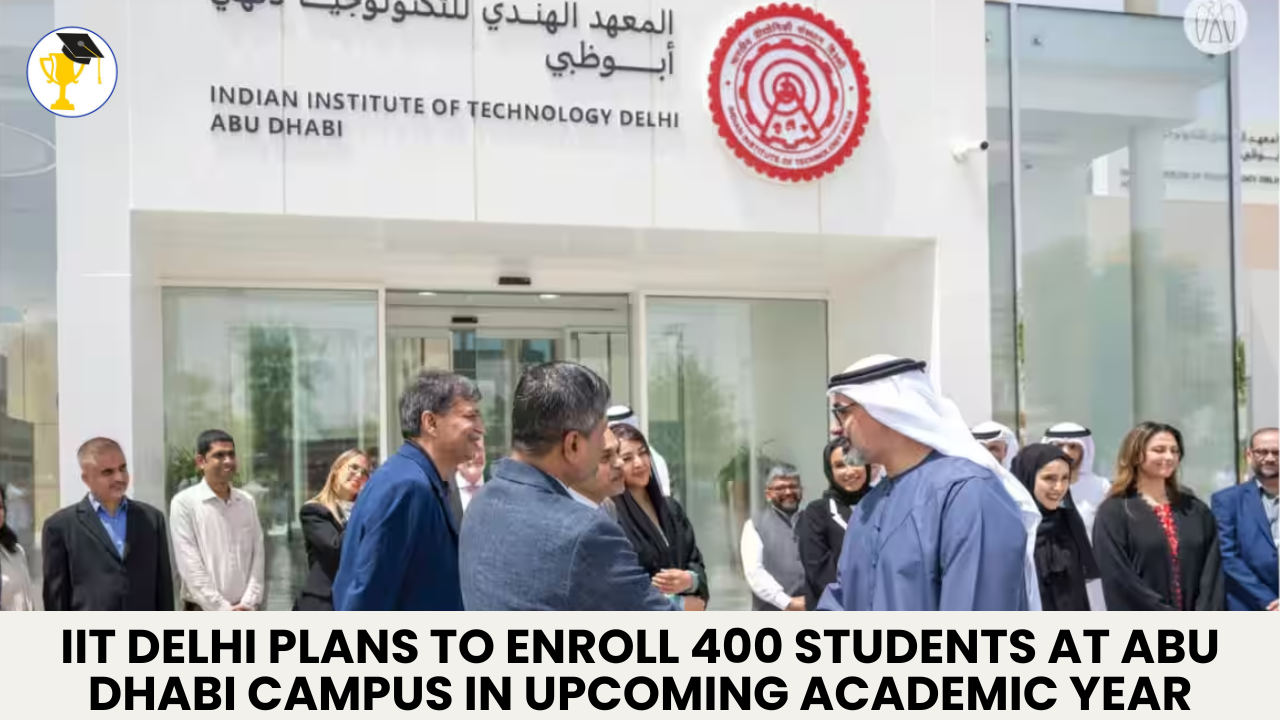
IIT Delhi Plans to Enroll 400 Students at Abu Dhabi Campus in Upcoming Academic Year

IIT Delhi Plans to Enroll 400 Students at Abu Dhabi Campus in Upcoming Academic Year

The Indian Institute of Technology (IIT) Delhi Abu Dhabi campus is expected to host around 400 students in the next academic year, nearly doubling its current student strength, a senior official has said.

Shantanu Roy, Executive Director of IIT Delhi–Abu Dhabi, said the parent IIT Delhi campus currently has around 12,000 students, while the Abu Dhabi campus has 182 students at present.

“That number is likely to become 400 next year,” Roy told visiting Indian media during an interaction at the IIT Delhi–Abu Dhabi campus.


A Growing International Campus

Roy highlighted that the Abu Dhabi campus is IIT Delhi’s first international campus and forms part of a single global institution, rather than a separate entity.

“We are actually one institution, not two different institutions. We are one global institution with three campuses,” he said.

The Abu Dhabi campus was inaugurated on September 2, 2024, in Khalifa City, following an agreement between India and the United Arab Emirates (UAE).


Aligned with UAE’s Development Priorities

Explaining how the Abu Dhabi campus differs from IIT campuses in India, Roy said the institution is designed to align with the strategic priorities of the UAE, particularly its transition away from a fossil fuel-based economy.

“The UAE is expanding and diversifying rapidly. The education and innovation ecosystem here is being built in alignment with that diversification,” he said.

He added that the campus focuses on areas such as energy, sustainability, artificial intelligence (AI), and smart materials, reflecting both UAE and global priorities.


Strong International Student Diversity

Roy noted that the UAE’s geographical position as a global crossroads has contributed to a highly diverse international student population at the campus.

“It’s a smaller country with a small population, but a very large international student presence. That brings diversity to the campus,” he said.


Academic Expansion Plans

The Abu Dhabi campus began operations with 17 students and a single master’s programme. Within six months, it introduced two undergraduate programmes, enrolling around 50 students.

“We are starting a new undergraduate programme almost every year, possibly a new master’s programme every year, and gradual growth on the PhD front as well,” Roy said.

Admissions to undergraduate programmes are conducted through JEE (Advanced) and the Combined Admission Entrance Test (CAET). Approximately one-third of students are admitted via JEE Advanced, while CAET caters primarily to UAE residents, including expatriates who have lived in the country for at least five years.


Curriculum and AI Focus

Roy emphasized that the academic curriculum at the Abu Dhabi campus closely mirrors that of IIT Delhi, with minor local customisation to meet regional accreditation requirements.

“Students receive essentially the same training as at IIT Delhi, with some contextualisation for the Middle East,” he said.

He also highlighted IIT Delhi’s growing emphasis on artificial intelligence, noting the introduction of AI-focused master’s programmes and a strategic collaboration with the Mohamed bin Zayed University of Artificial Intelligence (MBZUAI).


Permanent Campus Still in the Works

Roy clarified that the current Abu Dhabi facility is a transit campus, with plans for a permanent campus underway.

“The permanent campus is still some years away, but when it comes, it will meet the highest global standards in infrastructure and sustainability,” he said.


Key Highlights:

  • Student strength expected to rise from 182 to around 400 next year

  • First international campus of IIT Delhi

  • Focus on AI, sustainability, energy, and smart materials

  • Admissions via JEE Advanced and CAET

  • Permanent campus planned for the future

Latest News