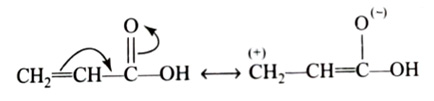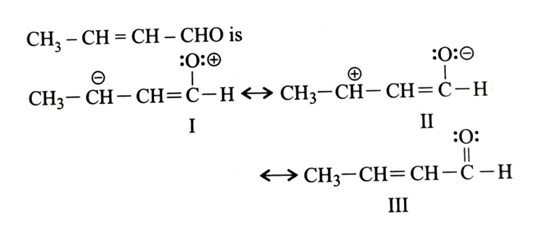


The difference in energy between the actual structure and the lowest energy resonance structure for the given compound is [2024]
electromeric energy
ionization energy
hyperconjugation energy
resonance energy
(4)
Resonance energy is defined as the difference in energy between the actual structure (real hybrid) and the lowest energy resonance structure for the given compound.
Which among the following is incorrect statement? [2024]
Electromeric effect dominates over inductive effect.
The electromeric effect is, temporary effect.
The organic compound shows electromeric effect in the presence of the reagent only.
Hydrogen ion () shows negative electromeric effect.
(4)
Electromeric effect (E) is a temporary effect that involves the complete transfer of a shared pair of electrons to one or the other atom joined by a multiple bond (double or triple).
It occurs only in the presence of an attacking reagent and direction of electron shift always facilitates the reaction.
Electromeric effect is said to be +E when the displacement of electrons is towards the attacking reagent and -E when the displacement of electrons is away from the attacking reagent. shows positive electromeric effect.
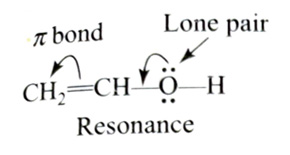
The interaction between bond and lone pair of electrons present on an adjacent atom is responsible for [2024]
Resonance effect
Electromeric effect
Inductive effect
Hyperconjugation
(1)

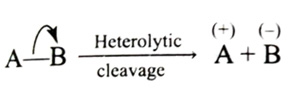
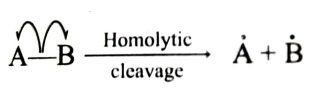
Ionic reactions with organic compounds proceed through: [2024]
(A) homolytic bond cleavage
(B) heterolytic bond cleavage
(C) free radical formation
(D) primary free radical
(E) secondary free radical
Choose the correct answer from the options given below:
(A) only
(C) only
(B) only
(D) and (E) only
(3)
Ions in organic reaction are generated by heterolytic cleavage of bond. So ionic reactions with organic compounds proceed through heterolytic bond cleavage.

Homolytic bond cleavage results in formation of free radicals.

The functional group that shows negative resonance effect is: [2024]
—OH
—OR
—COOH
—
(3)
Groups of the type and act as –M groups. –COOH is –M group.

Groups which have lone pair containing first atom act as +M groups. –OH, –OR and are +M groups.
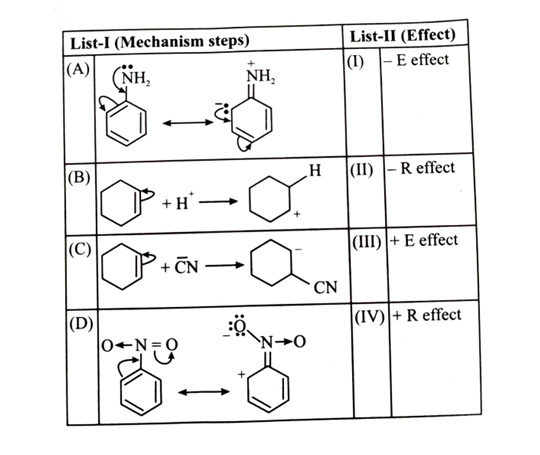
Match List-I with List-II: [2024]

Choose the correct answer from the options given below
(A) – (II), (B) – (IV), (C) – (III), (D) – (I)
(A) – (IV), (B) – (III), (C) – (I), (D) – (II)
(A) – (III), (B) – (I), (C) – (II), (D) – (IV)
(A) – (I), (B) – (II), (C) – (IV), (D) – (III)
(2)
A group is said to be +M group, when it supplies electrons to the system through resonance. A group is said to be –M group, when it supplies electrons to the system through resonance. Electromeric effect is said to be +E when the displacement of electrons is towards the attacking reagent and –E when the displacement of electrons is away from the attacking reagent.
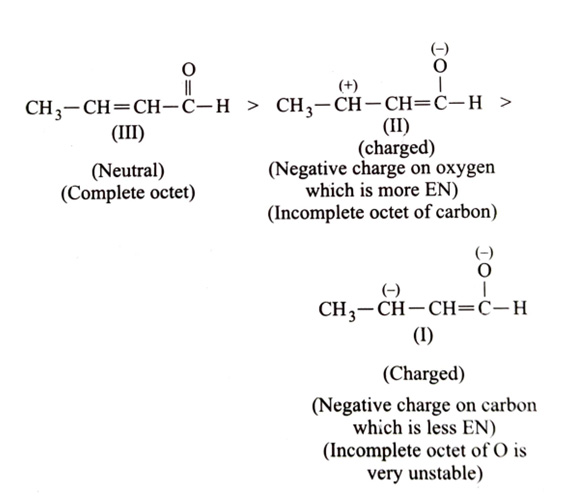
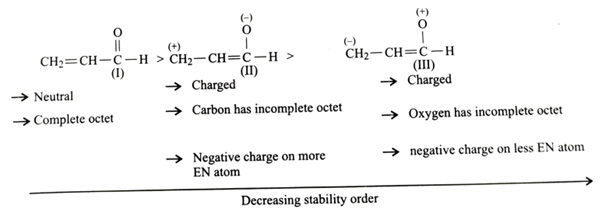
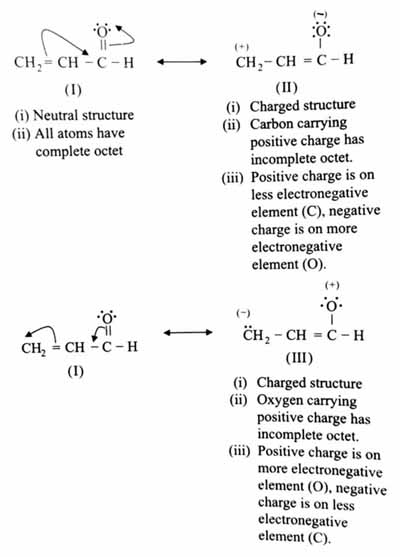
The correct stability order of the following resonance structures of [2024]

II > I > III
III > II > I
II > III > I
I > II > III
(2)
Neutral resonating structures are more stable than charged resonating structure. Amongst charged resonating structures, those structures which have negative charge on more electronegative atom and positive charge on less electronegative atom are more stable.

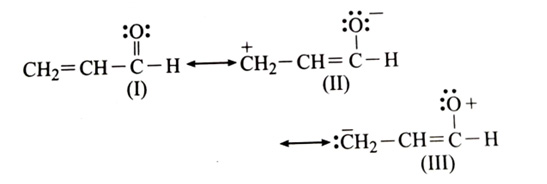
Relative stability of the contributing structures is: [2024]

(I) > (III) > (II)
(III) > (II) > (I)
(I) > (II) > (III)
(II) > (I) > (III)
(3)
Neutral resonating structures are more stable than charged resonating structures. Amongst charged resonating structures, those carrying negative charge on more electronegative atom and positive charge on less electronegative atom are more stable.

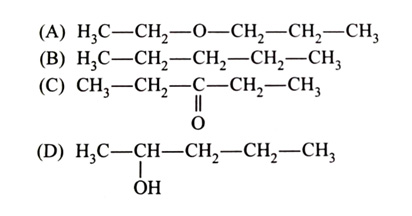
For the compounds: [2024]

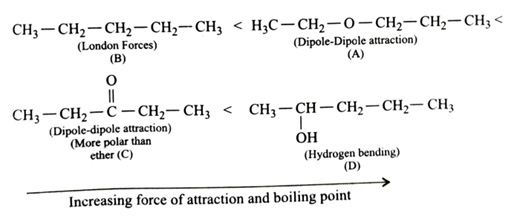
The increasing order of boiling point is:
Choose the correct answer from the option given below:
(B) < (A) < (C) < (D)
(B) < (A) < (D) < (C)
(D) < (C) < (A) < (B)
(A) < (B) < (C) < (D)
(1)

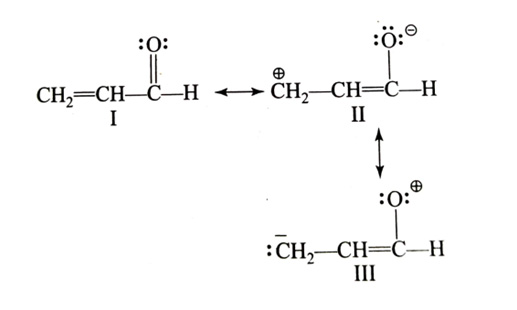
The order of relative stability of the contributing structure is: [2024]

Choose the correct answer from the options given below:
I > II > III
II > I > III
I = II = III
III > II > I
(1)