

Q 1 :

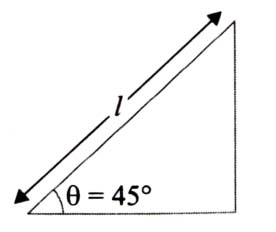
A 2 kg brick begins to slide over a surface which is inclined at an angle of 45° with respect to horizontal axis.

The co-efficient of static friction between their surfaces is         [2024]

  • 1


  • 0.5


  • 1.7


  • 13


(1)  

     Slipping starts when, tanθ=μs (θ is angle of respose) 

      μs=tan 45o

      ⇒μs=1


Q 2 :

Given below are two statements:


Statement (I): The limiting force of static friction depends on the area of contact and independent of materials.


Statement (II): The limiting force of kinetic friction is independent of the area of contact and depends on materials.


In the light of the above statements, choose the most appropriate answer from the given below:            [2024]

  • Statement I is correct but Statement II is incorrect


  • Statement I is incorrect but Statement II is correct


  • Both Statement I and Statement II are incorrect


  • Both Statement I and Statement Il are correct


(2)  

Co-efficient of friction depends on surface in contact So, it depends on material of object.


Q 3 :

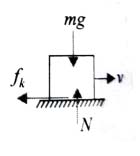
A heavy box of mass 50 kg is moving on a horizontal surface. If the coefficient of kinetic friction between the box and the horizontal surface is 0.3, then the force of kinetic friction is          [2024]

  • 1.47 N


  • 14.7 N


  • 1470 N


  • 147 N


(4)

Given m=50 kg, μk=0.3        

fk=μkN=μkmg=0.3×50×9.8=147 N


Q 4 :

A given object takes n times the time to slide down 45° rough inclined plane as it takes the time to slide down an identical perfectly smooth 45° inclined plane. The coefficient of kinetic friction between the object and the surface of the inclined plane is ______            [2024].

  • 1-n2


  • 1-1n2


  • 1-n2


  • 1-1n2


(4)

Case-1: No friction

a=gsinθ

ℓ=12(gsinθ)t12⇒t1=2ℓgsinθ

Case-2: With friction

a=gsinθ-μgcosθ

ℓ=12(gsinθ-μgcosθ)t22⇒t2=2ℓ(gsinθ-μgcosθ)

t2=nt1⇒2ℓ(gsinθ-μgcosθ)=n2ℓgsinθ

⇒(sinθ-μcosθ)=1n2sinθ

⇒(1-μ)=1n2⇒μ=1-1n2


Q 5 :

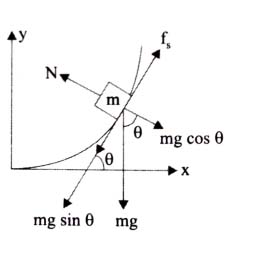
A block of mass m is placed on a surface having a vertical cross-section given by y=x2/4. If the coefficient of friction is 0.5, the maximum height above the ground at which the block can be placed without slipping is     [2024].

  • 1/4 m


  • 1/2 m


  • 1/6 m


  • 1/3 m


(1)

fs=mgsinθ                    ...(1)

N=mgcosθ                  ...(2)

Now, fs≤μN

mgsinθ≤μmgcosθ

tanθ≤μ                         ...(3)

According to question, y=x24

tanθ=dydx=14·2x=x2

Put in (3) x2≤μ⇒x≤2(0.5)

⇒x≤1 So y≤124⇒ymax=14=0.25


Q 6 :

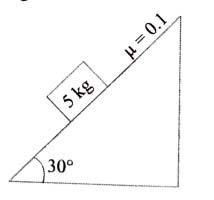
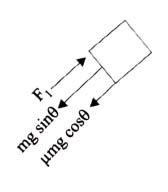
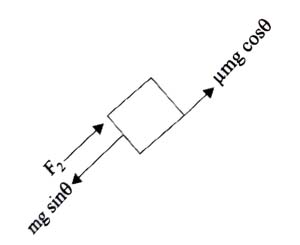
A block of mass 5 kg is placed on a rough inclined surface as shown in the figure.

If F→1 is the force required to just move the block up the inclined plane and F→2 is the force required to just prevent the block from sliding down, then the value of |F→1|-|F→2| is        [Use g = 10 m/s2]                    [2024]

  • 253 N


  • 53 N


  • 532 N


  • 10 N


(2)

fK=μmgcosθ

=0.1×50×32=2.53 N   

F1=mgsinθ+fK=25+2.53

F2=mgsinθ-fK=25-2.53

∴ F1-F2=53 N


Q 7 :

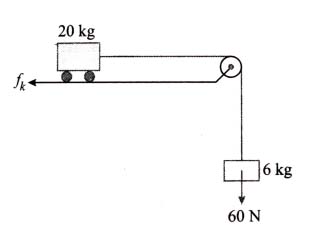
Consider a block and trolley system as shown in the figure. If the coefficient of kinetic friction between the trolley and the surface is 0.04, the acceleration of the system in ms-2 is ______.

(Consider that the string is massless and unstretchable and the pulley is also massless and frictionless.)           [2024]

  • 3


  • 4


  • 2


  • 1.2


(3)

fk=μN=0.04×20g=8 Newton

Acceleration a=60-826=2 m/s2


Q 8 :

A body of mass 10 kg is moving with an initial speed of 20 m/s. The body stops after 5 s due to friction between the body and the floor. The value of the coefficient of friction is
(Take acceleration due to gravity g = 10 ms-2)              [2023]

  • 0.2


  • 0.3


  • 0.5


  • 0.4


(4)

a=-μg

∵  v=u+at

         0=20+(-μ×10)×5

         50μ=20

         μ=25=0.4


Q 9 :

A block of mass 5 kg is placed at rest on a table of rough surface. Now, if a force of 30 N is applied in the direction parallel to the surface of the table, the block slides through a distance of 50 m in an interval of time 10 s. Coefficient of kinetic friction is (given g = 10 ms-2)          [2023]

  • 0.60


  • 0.75


  • 0.50


  • 0.25


(3)

S=ut+12at2

50=0+12×a×100

⇒ a=1 m/s2

F-μmg=ma

30-μ×50=5×1

⇒ 50μ=25

⇒ μ=12


Q 10 :

A block of mass 5 kg is moving on an inclined plane which makes an angle of 30∘with the horizontal. The coefficient of friction between the block and the inclined plane surface is 32 The force to be applied on the block so that the block will move down without acceleration is_______N.

(g=10 m/s2)         [2026]

  • 12.5


  • 25


  • 7.5


  • 15


(1)

mgsin30°=F+μmgcos30°

F=5×10×12-32×5×10×32

F=25-752=25-37.5

F=-12.5 N

∴ Force will be downward on incline of magnitude 12.5 N


Q 11 :

A block of mass 2 kg rests on a rough inclined plane making an angle of 30° with the horizontal. The coefficient of static friction between the block and the plane is 0.7. The frictional force on the block is .......... N (take g = 10 m/s2).


(10)

Since μmgcosθ>mgsinθ

So block is in rest.

Force of friction is f=mgsinθ

=2×10×sin30°=10 N


Q 12 :

Given below are two statements:

Statement (I): The limiting force of static friction depends on the area of contact and independent of materials.

Statement (II): The limiting force of kinetic friction is independent of the area of contact and depends on materials.

In the light of the above statements, choose the most appropriate answer from the options given below:

  • Statement I is correct but statement II is incorrect


  • Statement I is incorrect but Statement II is correct


  • Both Statement I and Statement II are incorrect


  • Both Statement I and Statement II are correct


(2)

Co-efficient of depends on surface in contact. So, depends on material of object.


Q 13 :

Assertion: The direction of the frictional force on an object is opposite to the actual motion (kinetic friction) or the impending motion (static friction) of the object relative to the surface with which it is in contact.

Reason: Friction force always opposes the motion.

  • Both A and R are true and R is the correct explanation of A


  • Both A and R are true and R is NOT the correct explanation of A


  • A is true but R is false


  • A is false but R is true


(3)

Frictional force between two surfaces in contact always opposes relative motion between the surfaces in contact.


Q 14 :

The time taken by a block of mass m to slide down from the highest point to the lowest point on a rough inclined plane is 50% more compared to the time taken by the same block on identical inclined smooth plane. Both inclined planes are at 45° with the horizontal. The coefficient of kinetic friction between the rough inclined surface and block is _________.                    [2026]

  • 34


  • 23


  • 59


  • 49


(3)

arough=g(sinθ-μcosθ)

asmooth inclined plane=gsinθ

For Rough incline plane,   t1=2ℓg(sinθ-μcosθ)

For smooth incline plane,   t2=2ℓgsinθ

Given,   t1=1.5t2

2ℓg(sinθ-μcosθ)=32×2ℓgsinθ

(sinθ-μcosθ)=49sinθ

59sinθ=μcosθ⇒μ=59tanθ        (∵ θ=45°)

⇒μ=59tan45°=59


Q 15 :

Two blocks (P and Q) with respectively masses 2 kg and 1.5 kg are joined by a massless thread. These blocks are mounted on a frictionless pulley which is fixed on the edge of a cube (S), as shown in the figure below. Block P is positioned on the top surface which has no friction and block Q is in contact with side-surface, having coefficient of friction μ. The cube (S) moves towards the right with acceleration of g2, where g is gravitational acceleration. During this movement the block P and Q remain stationary. The value of μ is ______.   (Take g = 10 m/s2)                      [2026]

[IMAGE 10]

  • 0.33


  • 0.67


  • 1


  • 0.5


(2)

[IMAGE 11]

From F.B.D of 1.5 kg block:  f=μN2=μ×1.5g2        ...(i)

f+T=1.5g                                                                             ...(ii)

From F.B.D of 2 kg block:  T=2×g2                             ...(iii)

From (i), (ii) and (iii)

μ×1.5g2+2×g2=1.5g⇒μ=23


Q 16 :

A block takes t time to slide down a plane inclined at 45° to the horizontal. If the surface is made smooth (frictionless), the block takes time t2 to slide down the plane. The coefficient of friction between the block and the inclined plane is (α100). The value of α is _________.                [2026]


(75)

The block takes time t to slide down the inclined plane when friction is present,

s=12a1t2                            ...(1)

The block takes time t2 to slide down the inclined plane when friction is absent,

s=12a2(t2)2                     ...(2)

From (i) and (ii),

12a1t2=12a2×t24⇒a1=a24

a1=gsin45°-μgcos45°=g2(1-μ),  a2=g2

g2=4(g2(1-μ))⇒μ=1-14=34

α100=34⇒α=75