Q 11 :

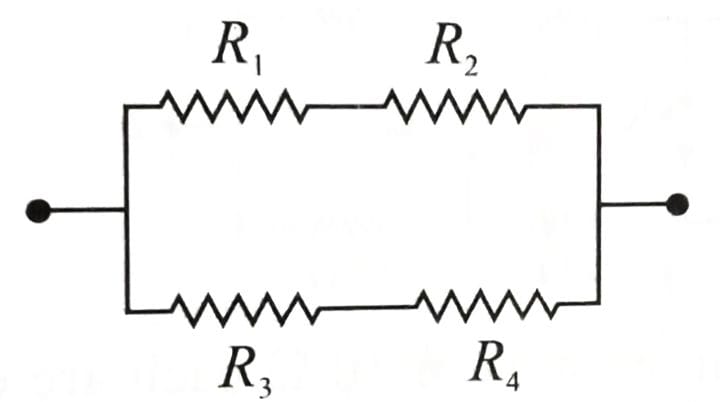
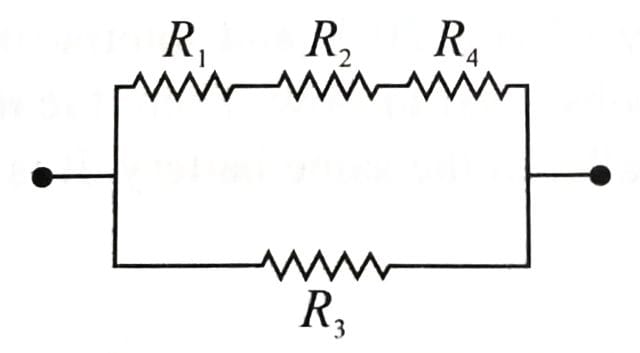
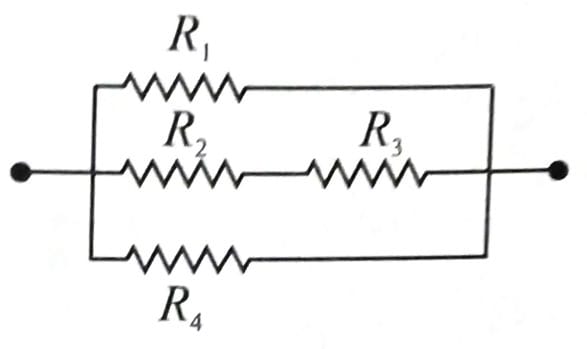
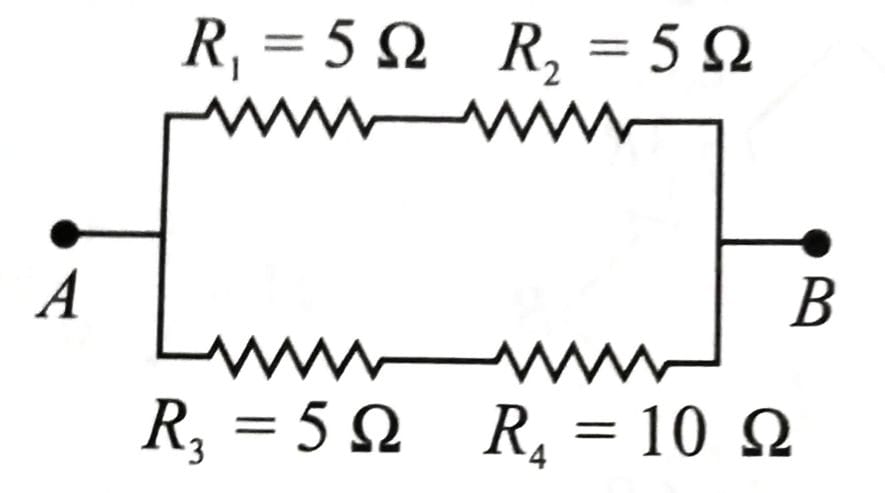
From the combination of resistors with resistance values R1=R2=R3=5Ω and R4=10Ω, which of the following combination is the best circuit to get an equivalent resistance of 6Ω?          [2025]


  •  

  •  

  •  

  •  

(1)

1Req=110+115=3+230=16  Req=6Ω


Q 12 :

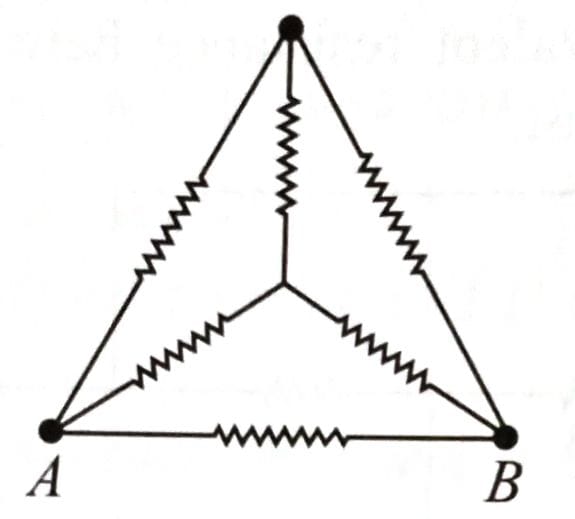
A wire of resistance R is bent into a triangular pyramid as shown in figure with each segment having same length. The resistance between points A and B is R/n. The value of n is:          [2025]

  • 16


  • 14


  • 10


  • 12


(4)

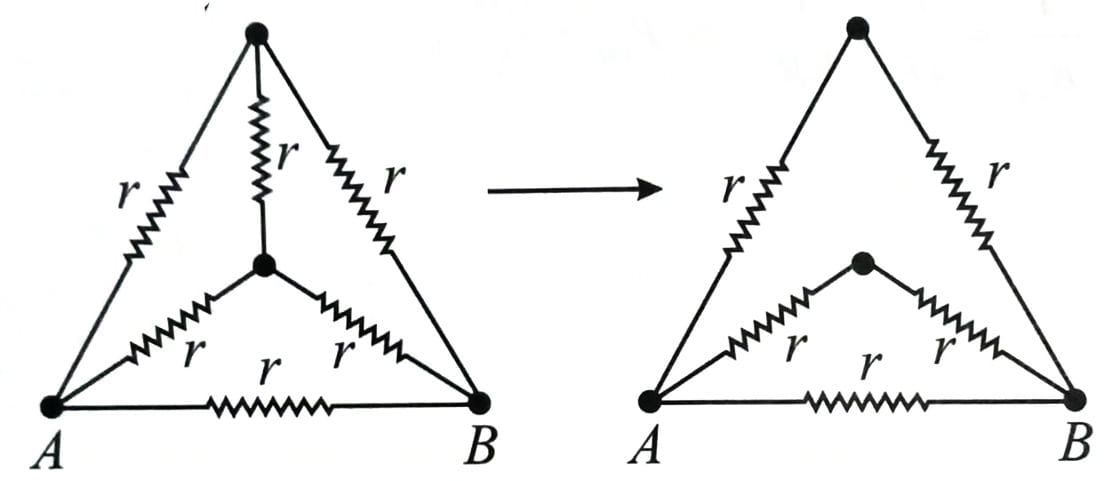
As, r=R6

(As balanced wheat stone bridge is formed)

Now, Equivalent resistance between A and B can be written as

Clearly, R1=r6

So, RAB=R12R12R1

 1RAB=1R1+12R1+12R1=42R1=2R1

 RAB=R12=r12


Q 13 :

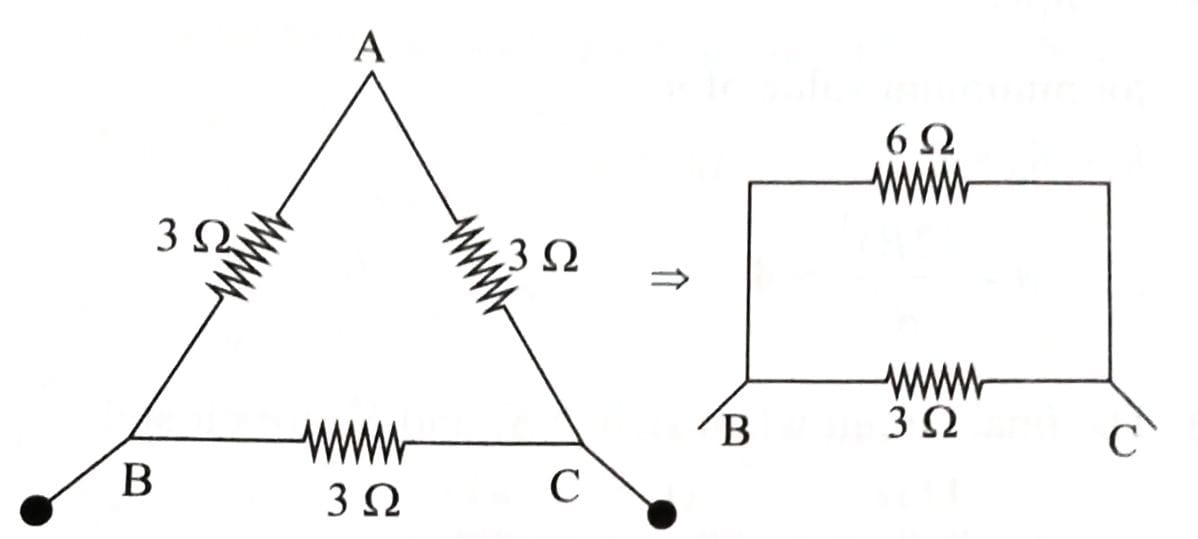
A wire of resistance 9Ω is bent to form an equilateral triangle. Then the equivalent resistance across any two vertices will be ____ ohm.          [2025]


(2)

9Ω is the resistance of whole wire

  Resistance of each wire = 3Ω

  Equivalent resistance = 2Ω


Q 14 :

As shown in the figure, a network of resistors is connected to a battery of 24 V with an internal resistance of 3Ω. The currents through the resistors R4 and R5 are I4 and I5 respectively. The values of I4 and I5 are                      [2023]

[IMAGE 177]

  • I4=85A and I5=25A


  • I4=65A and I5=245A


  • I4=25A and I5=85A


  • I4=245A and I5=65A


(3)

Equivalent resistance of circuit

Req=3+1+2+4+2=12 Ω

Current through battery i=2412=2 A

I4=R5R4+R5×2=520+5×2=25 A

I5=2-25=85 A


Q 15 :

The equivalent resistance between A and B is                      [2023]

[IMAGE 178]

  • 23Ω


  • 12Ω


  • 32Ω


  • 13Ω


(1)

[IMAGE 179]

1Req=12+112+14+16+12

           =6+1+3+2+612=1812=32

  Req=23Ω


Q 16 :

The equivalent resistance between A and B of the network shown in the figure:                     [2023]

[IMAGE 180]

  • 112R3


  • 14R


  • 21R


  • 83R


(4)

Wheatstone bridge is in balanced condition.

[IMAGE 181]

1Req=14R+18RReq=8R3


Q 17 :

Equivalent resistance between the adjacent corners of a regular n-sided polygon of uniform wire of resistance R would be             [2023]

  • (n-1)Rn2


  • (n-1)R(2n-1)


  • n2R(n-1)


  • (n-1)Rn


(1)

[IMAGE 182]

Suppose resistance of each arm is r, then r=Rn

Req(AB)=R1R2R1+R2

=r(n-1)rr+(n-1)r=r(n-1)rnr=n-1nr=(n-1)Rn2


Q 18 :

The equivalent resistance between A and B as shown in the figure is                    [2023]

[IMAGE 183]

  • 5 kΩ


  • 20 kΩ


  • 10 kΩ


  • 30 kΩ


(1)

[IMAGE 184]

All resistors are in parallel.

So, 1Req=110+120+120

         Req=5 kΩ


Q 19 :

The equivalent resistance of the circuit shown below between points a and b is                 [2023]

[IMAGE 185]

  • 24Ω


  • 3.2Ω


  • 20Ω


  • 16Ω


(2)

The circuit can be reduced to

[IMAGE 186]

  Req=16×416+4=165Ω=3.2Ω


Q 20 :

Given below are two statements:                                       [2023]

Statement I: The equivalent resistance of resistors in a series combination is smaller than the least resistance used in the combination.

Statement II: The resistivity of the material is independent of temperature.

In the light of the above statements, choose the correct answer from the options given below:

  • Statement I is false but Statement II is true


  • Both Statement I and Statement II are false


  • Statement I is true but Statement II is false


  • Both Statement I and Statement II are true


(2)

Req=R1+R2+R3  St-1 False

Resistivity depends on temperature.  St-2 False