

Q 1 :

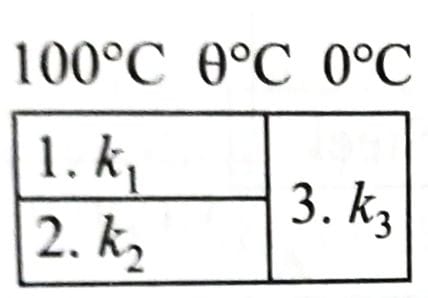
Three conductors of same length having thermal conductivity k1,k2 and k3 are connected as shown in figure.

Area of cross sections of 1st and 2nd conductor are same and for 3rd conductor it is double of the 1st conductor. The temperatures are given in the figure. In steady state condition, the value of θ is _______ °C.

(Given :k1=60 Js–1 m–1 K—1, k2=120 Js–1 m–1 K—1, k3=135 Js–1 m–1 K—1)          [2025]


(40)

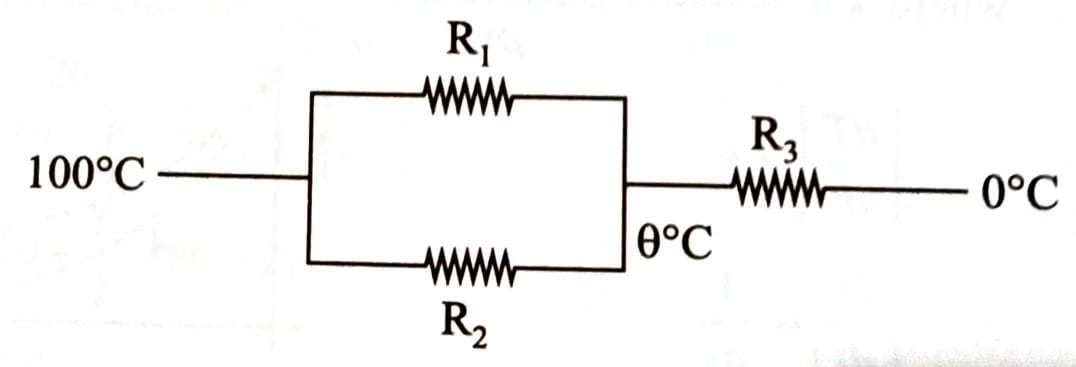
R1=2lk1A, R2=2lk2A, R3=lk3A

(100–θ)(1R1+1R2)=(θ–0)R3

(100–θ)(k1+k2)A2l=θk3Al

(100–θ)(k1+k2)=2θk3

θ=100(k1+k2)k1+k2+2k3=100×180450=40


Q 2 :

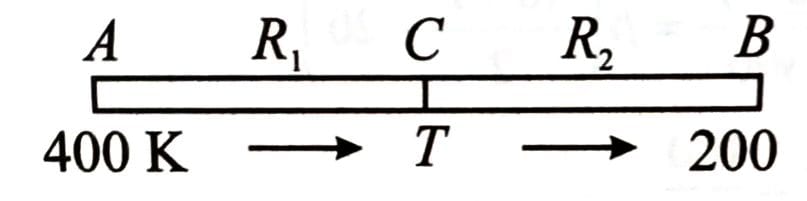
Two cylindrical rods A and B made of different materials, are joined in a straight line. The ratio of lengths, radii and thermal conductivities of these rods are: LALB=12, rArB=2 and KAKB=12. The free ends of rods A and B are maintained at 400 K, 200 K, respectively. The temperature of rods interface is ________ K, when equilibrium is established.           [2025]


(360)

R1=l1K1A1, R2=l2K2A2

dQdt=△TR

(dQdt)1=(dQdt)2

400–TR1=T–200R2

400–TT–200=R1R2=(l1l2)(r2r1)2×K2K1

400–TT–200=12×(12)2×2=(14)

1600 – 4T = T –200

5T = 1800 ⇒ T = 360 K


Q 3 :

Two plates A and B have thermal conductivities 84 W m-1 K-1 and 126 W m-1 K-1 respectively. They have same surface area and same thickness. They are placed in contact along their surfaces. If the temperatures of the outer surfaces of A and B are kept at 100°C and 0°C respectively, then the temperature of the surface of contact in steady state is ________ C∘.                 [2023]


(40)

Let the temperature of the contact surface is T, then

HA=HB

KAA(TA-T)L=KBA(T-TB)L

84(100-T)=126(T-0)

2(100-T)=3T

⇒ T=40°C


Q 4 :

Rods x and y of equal dimensions but of different materials are joined as shown in the figure. Temperatures of end points A and F are maintained at 100°C and 40°C respectively. Given the thermal conductivity of rod x is three times of that of rod y, the temperature at junction points B and E are (close to):         [2026]

  • 89 °C and 73 °C respectively


  • 80 °C and 60 °C respectively


  • 80 °C and 70 °C respectively


  • 60 °C and 45 °C respectively


(1)

Let [R=ℓ3KA]

H=[100-4011R2]    ...(1)

H=100-TBR    ...(2)

H=TE-403R    ...(3)

Using (1) and (2)

120=1100-11TA

TB=89°C

Using (1) and (3)

TE=73°C


Q 5 :

The temperature of the two outer surfaces of a composite slab, consisting of two materials having coefficients of thermal conductivity K and 2K and thickness x and 4x, respectively, are T2 and T1(T2>T1). The rate of heat transfer through the slab, in a steady state is (A(T2-T1)Kx)f. Find the value of 100f.


(33)

The thermal resistance is given by

xKA+4x2KA=xKA+2xKA=3xKA

∴ dQdt=ΔT3xKA=(T2-T1)KA3x=13{A(T2-T1)Kx}

∴  f=13


Q 6 :

Identify the true statement(s) from the following

  • A hot bar placed under a running tap loses heat by convection at the surface of the bar and water and not by conduction within the water


  • Conduction is the reason behind trade wind


  • Convection involves bulk transport of different parts of fluid


  • Natural convection is responsible for cooling system of an automobile engine


(3)

NCERT Theory


Q 7 :

Three rods made of same material and having the same cross-section have been joined as shown in the figure. Each rod is of the same length. The left and right ends are kept at 0°C and 90°C respectively. The temperature of the junction of three rods will be

  • 45°C


  • 60°C


  • 30°C


  • 20°C


(2)

T=(T1+T2+T3)3=60