

Q 1 :

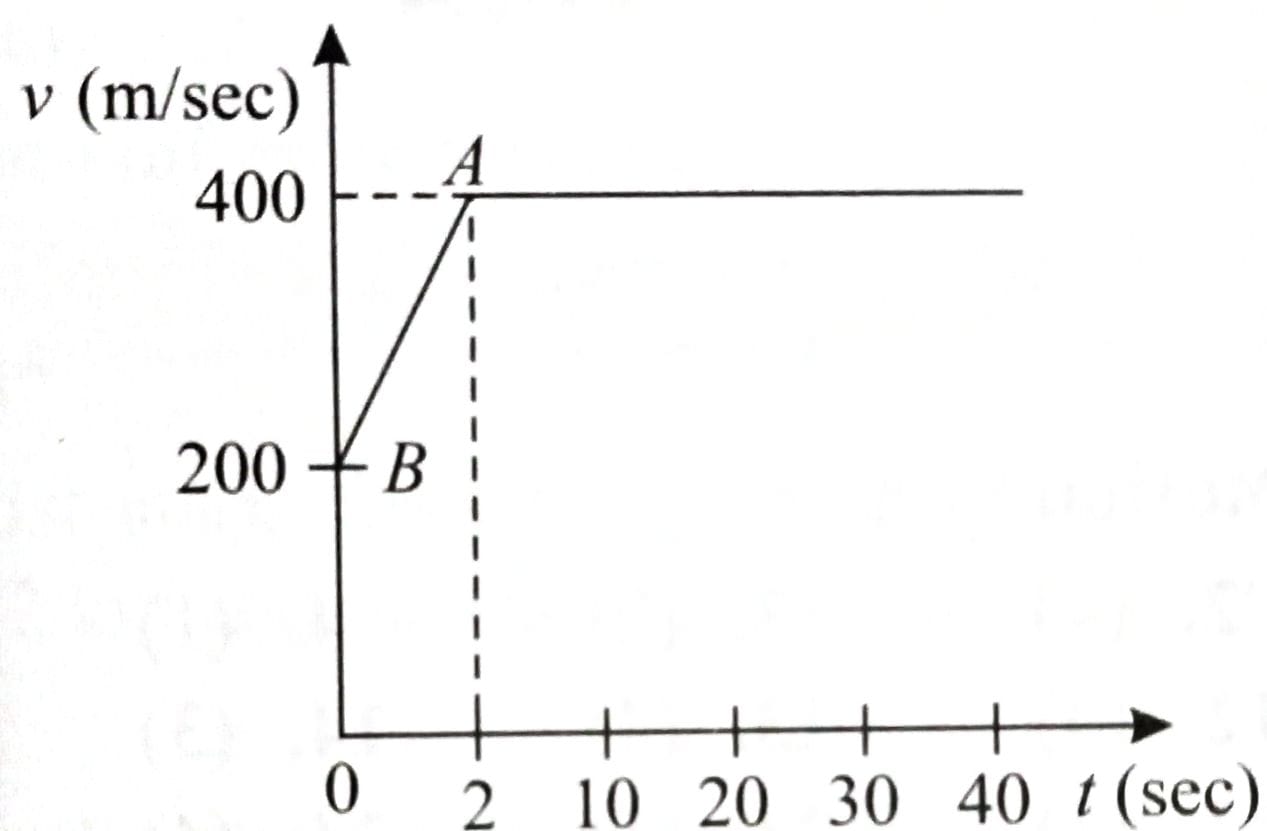
The motion of an airplane is represented by velocity-time graph as shown below. The distance covered by airplane in the first 30.5 second is ______ km.          [2025]

  • 9


  • 6


  • 3


  • 12


(4)

Distance = area under the graph

d=300×2+400×28.5

     = 600 + 114000 = 12000 m.


Q 2 :

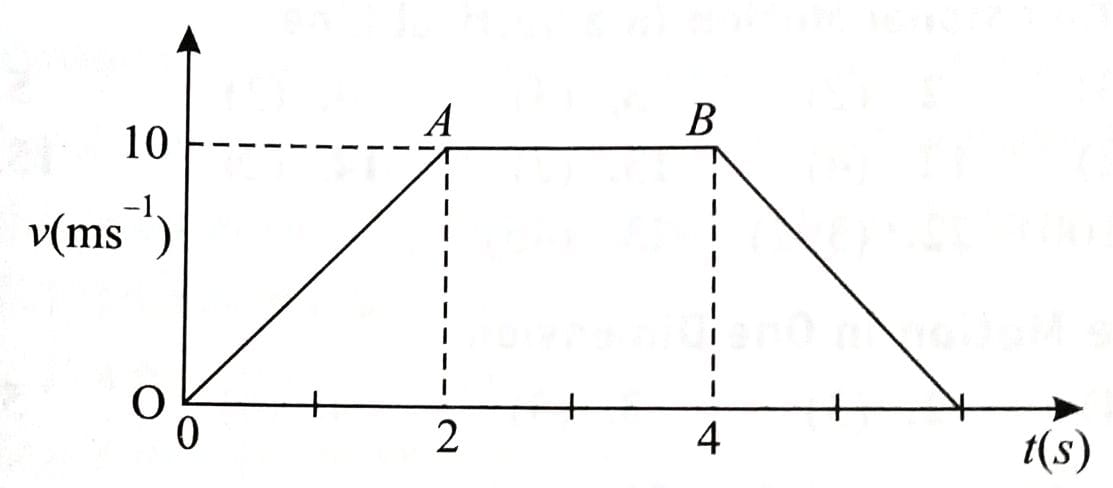
The velocity-time graph of an object moving along a straight line is shown in figure. What is the distance covered by the object between t = 0 to t = 4 s?          [2025]

  • 30 m


  • 10 m


  • 13 m


  • 11 m


(1)

Distance travelled = displacement when direction of velocity remains constant

Distance = Area under v/t graph

 s=12(2s+4s)(10 m/s)=30 m


Q 3 :

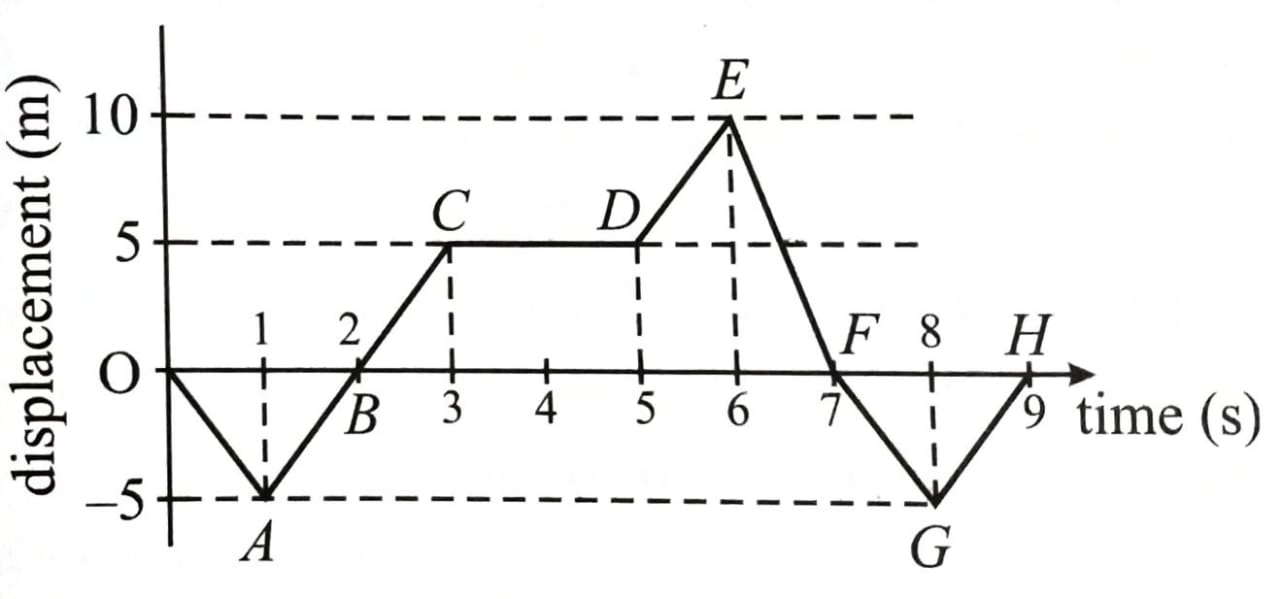
The displacement x versus time graph is shown below:

(A) The average velocity during 0 to 3s is 10 m/s

(B) The average velocity during 3 to 5s is 0 m/s

(C) The instantaneous velocity at t = 2s is 5 m/s

(D) The avberage velocity during 5 to 7s and instantaneous velocity at t = 6.5s are equal

(E) The average velocity from t = 0 to t = 9s is zero

Choose the correct answer from  the options given below:          [2025]

  • (A), (D), (E) only


  • (B), (C), (D) only


  • (B), (D), (E) only


  • (B), (C), (E) only


(4)

<v>=st=SfSitfti

v=dsdt=slope

(A) 0 to 3 sec <v>=503=53 m/s

(B) 0 to 5 sec,<v>=552=0 

(C) t = 2 sec, v=dsdt=Slope=<v>=5(5)2=5 m/s

(D) t = 5 sec to 7 sec, <v>=052=2.5 m/s

        At t = 6.5 sec, v=dsdt=Slope=<v>=0(10)1=10 m/s

(E) t = 0 to 9 sec <v>=009=0


Q 4 :

The velocity–time graph of a body moving in a straight line is shown in the figure.

The ratio of displacement to distance travelled by the body in time 0 to 10 s is:              [2023]

  • 1 : 2


  • 1 : 4


  • 1 : 3


  • 1 : 1


(3)

Displacement=Area=16-8+16-8=16 m

Distance=|area|=48 m

displacementdistance=13


Q 5 :

Match Column-I with Column-II:               [2023]

Choose the correct answer from the options given below:

  • A-II, B-IV, C-III, D-I


  • A-I, B-II, C-III, D-IV


  • A-II, B-III, C-IV, D-I


  • A-I, B-III, C-IV, D-II


(1)

dxdt=slope0  always increasing

(A-II)  

dxdt<0  and at t, dxdt0

(B-IV)   

dxdt>0  for first half,  dxdt<0  for second half

(C-III)  

dxdt=constant

(D-I)


Q 6 :

Given below are two statements:                             [2023]

Statement I: Area under the velocity–time graph gives the distance travelled by the body in a given time.

Statement II: Area under the acceleration–time graph is equal to the change in velocity in the given time.

In the light of the given statements, choose the correct answer from the options given below:

  • Both Statement I and Statement II are false.


  • Statement I is correct but Statement II is false.


  • Statement I is incorrect but Statement II is true.


  • Both Statement I and Statement II are true.


(3)

Area under velocity–time graph gives displacement of body in given time.

Area under acceleration–time graph gives change in velocity in the given time.

So Statement I is false

Statement II is True


Q 7 :

The position–time graphs for two students A and B returning from the school to their homes are shown in the figure.            [2023]

(A) A lives closer to the school
(B) B lives closer to the school
(C) A takes lesser time to reach home
(D) A travels faster than B
(E) B travels faster than A

Choose the correct answer from the options given below:

  • (A) and (E) only


  • (B) and (E) only


  • (A), (C) and (E) only


  • (A), (C) and (D) only


(1)

As slope of B>slope of A

     VB>VA

Also, tB<tA


Q 8 :

From the vt graph shown, the ratio of distance to displacement in 25 s of motion.                  [2023]

  • 35


  • 12


  • 53


  • 1


(3)

Area under the graph from t=0 to t=20 s=200 m

Area under the graph from t=20 to t=25 s=50 m

So distance covered=(200+50) m=250 m

Displacement=(200-50) m=150 m

          250150=53


Q 9 :

The velocity (v) – Distance (x) graph is shown in figure. Which graph represents acceleration (a) versus distance (x) variation of this system?           [2026]

  •  

  •  

  •  

  •  

(2)