

Q 1 :

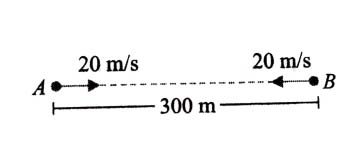
Two cars are travelling towards each other at a speed of 20 ms-1 each. When the cars are 300 m apart, both the drivers apply brakes and the cars retard at the rate of 2 ms-2. The distance between them when they come to rest is:                    [2024]

  • 200 m


  • 50 m


  • 100 m


  • 25 m


(3)

|uBA|=40 m/s

|aBA|=4 m/s2

Applying, (v2=u2+2as)relative

0=(40)2+2(-4)(s)s=200 m

Remaining distance =300-200=100 m

So, when both cars will stop then the distance between them, will be

d=300-200=100 m


Q 2 :

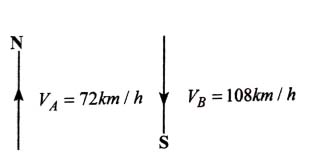
Train A is moving along two parallel rail tracks towards north with speed 72 km/h, and train B is moving towards south with speed 108 km/h.

Velocity of train B with respect to A and velocity of ground with respect to B are (in ms-1)               [2024]

  • −30 and 50


  • −50 and −30


  • −50 and 30


  • 50 and −30


(4)

=72×518=20 m/s    =108×518=30 m/s

Velocity of train B with respect to train A

VBA=VB-VA=30-(-20)=50 m/s

[Taking South = +ve, North = -ve]

Ground is at rest, so

VGB=VG-VB

=0-(30)=-30 m/s


Q 3 :

Two cars P and Q are moving on a road in the same direction. Acceleration of car P increases linearly with time whereas car Q moves with a constant acceleration. Both cars cross each other at time t = 0, for the first time. The maximum possible number of crossing(s) (including the crossing at t = 0) is __________.          [2025]


(3)

For first car P  acceleration (aP) = ct, c is constant

For second car Q  acceleration (aQ) = a, a is constant

Let us analyse the problem in two cases

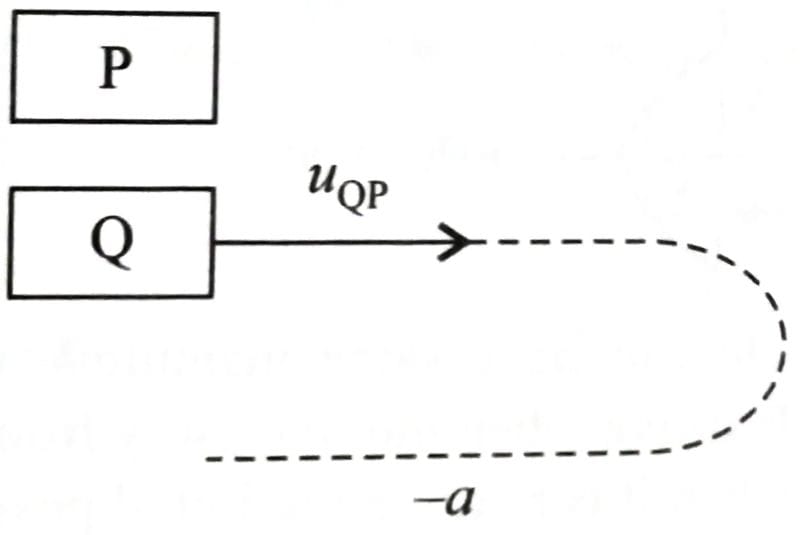
Case I:

 uQP and aQP in same direction

They cross 2 times in this case

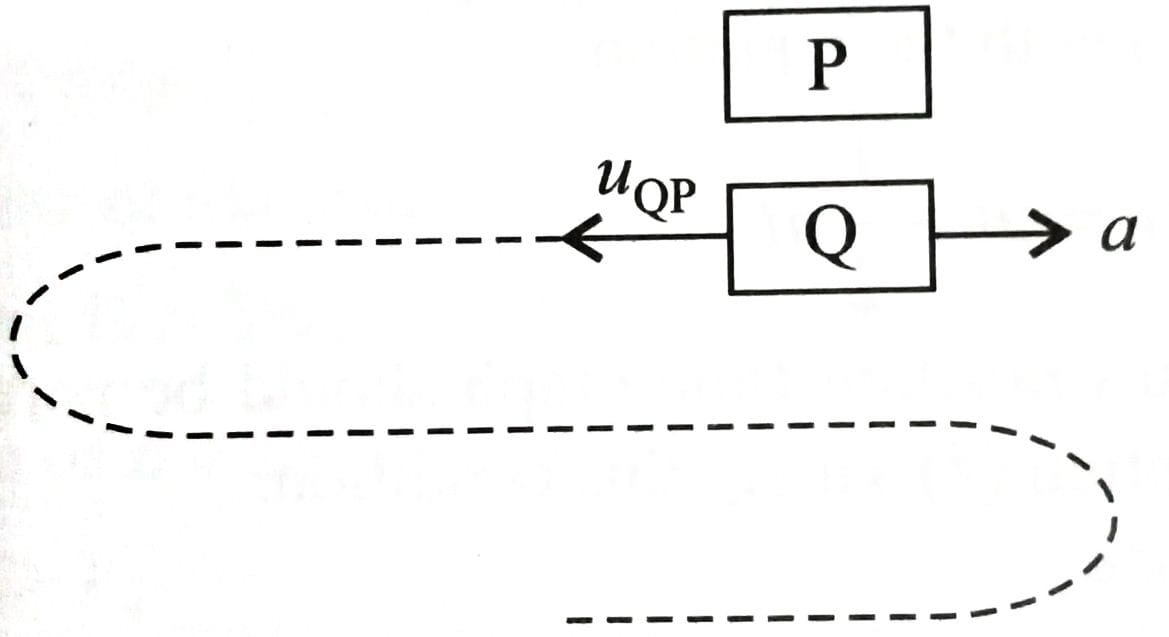
Case-II:

aQP and uQP in opposite direction

They cross 3 times in this case.


Q 4 :

Two trains A and B of length 'l' and '4l' are travelling into a tunnel of length 'L' in parallel tracks from opposite directions with velocities 108 km/h and 72 km/h, respectively. If train ‘A’ takes 35 s less time than train ‘B’ to cross the tunnel then, length ‘L’ of tunnel is: (Given L = 60l         [2023]

  • 1200 m


  • 2700 m


  • 1800 m


  • 900 m


(3)

60+420-6130=35

=105035

L=60=105035×60=1800 m


Q 5 :

A passenger sitting in a train A moving at 90 km/h observes another train B moving in the opposite direction for 8 s. If the velocity of the train B is 54 km/h, then length of train B is                     [2023]

  • 80 m


  • 200 m


  • 120 m


  • 320 m


(4)

Velocity of train A

VA=90kmhr=90×518=25 m/s

Velocity of train B

VB=54kmhr=54×518=15 m/s

Velocity of train B w.r.t. train A =VB-VA

                                                 =15-(-25)m/s=40 m/s

Time of crossing=length of trainrelative velocity

           8=40

l=8×40=320 meter