

Which of the following is an example of actinomorphic flower? [2024]
Datura
Cassia
Pisum
Sesbania
(1)
Datura is an example of actinomorphic flower, i.e., can be divided into two equal halves in any radial plane passing through the center. However, Cassia, Sesbania, and Pisum are zygomorphic flowers.
Match List I with List II. [2024]
| List I (Types of stamens) | List II (Example) |
| A. Monoadelphous | I. Citrus |
| B. Diadelphous | II. Pea |
| C. Polyadelphous | III. Lily |
| D. Epiphyllous | IV. China-rose |
Choose the correct answer from the options given below:
A-IV, B-II, C-I, D-III
A-IV, B-I, C-II, D-III
A-I, B-II, C-IV, D-III
A-III, B-I, C-IV, D-II
(1)
Monoadelphous - China rose
Diadelphous - Pea
Polyadelphous - Citrus
Epiphyllous - Lily
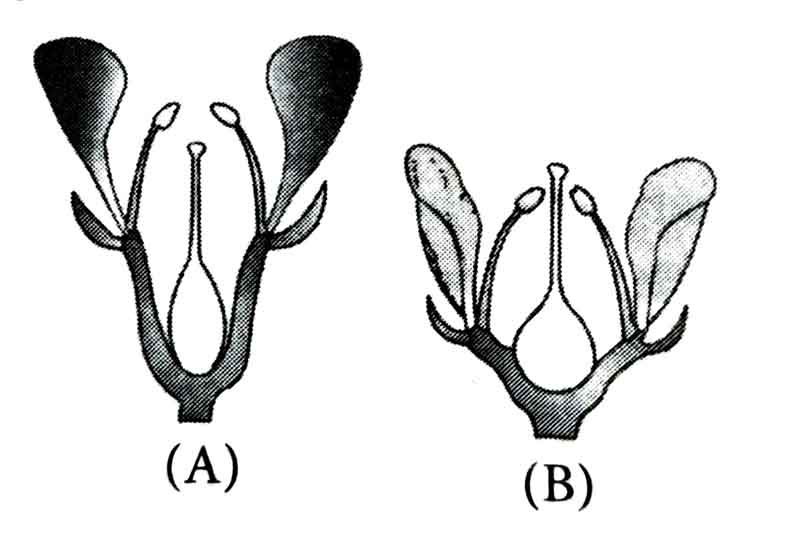
Identify the type of flowers based on the position of calyx, corolla, and androecium with respect to the ovary from the given figures (A) and (B). [2024]

(A) Epigynous; (B) Hypogynous
(A) Hypogynous; (B) Epigynous
(A) Perigynous; (B) Epigynous
(A) Perigynous; (B) Perigynous
(4)
Both given figures (A) and (B) represent perigynous flowers characterized by the position of gynoecium in the center and other floral parts on the rim of the thalamus almost at the same level. This is observed in plum, rose, and peach.
Match List I with List II. [2024]
| List I | List II |
| A. Rose | I. Twisted aestivation |
| B. Pea | II. Perigynous flower |
| C. Cotton | III. Drupe |
| D. Mango | IV. Marginal placentation |
Choose the correct answer from the options given below:
A-II, B-IV, C-I, D-III
A-I, B-II, C-III, D-IV
A-IV, B-III, C-II, D-I
A-II, B-III, C-IV, D-I
In Calotropis, aestivation is [2023]
valvate
vexillary
imbricate
twisted
(1)
In Calotropis, sepals or petals in a whorl just touch one another at the margin, without overlapping. This type of aestivation is called valvate.
In a pea flower, five petals are arranged in a specialised manner with one posterior, two lateral and two anterior. These are named as ______, ______, and ______ respectively. [2023]
Keel, Wings and Standard
Vexillum, Keel and Standard
Keel, Standard and Carina
Standard, Wings and Keel
(4)
In flowers of pea, there are five petals which are arranged in a specialised manner. The largest (standard) posterior petal overlaps the two lateral petals (wings), which in turn overlap the two smallest anterior petals (keel). This type of aestivation is known as vexillary or papilionaceous.
Match List I with List II. [2023]
| Type of flower | Example |
| (A) Zygomorphic | (I) Mustard |
| (B) Hypogynous | (II) Plum |
| (C) Perigynous | (III) Cassia |
| (D) Epigynous | (IV) Cucumber |
Select the correct option:
(A)-(I), (B)-(II), (C)-(IV), (D)-(III)
(A)-(I), (B)-(II), (C)-(III), (D)-(IV)
(A)-(IV), (B)-(I), (C)-(III), (D)-(II)
(A)-(III), (B)-(I), (C)-(II), (D)-(IV)
Axile placentation is observed in [2023]
tomato, Dianthus and pea
China rose, Petunia and lemon
mustard, cucumber and primrose
China rose, beans and lupin
(2)
When placenta is axial and the ovules are attached to it in a multilocular ovary, the placentation is said to be axile, as in China rose, tomato, Petunia, and lemon. Dianthus and Primrose have free central placentation. Pea, beans, and lupin have marginal placentation, while mustard and cucumber have parietal placentation.
The flowers are zygomorphic in [2022]
(A) Mustard
(B) Gulmohar
(C) Cassia
(D) Datura
(E) Chilly
Choose the correct answer from the options given below:
(A), (B), (C) only
(B), (C) only
(D), (E) only
(C), (D), (E) only
(2)
Zygomorphic flower can be divided into two similar halves only in one particular vertical plane, e.g., Gulmohar, Cassia. Flowers of mustard, Datura, and chilly are actinomorphic. Actinomorphic flowers can be divided into two equal radial halves in any radial plane passing through the centre.
Which one of the following plants shows vexillary aestivation and diadelphous stamens? [2022]
Colchicum autumnale
Pisum sativum
Allium cepa
Solanum nigrum
(2)
Colchicum autumnale, Allium cepa, and Solanum nigrum show valvate aestivation.
Diadelphous stamens are found in [2021]
China rose and citrus
China rose
citrus
pea
(4)
Pea (Pisum sativum) belongs to Family Fabaceae in which all stamens are united and form two bundles.
Ray florets have [2020]
inferior ovary
superior ovary
hypogynous ovary
half inferior ovary
(1)
The ovary is inferior in ray florets of sunflower. It possesses an epigynous flower i.e., the margin of the thalamus grows upward enclosing the ovary completely and getting fused with it. The other parts of the flower arise above the ovary.
The ovary is half-inferior in [2020]
brinjal
mustard
sunflower
plum
(4)
The ovary is superior in brinjal and mustard while it is inferior in sunflower.
Placentation in which ovules develop on the inner wall of the ovary or in the peripheral part, is [2019]
free central
basal
axile
parietal
(4)
Parietal placentation is found in a compound or syncarpous ovary. There are two or more longitudinal placentae or files of ovules attached to the ovary wall. The ovary is usually unilocular but becomes falsely two or more locular due to the ingrowth of placentae or formation of false septa.
Match the placental types (column-I) with their examples (column-II). [2019]
| Column-I | Column-II |
| (A) Basal | (i) Mustard |
| (B) Axile | (ii) China rose |
| (C) Parietal | (iii) Dianthus |
| (D) Free central | (iv) Sunflower |
Choose the correct answer from the following options:
(A)-(ii), (B)-(iii), (C)-(iv), (D)-(i)
(A)-(i), (B)-(ii), (C)-(iii), (D)-(iv)
(A)-(iv), (B)-(ii), (C)-(i), (D)-(iii)
(A)-(iii), (B)-(iv), (C)-(i), (D)-(ii)
The term 'polyadelphous' is related to [2016]
gynoecium
androecium
corolla
calyx
(2)
Polyadelphous condition represents cohesion of stamens. In this condition, stamens of a flower are fused by their filaments only to form many groups, e.g., Citrus.
How many plants among Indigofera, Sesbania, Salvia, Allium, Aloe, mustard, groundnut, radish, gram, and turnip have stamens with different lengths in their flowers? [2016]
Three
Four
Five
Six
Radial symmetry is found in the flowers of [2016]
Brassica
Trifolium
Pisum
Cassia
(1)
The flowers of Brassica are radially symmetrical, whereas flowers of Trifolium, Pisum, and Cassia are zygomorphic.
Free central placentation is found in [2016]
Dianthus
Argemone
Brassica
Citrus
(1)
Free central placentation is found in Dianthus. Parietal placentation is present in Argemone and Brassica, whereas Citrus has axile placentation in the ovary.
The standard petal of a papilionaceous corolla is also called [2016]
vexillum
corona
carina
pappus
(1)
The posterior large bilobed petal of a papilionaceous corolla is called standard or vexillum. It overlaps the two smaller lateral petals known as wings or alae.
Among China rose, mustard, brinjal, potato, guava, cucumber, onion, and tulip, how many plants have a superior ovary? [2015]
Three
Four
Five
Six
(4)
China rose, mustard, brinjal, potato, onion, and tulip are the plants that have a superior ovary, whereas in guava and cucumber, the ovary is inferior.
Axile placentation is present in [2015]
pea
Argemone
Dianthus
lemon
(4)
Axile placentation occurs in syncarpous pistils. The ovary is partitioned into two or more chambers. Placentae occur in the central region where the septa meet so that an axile column bearing ovules is formed, e.g., shoe flower (pentalocular), lemon (multilocular), etc.
Keel is the characteristic feature of the flower of [2015]
Aloe
tomato
tulip
Indigofera
(4)
The flowers of Family Papilionaceae have butterfly-shaped corolla (papilionaceous corolla). The posterior or outermost petal is the largest and is called the standard or vexillum, two lateral petals are similar and generally clawed, called wings or alae, and the two anterior petals called keel are fused, enclosing stamens and carpels. This type of petal arrangement is found in bean, gram, pea, Indigofera, etc.
When the margins of sepals or petals overlap one another without any particular direction, the condition is termed as [2014]
vexillary
imbricate
twisted
valvate
(2)
Aestivation is the arrangement of accessory floral organs (sepals or petals) in relation to one another in the floral bud. It may be of open, valvate, twisted, or imbricate type. In imbricate aestivation, there is an irregular overlapping of petals or sepals by one another. Cassia, Gulmohar, etc., show imbricate aestivation.
Given below are two statements:
Statement I: In a floral formula stands for zygomorphic nature of the flower, and stands for inferior ovary.
Statement II: In a floral formula stands for actinomorphic nature of the flower and stands for superior ovary.
In the light of the above statements, choose the correct answer from the options given below: [2025]
Both Statement I and Statement II are correct
Both Statement I and Statement II are incorrect
Statement I is correct but Statement II is incorrect
Statement I is incorrect but Statement II is correct
(4)
The floral formula symbol is used for actinomorphic flower, while % is used for zygomorphic flower.
The symbol G represents gynoecium and symbol represent superior ovary, while inferior ovary is represented by .
Thus, statement I is incorrect and Statement II is correct.
Which of the following is an example of a zygomorphic flower? [2025]
Petunia
Datura
Pea
Chilli
(3)
Zygomorphic flowers can be divided into two equal halves by only a single vertical plane and shows bilateral symmetry.
Pea possess zygomorphic flowers.
Chilli, Petunia and Datura possess actinomorphic flowers.