

Q 11 :

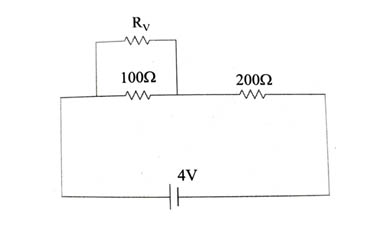
Two resistance of 100Ω and 200Ω are connected in series with a battery of 4V and negligible internal resistance. A voltmeter is used to measure voltage across 100Ω resistance, which gives reading as 1V. The resistance of voltmeter must be ________ Ω.             [2024]


(200)

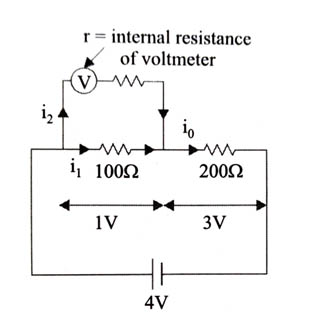
Given potential across Voltmeter = 1V

Current in 100Ω=1100A=i1

200Ω=3100Aas total potential =4V1&1V is drop across 100Ω

Let current in voltmeter = i

i1+i2=i0

i2+1100=3200

i2+3200-1100=1200A1

V=IR11=1200(r),r=200Ω


Q 12 :

Consider a moving coil galvanometer (MCG):

A. The torsional constant in moving coil galvanometer has dimensions [ML2T2]

B. Increasing the current sensitivity may not necessarily increase the voltage sensitivity.

C. If we increase number of turns (N) to its double (2N), then the voltage sensitivity doubles.

D. MCG can be converted into an ammeter by introducing a shunt resistance of large value in parallel with galvanometer.

E. Current sensitivity of MCG depends inversely on number of turns of coil.

Choose the correct answer from the options given below:          [2025]

  • A, B only


  • A, D only


  • B, D, E only


  • A, B, E only


(1)

(A) τ=Cθ  [ML2T2]=[C][1]

(B) C.S.=θI=BNAC;

       V.S.=BNARC    [R = also depends on 'N']

(C) V.S.NABCR  RNR

(D) Shunt of law of resistance, False [Theory]

(E) E [False] C.S  N

      C.S=NABC


Q 13 :

A galvanometer having a coil of resistance 30 Ω need 20 mA of current for full-scale deflection. If a maximum current of 3 A is to be measured using this galvanometer, the resistance of the shunt to be added to the galvanometer should be 30XΩ, where X is          [2025]

  • 447


  • 298


  • 149


  • 596


(3)

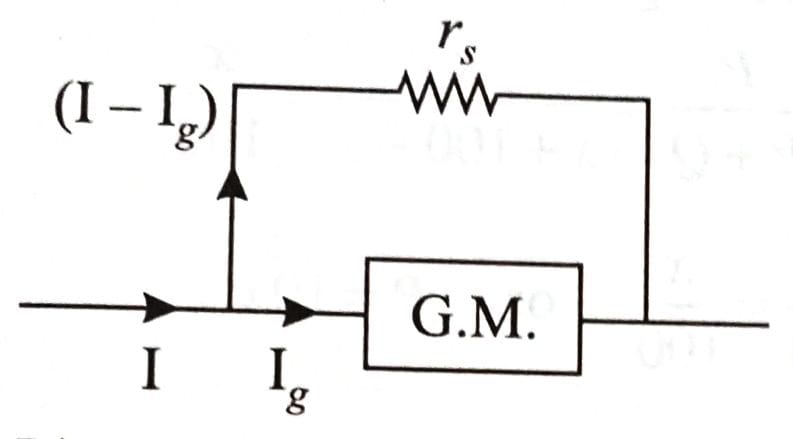
IgRg=(IIg)rs

20×103×30=(30.02)×rs

rs=(0.62.98)=30x

x=(2.98×300.6)=149


Q 14 :

In a moving coil galvanometer, two moving coils M1 and M2 have the following particulars:

R1=5Ω, N1=15, A1=3.6×10³m2, B1=0.25T

R2=7Ω, N2=21, A2=1.8×10³m2, B2=0.50T

Assuming that torsional constant of the springs are same for both coils, what will be the ratio of voltage sensitivity of M1 and M2?          [2025]

  • 1 : 1


  • 1 : 4


  • 1 : 3


  • 1 : 2


(1)

Kθ=NIAB  θI=NABK

Voltage sensitivity =θV=θRI=NABKR

Ratio of voltage sensitivity =(N1A1B1R1)(R2N2A2B2)

Ratio =(N1A1B1N2A2B2)R2R1=15×3.6×0.2521×1.8×0.5×75=11


Q 15 :

A cell of emf 90 V is connected across series combination of two resistors each of 100Ω resistance. A voltmeter of resistance 400Ω is used to measure the potential difference across each resistor. The reading of the voltmeter will be         [2023]

  • 45 V


  • 40 V


  • 80 V


  • 90 V


(2)

Req=400×100500+100=180Ω

[IMAGE 214]------------------

i=90180=12 A

Reading=12×400500×100=40 V


Q 16 :

The number of turns of the coil of a moving coil galvanometer is increased in order to increase current sensitivity by 50%. The percentage change in voltage sensitivity of the galvanometer will be            [2023]

  • 100%


  • 50%


  • 75%


  • 0%


(4)

Current sensitivity=Voltage sensitivity×R

Current sensitivity is made 1.5 times.

R also increases 1.5 times.

Hence voltage sensitivity=1.5×current sensitivity1.5×R=no change


Q 17 :

Given below are two statements: One is labelled as Assertion A and the other is labelled as Reason R.               [2023]

Assertion A: For measuring the potential difference across a resistance of 600Ω , the voltmeter with resistance 1000Ω will be preferred over voltmeter with resistance 4000Ω .

Reason R: Voltmeter with higher resistance will draw smaller current than voltmeter with lower resistance.

In the light of the above statements, choose the most appropriate answer from the options given below.

  • A is not correct but R is correct


  • Both A and R are correct and R is the correct explanation of A


  • Both A and R are correct but R is not the correct explanation of A


  • A is correct but R is not correct


(1)

Error of voltmeter decreases with increase in its resistance.


Q 18 :

A student is provided with a variable voltage source V, a test resistor Rr=10Ω, two identical galvanometers G1 and G2, and two additional resistors, R1=10 MΩ and R2=0.001 Ω. For conducting an experiment to verify Ohm's law, the most suitable circuit is                [2023]

  • [IMAGE 215]


  • [IMAGE 216]


  • [IMAGE 217]


  • [IMAGE 218]


(3)

To convert galvanometer into ammeter low resistance should be added in parallel and for voltmeter conversion, a very high resistance should be added in series.


Q 19 :

For designing a voltmeter of range 50 V and an ammeter of range 10 mA using a galvanometer which has a coil of resistance 54Ω showing a full-scale deflection for 1 mA as shown in figure.            [2023]

[IMAGE 219]

(A) for voltmeter R50 kΩ
(B) for ammeter r0.2 Ω
(C) for ammeter r6 Ω
(D) for voltmeter R5 kΩ
(E) for voltmeter R500 Ω

Choose the correct answer from the options given below:

  • (C) and (E)


  • (C) and (D)


  • (A) and (C)


  • (A) and (B)


(3)

For voltmeter

R=VIg-G=5010-3-5450 kΩ (A)

For ammeter

S=IgGI-Ig=10-3×54(10-1)×10-3=6Ω (C)


Q 20 :

As shown in the figure, the voltmeter reads 2 V across 5Ω resistor. The resistance of the voltmeter is ______ Ω.               [2023]

[IMAGE 220]


(20)

i1=2 V5 Ω=25A

[IMAGE 221]--------------

i=1 V2Ω=12A

  Current through voltmeter=i-i1

=12-25=5-410=110 A

 For voltmeter  2=(110)RR=20 Ω