

Q 1 :

An electric bulb rated 50 W – 200 V is connected across a 100 V supply. The power dissipation of the bulb is              [2024]

  • 12.5 W


  • 25 W


  • 100 W


  • 50 W


(1)     

          Resistance, R=V2P=(200)250=800Ω

          Power dissipated, P=(Vapplied)2R=(100)2800=1008=12.5W


Q 2 :

The number of electrons flowing per second in the filament of a 110 W bulb operating at 220 V is (Given e=1.6×10⁻¹⁹C)                              [2024]

  • 1.25×10¹⁹


  • 6.25×10¹⁷


  • 6.25×10¹⁸


  • 31.25×10¹⁷


(4)     

          Given: P = 110 W, V = 220 V

           Power, P=V.I⇒110=(220)(I)⇒I=0.5A

           I=qt=net⇒0.5=(nt)×1.6×10⁻¹⁹

          (nt)=0.51.6×10-19=31.25×10¹⁷


Q 3 :

Water boils in an electric kettle in 20 minutes after being switched on. Using the same main supply, the length of the heating element should be _________ to ________ times of its initial length if the water is to be boiled in 15 minutes.                           [2024]

  • increased, 4/3


  • increased, 3/4


  • decreased, 3/4


  • decreased, 4/3


(3)   

          P=V2R,R=ρLA⇒P=V2AρL or P∝1L

          P1×t1=P2×t2

          P1P2=t2t1=L2L1=1520⇒L2=34L1


Q 4 :

By what percentage will the illumination of the lamp decrease if the current drops by 20% ?                        [2024]

  • 46%


  • 26%


  • 36%


  • 56%


(3)     

             Pinitial=I2initialR

            Pfinal=(0.8 Iinitial)2R

            % change in power

           Pfinal-PinitialPinitial×100=(0.64-1)×100=-36%


Q 5 :

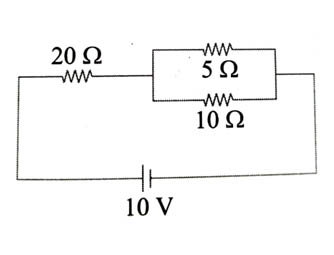
The ratio of heat dissipated per second through the resistance 5Ω and 10Ω in the circuit given below is            [2024]

  • 4 : 1


  • 1 : 1


  • 2 : 1


  • 1 : 2


(3)

As parallel combination so, p.d. is same P=V2R⇒P∝1R

P1P2=R2R1=105=21


Q 6 :

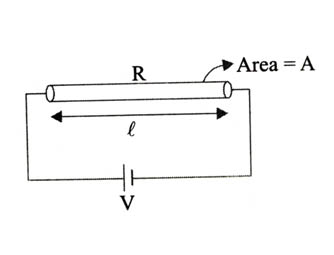
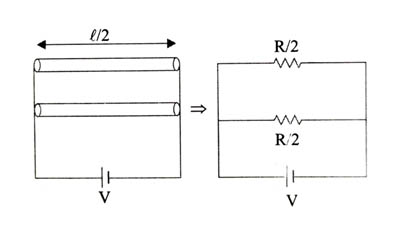
When a potential difference V is applied across a wire of resistance R, it dissipates energy at a rate W. If the wire is cut into two halves and these halves are connected mutually parallel across the same supply, the energy dissipation rate will become          [2024]

  • 1/4 W


  • 1/2 W


  • 2W


  • 4W


(4)

W=V2R                          ...(1)

and R=ρℓA

Now 

Req=R4

W'=V2R4=4V2R=4W


Q 7 :

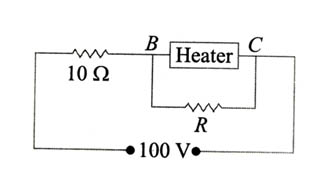
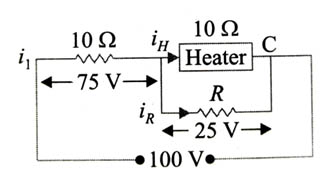
A heater is designed to operate with a power of 1000 W in a 100 V line. It is connected in combination with a resistance of 10 Ω and a resistance R, to a 100 V mains as shown in figure. For the heater to operate at 62.5 W, the value of R should be _____ Ω.               [2024]


(5)

Rheater=V2P=(100)21000=10 Ω

For heater P=V2R⇒V=PR

V=62.5×10=25 V

i1=7510=7.5 A,  iH=2510=2.5 A

iR=i1-iH=7.5-2.5=5 A

V=IR⇒R=255=5 Ω


Q 8 :

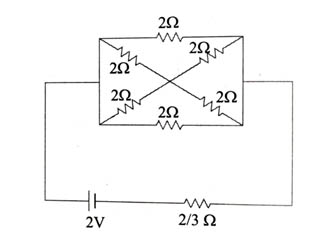
In the following circuit, the battery has an emf of 2V and an internal resistance of 23Ω. The power consumption in the entire circuit is ______ W.      [2024]


(3)

Req=43Ω

∴P=V2Req=443=3W


Q 9 :

The battery of a mobile phone is rated as 4.2 V, 5800 mAh. How much energy is stored in it when fully charged?          [2025]

  • 43.8 kJ


  • 48.7 kJ


  • 87.7 kJ


  • 24.4 kJ


(3)

Given V = 4.2 Volt

∴ Energy supplied by battery

     W=Vq=4.2×5800×3600×10–3J=87.696 kJ

∴ Energy stored in the battery when fully charged

       =87.696 kJ ≈ 87.7 kJ


Q 10 :

There are 'n' number of identical electric bulbs, each is designed to draw a power p independently from the mains supply. They are now joined in series across the main supply. The total power drawn by the combination is:          [2025]

  • np


  • pn2


  • pn


  • p


(3)

Rs=R1+R2+R3+.....+Rn

V2Ps=V2P+V2P+.....+V2Pn

Ps=Pn


Q 11 :

Ratio of thermal energy released in two resistor R and 3R connected in parallel in an electric circuit is                 [2023]

  • 3 : 1


  • 1 : 1


  • 1 : 3


  • 1 : 27


(1)

H=V2R×t

H1H2=V2tRV2t3R=3:1


Q 12 :

The H amount of thermal energy is developed by a resistor in 10 s when a current of 4 A is passed through it. If the current is increased to 16 A, the thermal energy developed by the resistor in 10 s will be                   [2023]

  • H


  • 16H


  • H4


  • 4H


(2)

H∝i2 for t=constant

HH'=(416)2

H'=16H


Q 13 :

Two identical heater filaments are connected first in parallel and then in series. At the same applied voltage, the ratio of heat produced in same time for parallel to series will be:        [2023]

  • 4 : 1


  • 2 : 1


  • 1 : 2


  • 1 : 4


(1)

Parallel combination;

          HP=(V2(R2))t=2V2tR

Series combination;

        HS=(V22R)t

∴  HPHS=4


Q 14 :

Different combination of 3 resistors of equal resistance R are shown in the figures.

The increasing order for power dissipation is:                     [2023]

  • PA<PB<PC<PD


  • PC<PD<PA<PB


  • PB<PC<PD<PA


  • PC<PB<PA<PD


(4)

P=i2R

R1=3R2, R2=2R3, R3=R3, R4=3R

Since i is same, hence P∝R, so option (4) is correct.


Q 15 :

A water heater of power 2000 W is used to heat water. The specific heat capacity of water is 4200 J kg-1 K-1. The efficiency of heater is 70%. Time required to heat 2 kg of water from 10°C to 60°C is __________ s.

(Assume that the specific heat capacity of water remains constant over the temperature range of the water.)              [2023]


(300)

η×P×Δt=M×s×ΔT

⇒Δt=2×4200×(60-10)0.7×2000s=300 s


Q 16 :

A potential V0 is applied across a uniform wire of resistance R. The power dissipation is P1. The wire is then cut into two equal halves and a potential of V0 is applied across the length of each half. The total power dissipation across two wires is P2. The ratio P2:P1 is x:1. The value of x is _______.               [2023]


(16)

P=VI=I2R=V2R

Now R=ρℓA

If the wire is cut into two equal half, R=R2

Initial P1=V02R

After P2=V02R'×2⇒V02R×4

P2P1=4=x1⇒x=16


Q 17 :

The heat generated in 1 minute between points A and B in the given circuit, when a battery of 9 V with internal resistance of 1 Ω is connected across these points is __________ J.       [2026]


(1080)

i=93=3 A

∴  HAB=i2RABt

                  =(3)2×2×60=1080 J


Q 18 :

A battery with EMF E and internal resistance r is connected across a resistance R. The power consumption in R will be maximum when:   [2026]

  • R = r


  • R = 2r


  • R = r/2


  • R=2r


(1)

For maximum power drawn across load

Resistance RLoad=Rinternal

R=r


Q 19 :

An electric power line having total resistance of 2Ω,delivers 1 kW of power at 250 V. The percentage efficiency of transmission line is ________.    [2026]

  • 96.9


  • 92.5


  • 100


  • 86.5


(1)

Pout=1000 W

P=VI

1000=250×I

I=4 A

Ploss=I2R=(4)2×2=3200

Pnet=1000+32=103200

η=(PoutPnet)×100=10001032×100=96.9%


Q 20 :

In the given circuit if the internal resistance of the batteries are negligible, then for what value of resistance R (in Ω) will the thermal power generated in it be maximum.


(2)

Given circuit can be simplified as dotted part can be replaced as

P=(62+R)2R=36R(2+R)2

For P to be maximum,  dPdR=0


Q 21 :

Two resistors of 200 Ω and 400 Ω are connected in series with a battery of 100 V. A bulb rated at 200 V, 100 W is connected across the 400 Ω resistance. The potential drop across the bulb is _____ V.                   [2026]

  • 25


  • 50


  • 66.6


  • 100


(2)

For resistance of bulb

R=V2P=200×200100=400 Ω

Req=(200+200) Ω=400 Ω

I=100400=14 A

Vbulb=14×200=50 V