

Q 1 :

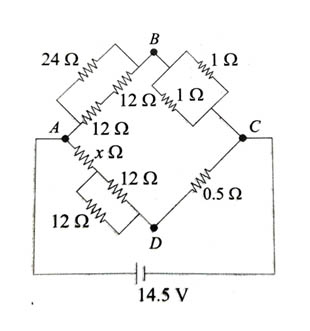
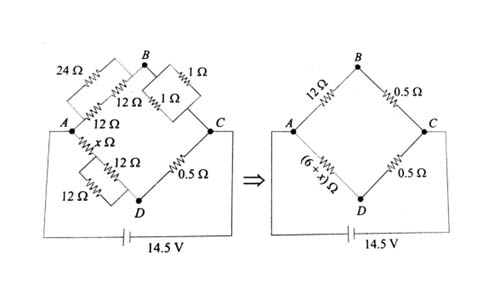
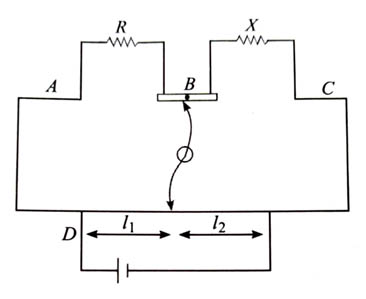
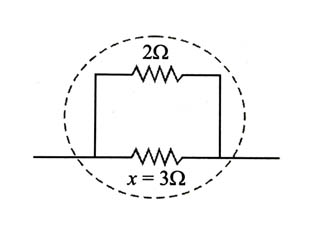
The value of unknown resistance (x) for which the potential between B and D will be zero in the arrangement shown, is     [2024]

  • 6Ω


  • 9Ω


  • 42Ω


  • 3Ω


(1)

Potential difference between B and D will be zero in a balanced

Wheatstone Bridge

In case of balanced Wheatstone Bridge,

VABVAD=VBCVCD126+x=0.50.5x=6Ω


Q 2 :

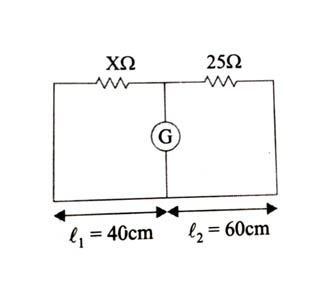
The resistance per centimeter of a meter bridge wire is r, with XΩ resistance in left gap. Balancing length from left end is at 40 cm with 25Ω resistance in right gap. Now the wire is replaced by another wire of 2r resistance per centimeter. The new balancing length for same settings will be at              [2024]

  • 20 cm


  • 10 cm


  • 80 cm


  • 40 cm


(4)

25r2=Xr1                      ...(i)

252r'2=X2r'1              ...(ii)

From (i) and (ii) '2=2=40cm


Q 3 :

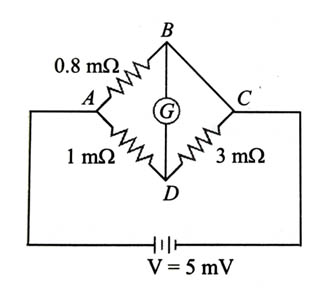
To measure the temperature coefficient of resistivity α of a semiconductor, an electrical arrangement shown in the figure is prepared. The arm BC is made up of the semiconductor. The experiment is being conducted at 25 °C and resistance of the semiconductor arm is 3 mΩ. Arm BC is cooled at a constant rate of 2° C/s. If the galvanometer G shows no deflection after 10 s, then α is                [2024]

  • -1×10⁻²C-1o


  • -2×10⁻²C-1o


  • -2.5×10⁻²C-1o


  • -1.5×10⁻²C-1o


(1)

For no. deflection =0.81=R3

R=2.4mΩ

ΔR=RαΔT

α=ΔRRΔT=-0.63×20=-10-2C-1o


Q 4 :

In a metre-bridge when a resistance in the left gap is 2Ω and unknown resistance in the right gap, the balance length is found to be 40 cm. On shunting the unknown resistance with 2Ω, the balance length changes by                 [2024]

  • 22.5 cm


  • 20 cm


  • 62.5 cm


  • 65 cm


(1)

Given for l1=40 cm
Rl1=Xl2240=X60

x=3Ω

After shunting

Req=2×33+2=65Ω

Rl=Req100-l2l=65(100-l)

10(100-l)=6l

500-5l=3l

500=8l

l=5008=1252=62.5 cm

Balance length change

by =62.5-40=22.5 cm


Q 5 :

In a metre bridge experiment, the balance point is obtained if the gaps are closed by 2Ω and 3Ω . A shunt of X Ω is added to the 3Ω resistor to shift the balancing point by 22.5 cm. The value of X is __________.                [2023]


(2)

2(3x3+x)=40+22.560-22.5=62.537.5=53

65=3x3+x  6+2x=5x  x=2


Q 6 :

When two resistances R1 and R2 are connected in series and introduced into the left gap of a metre bridge and a resistance of 10Ω is introduced into the right gap, a null point is found at 60 cm from the left side. When R1 and R2 are connected in parallel and introduced into the left gap, a resistance of 3Ω is introduced into the right gap to get a null point at 40 cm from the left end. The product of R1R2 is ________ Ω2.                          [2023]


(30)

R1+R210=6040=32  R1+R2=15

Now  R1R2(R1+R2)×3=4060=23  R1R2=30


Q 7 :

A meter bridge with two resistances R1 and R2 as shown in the figure was balanced (null point) at 40 cm from the point P. The null point changed to 50 cm from the point P when 16Ω resistance is connected in parallel to R2. The values of resistances R1 and R2 are _______.            [2026]

[IMAGE 43]

  • R2=4Ω,  R1=43Ω


  • R2=12Ω,  R1=123Ω


  • R2=16Ω,  R1=163Ω


  • R2=8Ω,  R1=163Ω


(4)