A convex lens of focal length 30 cm is placed in contact with a concave lens of focal length 20 cm. An object is placed at 20 cm to the left of this lens system. The distance of the image from the lens in cm is [2025]
30
45
15
(4)
Equivalent focal length,
Lens formula
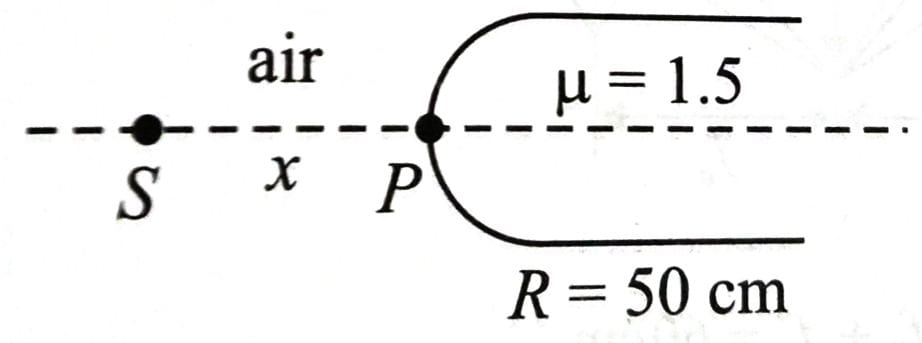
Light from a point source in air falls on a spherical glass surface (refractive index, = 1.5 and radius of curvature = 50 cm). The image is formed at a distance of 200 cm from the glass surface inside the glass. The magnitude of distance of the light source from the glass surface is ________ m. [2025]
(4)

When a beam of white light is allowed to pass through a convex lens parallel to principal axis, the different colours of light converge at different point on the principle axis after refraction. This is called [2023]
scattering
chromatic aberration
spherical aberration
polarisation
(2)
The phenomena is known as chromatic aberration.
A person has been using spectacles of power –1.0 D for distant vision and a separate reading glass of power 2.0 D. What is the least distance of distinct vision for this person [2023]
10 cm
40 cm
30 cm
50 cm
(4)
As shown in the figure, a combination of a thin plano concave lens and a thin plano convex lens is used to image an object placed at infinity. The radius of curvature of both the lenses is 30 cm and refractive index of the material for both the lenses is 1.75. Both the lenses are placed at distance of 40 cm from each other. Due to the combination, the image of the object is formed at distance = ____ cm, from concave lens. [2023]

(120)
Image from will be virtual and on the left of at focal length 40 cm. So the object for will be 80 cm from which is . Final image is formed at 80 cm from on the right.
So
A convex lens of refractive index 1.5 and focal length 18 cm in air is immersed in water. The change in focal length of the lens will be ________ cm.
(Given refractive index of water ) [2023]
(54)
An object is placed on the principal axis of a convex lens of focal length 10 cm as shown. A plane mirror is placed on the other side of lens at a distance of 20 cm. The image produced by the plane mirror is 5 cm inside the mirror. The distance of the object from the lens is ________cm. [2023]

(30)

On solving we get value of as 30 cm.
Two transparent media having refractive indices 1.0 and 1.5 are separated by a spherical refracting surface of radius of curvature 30 cm. The centre of curvature of surface is towards denser medium and a point object is placed on the principal axis in rarer medium at a distance of 15 cm from the pole of the surface. The distance of image from the pole of the surface is ________cm. [2023]
(30)

A point object, 'O' is placed in front of two thin symmetrical coaxial convex lenses and with focal length 24 cm and 9 cm respectively. The distance between two lenses is 10 cm and the object is placed 6 cm away from lens as shown in the figure. The distance between the object and the image formed by the system of two lenses is __________ cm. [2023]

(34)

So distance between object and its image
The radius of curvature of each surface of a convex lens having refractive index 1.8 is 20 cm. The lens is now immersed in a liquid of refractive index 1.5. The ratio of power of lens in air to its power in the liquid will be . The value of is ____ . [2023]
(4)