

Q 1 :

Given below are two statements:

Statement I: When the white light passed through a prism, the red light bends lesser than yellow and violet.

Statement II: The refractive indices are different for different wavelengths in dispersive medium.

In the light of the above statements, choose the correct answer from the options given below:          [2024]

  • Statement I is false but Statement II is true


  • Statement I is true but Statement II is false


  • Both Statement I and Statement II are false


  • Both Statement I and Statement II are true


(4)     

            As λred>λyellow>λviolet

            Light ray with longer wavelength bends less. So red has minimum wavelength so least bends.


Q 2 :

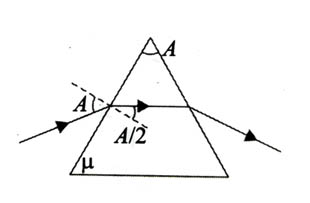
If the refractive index of the material of a prism is cot(A/2), where A is the angle of prism then the angle of minimum deviation will be         [2024]

  • π-2A


  • π2-2A


  • π-A


  • π2-A


(1)     

           cosA2=sin(A+δmin2)

             A+δmin2=π2-A2

              δmin=π-2A


Q 3 :

The refractive index of a prism with apex angle A is cot A/2. The angle of minimum deviation is             [2024]

  • δm=180o-4A


  • δm=180o-3A


  • δm=180o-2A


  • δm=180o-A


(3)   

           μ=sin(A+δm2)sinA2

           cosA2sinA2=sin(A+δm2)sinA2

           sin(π2-A2)=sin(A+δm2)

           π2-A2=A2+δm2δm=π-2A


Q 4 :

The refractive index of prism is μ=3 and the ratio of the angle of minimum deviation to the angle of prism is one. The value of angle of prism is _____°.           [2024]


(60)

δ=i+e-A and δA=1; δ=A

A=i+e-A

i+e=2A and for δmin, i=e

So, i=e=A

By Snell's law at the first surface of prism

1·sinA=3·sin(A2)A=60°


Q 5 :

The refractive index of the material of glass prism is 3. The angle of minimum deviation is equal to the angle of the prism. What is the angle of the prism?         [2025]

  • 50°


  • 60°


  • 58°


  • 48°


(2)

μ=sin(A+δmin2)sinA2

Given δmin=A

3=sin AsinA2=2 sinA2cosA2sinA2

cosA2=32  A=60°


Q 6 :

A thin prism P1 with angle 4° made of glass having refractive index 1.54, is combined with another thin prism P2 made of glass having refractive index 1.72 to get dispersion without deviation. The angle of the prism P2 in degree is          [2025]

  • 4


  • 3


  • 16/3


  • 1.5


(2)

For dispersion without deviation, δnet=0

(μ11)A1=(μ21)A2

 (1.541)4°=(1.721)A2

or A2=0.540.72×4=3°


Q 7 :

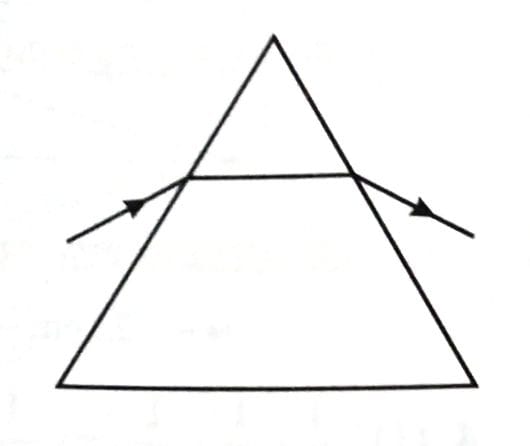
Consider following statements for refraction of light through prism, when angle of deviation is minimum.

(A) The refracted ray inside prism becomes parallel to the base.

(B) Larger angle prisms provide smaller angle of minimum deviation.

(C) Angle of incidence and angle of emergence becomes equal.

(D) There are always two sets of angles of incidence for which deviation will be same except at minimum deviation setting.

(E) Angle of refraction becomes double of prism angle.

Choose the correct answer from the options given below:          [2025]

  • A, C and D Only


  • B, C and D Only


  • A, B and E Only


  • B, D and E Only


(1)

Because of symmetry where i = r, and r=A2

δ=(μ1)A

(A) is correct

(B) is incorrect

(C) is correct

(D) is correct as δ=i+eA

(E) is incorrect


Q 8 :

A ray of light suffers minimum deviation when incident on a prism having angle of the prism equal to 60°. The refractive index of the prism material is 2. The angle of incidence (in degrees) is __________.         [2025]


(45)

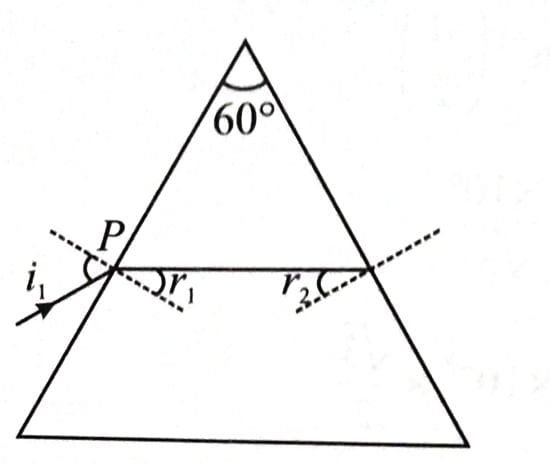
For minimum deviation r1=r2=A2=30°

At P1×sin i=μ×sin 30

sin i=2×12=12  i=45°


Q 9 :

A thin prism P1 with an angle 6° and made of glass of refractive index 1.54 is combined with another prism P2 made from glass of refractive index 1.72 to produce dispersion without average deviation. The angle of prism P2 is               [2023]

  • 6°


  • 1.3°


  • 7.8°


  • 4.5°


(4)

δ1=δ2 [for no average deviation]

 6°(1.54-1)=A(1.72-1)

 A=6°×0.540.72=18°4=4.5°


Q 10 :

The refractive index of a transparent liquid filled in an equilateral hollow prism is 2. The angle of minimum deviation for the liquid will be _____° .            [2023]


(30)

As μ=sin(Dmin+A2)sin(A2)

2=sin(Dmin+602)sin(602)

12=sin(Dmin+602)

Dmin+602=45  Dmin=30


Q 11 :

A thin prism with angle 5° of refractive index 1.72 is combined with another prism of refractive index 1.9 to produce dispersion without deviation. The angle of the second prism is ________.             [2026]

  • 4.5°


  •  

  •  

  •  

(4)

δnet=0

δ1+δ2=0

(μ1-1)A1+(μ2-1)A2=0

A2=(μ1-1)A1(μ2-1)

A2=(1.72-1)(1.9-1)×5°=4°


Q 12 :

The exit surface of a prism with refractive index n is coated with a material having refractive index n2. When this prism is set for minimum angle of deviation, it exactly meets the condition of critical angle. The prism angle is _________.             [2026]

  • 30°


  • 15°


  • 60°


  • 45°


(3)

i=e & r=A2 for minimum deviation

sinr=sinθc

sinr=n/2n

sinr=12

sinA2=sin30°

A2=30°

A=60°


Q 13 :

Consider an equilateral prism (refractive index 2). A ray of light is incident on its one surface at a certain angle i. If the emergent ray is found to graze along the other surface, then the angle of refraction at the incident surface is close to ______.             [2026]

  • 15°


  • 40°


  • 30°


  • 20°


(1)

Equilateral prism

A=60°

μsinr2=1·sine=1

sinr2=1μ=12

r2=45°

  r1=A-r2=15°


Q 14 :

For a transparent prism, if the angle of minimum deviation is equal to its refracting angle, the refractive index n of the prism satisfies [2026]

  • 2<n<22


  • 2<n<2


  • n2


  • 1<n<2


(2)

δmin=2i-A  i=δmin=A

Also, μ=sin(δmin+A2)sin(A2)

μ=sinAsinA2=2cos(A2)

1<μ<2    ...(1)

δmin=2i-A

A=2i-A  i=A

i<90° (grazing incidence)

A<90°

μ=2cos(A2), A<90°

μ>2    ...(2)

from (1) & (2)  

2<μ<2


Q 15 :

A prism of angle 75° and refractive index 3is coated with thin film of refractive index 1.5 only at the back exit surface. To have total internal reflection at the back exit surface the incident angle must be ______.

(sin15°=0.25 and sin25°=0.43)    [2026]

  • 15°


  • between 15° and 20°


  • <15°


  • None of these


(4)

r1+r2=75°

For TIR at back surface

3sinr2=32sin90°

r2>60°

r1<15°

sini=3sin15°

sini=1.73×0.25

sini=0.433

i=25°i<25°


Q 16 :

As shown in the diagram, when the incident ray is parallel to base of the prism, the emergent ray grazes along the second surface.

If refractive index of the material of prism is 2, the angle θ of prism is:   [2026]

  • 75


  • 45°


  • 90°


  • 60


(4)

For grazing emergence

sinr2=1μ

By Snell's Law at incident surface

1×12=2sinr1

r1=30°

r1+r2=A

A=75°

75°+45°+θ=180°

θ=60°