

Q 11 :

Two triangles are similar if their corresponding sides are __________.

  • equal 


  • proportional 


  • unequal 


  • no relation


(2)

Two triangles are similar if their corresponding sides are in proportion


Q 12 :

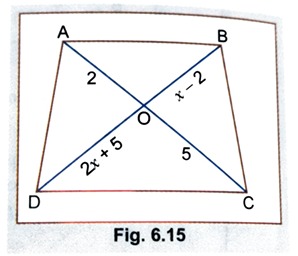
In Fig, in trapezium ABCD if AB  CD, then the value of x is

  • 29/8 


  • 8/29 


  • 20 


  • 1/20 


(3)

Since ABCD is a trapezium with AB ? CD and diagonals intersect at O

AO/OC = OB/OD ⇒ 2/5 = (x - 2)/(2x + 5)

=  2(2x + 5) = 5(x - 2)

= 4x + 10 = 5x - 10 x = 20

Option (c) is correct.


Q 13 :

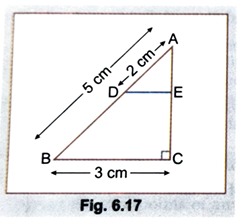
In the given triangle (Right angled at C), DE || BC, AB = 5 cm, AD = 2 cm and BC = 3 cm. Using BPT/Thales theorem:


(i) AE = 8/5 cm

(ii) AE = 1 cm

(iii) AC = 4 cm

(iv) AC = 3 cm

Choose the correct option from the following:

  • (i) and (iii) are correct.


  • (i) and (iv) are correct.


  • (ii) and (iii) are correct.


  • (ii) and (iv) are correct


(1)

Given right angled triangle ABC, using Pythagoras theorem we have

AB² = AC² + BC²  5² = AC² + 9  AC² = 25  9 = 16  AC = 4 cm, Hence (iii) is correct.Given DE  BC, using BPT theorem,AD/AB = AE/AC  2/5 = AE/4 AE = 8/5 cm, Hence (i) is correct.


Q 14 :

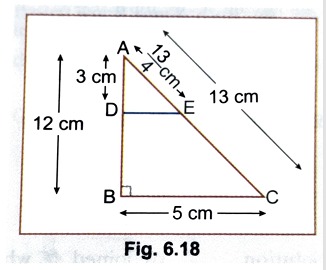
In the given triangle, we have AB = 12 cm, AC = 13 cm, AE = 13/4 cm, BC = 5 cm and AD = 3 cm. Then:

(i) ABC is a right-angled triangle

(ii) DE is parallel to BC

(iii) ABC is not a right-angled triangle

(iv) DE is perpendicular to AB

Choose the correct option from the following..

  • (i) and (iii) are correct.


  • (i) and (iv) are correct.


  • (i), (ii) and (iv) are correct.


  • Only (i) is correct.


(4)

Checking for right-angled triangle:

Given, AB = 12 cm, BC = 5 cm and AC = 13 cm(AB)² + (BC)² = (12)² + (5)² = 144 + 25 = 169 = (13)²So, (AB)² + (BC)² = (AC)², by Pythagoras Theorem,ΔABC is right angled at B.Hence, (i) is correct, and (iii) is incorrectNow, AD/AB = 3/12 = 1/4 and AE/AC = (13/4 × 1/13) = 1/4By BPT if AD/AB = AE/AC, then DE  BC, Hence (ii) is correct.As B is a right angle and DE  BC, angle D will also be 90°, so DE  AB,Hence (iv) is correct.


Q 15 :

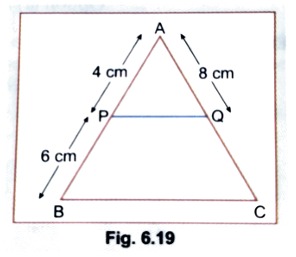
In the given triangle ABC, PQ || BC. If PB = 6 cm, AP = 4 cm and AQ = 8 cm. Then

(i)  AC = 20 cm

(ii) AC = 12 cm

(iii) AP, AQ and QC are in arithmetic progression

(iv)  AP/AB = AQ/AC

Choose the correct option from the following

  • (i) and (iii) are correct.


  • (ii), (iii) and (iv) are correct


  • (i), (ii) and (iv) are correct.


  • (i), (iii) and (iv) are correct.


(4)

Given PQ  BC  AP/AB = AQ/AC (By BPT)  (iv) is correct.4/4+6=8/ACAC=20cm,(i)iscorrect.

QC = 20 − 8 = 12 cm

4, 8, 12 are in Arithmetic Progression.

Hence, (iii) is correct.


Q 16 :

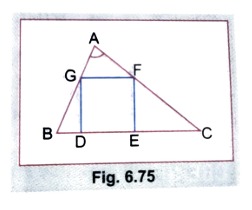
ΔABC is right-angled at A and DEFG is a square as shown in the figure. Then:

(i) ΔCBG ~ ΔEFC (ii) BD × EC = DE² (iii) ΔAGF ~ ΔDBG (iv) ΔAGF ~ ΔEFC


Choose the correct option from the following:

  • (iii) and (iv) are correct.


  • (i), (ii) and (iii) are correct.


  • (ii), (iii) and (iv) are correct.


  • (i) and (ii) are correct.


(3)

In ΔAGF and ΔDBG:GAF = BDG = 90° andAGF = DBG (Corresponding angles) ΔAGF ~ ΔDBG (By AA similarity) (A) (iii) is correct.Similarly, in ΔAGF and ΔEFC:GAF = CEF = 90° andAFG = FCE (Corresponding angles) ΔAGF ~ ΔEFC (By AA similarity) (B) (iv) is correct.From (A) and (B):ΔDBG ~ ΔEFCDBEF=DGECBut EF = DG = DE (side of square)DBDE=DEECDE2=DB×EC (ii) is correct. 


Q 17 :

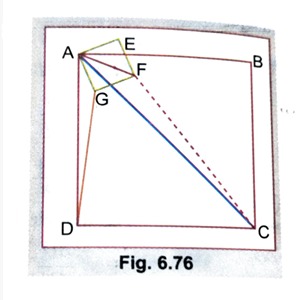
In the given figure, ABCD and AEFG are squares. Then

(i)AFAG=ACAD(ii)AFAG=ADAC(iii) ΔACF~ΔADG(iv)ΔACF~ΔAGD

Choose the correct option from the following:

  • (i) and (iii) are correct


  • (ii) and (iv) are correct


  • (ii) and (iii) are correct


  • (i) and (iv) are correct


(1)

In ΔAGF and ΔADCAGF=ADC (Each90°)GAF=DAC (Each45°)ΔAGF~ΔADC(By AA similaritycriterion)AGAD=AFACACAD=AFAG(i)also,DAC=GAF(Each45°)DAC-GAC=GAF-GACDAG=CAFandACAD=AFAG(From(i))ΔACF~ΔADG (By SAS similaritycriterion)