

Q 1 :

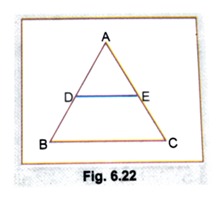
Assertion (A): ABCD is a trapezium with DC || AB. E and F are point on AD and BC respectively,  such that EF || AB. Then AEED=BFFC.

Reason (R): Any line parallel to parallel sides of a trapezium divides the non-parallel sides proportionally

  • Both A and R are true, and R is the correct explanation of A.


  • Both A and R are true, but R is not the correct explanation of A.


  • A is true, but R is false.


  • A is false, but R is true


(1)

We joined AC which intersects EF at O.

As, EF  AB  EF  DC ( AB  DC)

In ΔADC, we have EO  DC

AEED=AOOC  (i)

Also, in ΔABC, we have AB  OF

AOOC=BFFC  (ii)                    From (i) and (ii), we get:

AEED=BFFC

Thus, Assertion (A) is true and Reason (R) is also true, and Reason (R) is the correct explanation of Assertion (A).   Therefore, option (a) is correct.


Q 2 :

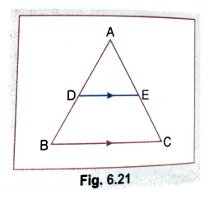
Assertion (A): In the given figure, DE || BC, so that  AD = (4x – 3) cm, AE = (8x – 7) cm, BD = (3x – 1) cm and CE = (5x – 3) cm, then the value of x is 1.

Reason (R): In triangle ABC, if DE || BC, then ADBD=AECE

  • Both A and R are true, and R is the correct explanation of A.


  • Both A and R are true, but R is not the correct explanation of A


  • A is true, but R is false.


  • A is false, but R is true.


(1)

Since, in ABC, DE||BCADDB=AEEC    [By BPT]4x-33x-1=8x-75x-3(4x-3)(5x-3)=(8x-7)(3x-1)20x2-12x-15x+9=24x2-8x-21x+720x2-27x+9=24x2-29x+74x2-2x-2=0    2x2-x-1=02x2-2x+x-1=0    2x(x-1)+1(x-1)=0(x-1)(2x+1)=0x=1    x-12

Both Assertion (A) and Reason (R) are true, and Reason (R) is the correct explanation of Assertion (A).  


Q 3 :

Assertion (A): D and E are points on the sides AB and AC respectively of ΔABC such that AB = 10.8 cm, AD = 6.3 cm, AC = 9.6 cm, EC = 4 cm, then DE is parallel to BC.

Reason (R): If a line is parallel to one side, then it divides the other two sides in the same ratio

  • Both A and R are true, and R is the correct explanation of A.


  • Both A and R are true, but R is not the correct explanation of A


  • A is true, but R is false.


  • A is false, but R is true.


(2)

In ΔABC, D and E are points on sides AB and AC respectively such that

AB = 10.8 cm, AD = 6.3 cm, AC = 9.6 cm, EC = 4 cm

BD=ABAD=10.86.3=4.5 cmAE=ACEC=9.64=5.6 cmNow, ADBD=6.34.5=6345=2115=75and   AEEC=5.64=5640=75ADBD=AEECDEBC

Therefore, Assertion (A) is true, Reason (R) is also true, but Reason (R) is not the correct explanation of Assertion (A).  


Q 4 :

Assertion (A): In a triangle, if a line is drawn parallel to one side of the triangle and it intersects the other two sides, then it divides those two sides proportionally.

Reason (R): The Basic Proportionality Theorem states that if a line parallel to one side of a triangle intersects the other two sides, then the segments created are proportional.

  • Both A and R are true, and R is the correct explanation of A.


  • Both A and R are true, but R is not the correct explanation of A.


  • A is true, but R is false.


  • A is false, but R is true.


(1)

We know that in a triangle, if a line is drawn parallel to one side of the triangle and it intersects the other two sides, then it divides those two sides proportionally.
It is known as Basic Proportionality Theorem.

Both Assertion (A) and Reason (R) is true, and Reason (R) is the correct explanation of Assertion (A).


Q 5 :

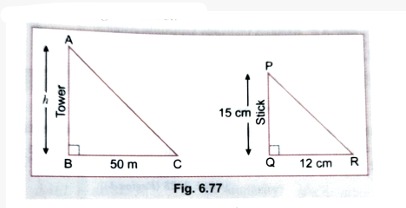
Assertion (A): A vertical stick which is 15 cm long casts a 12 cm long shadow on the ground. At the same time, a vertical tower casts a 50 m long shadow on the ground, then the height of the tower is 50 m.

Reason (R): The ratio of the perimeters of two similar triangles is the same as the ratio of their corresponding sides.

  • Both A and R are true, and R is the correct explanation of A.


  • Both A and R are true, but R is not the correct explanation of A.


  • A is true, but R is false.


  • A is false, but R is true


(4)

Let h be the height of the tower.

Since both the tower and stick are vertical:

ABC=PQR=90°

and the angles of depression at the same instant are equal:

BAC=LQPRABC~PQR(By AA similarity)ABPQ=BCQRh15 cm=50 m12 cmh50=0.150.12=1512h=50×1512=1252=62.5 mThus, the height of the tower is 62.5 m, not 50 m.


Q 6 :

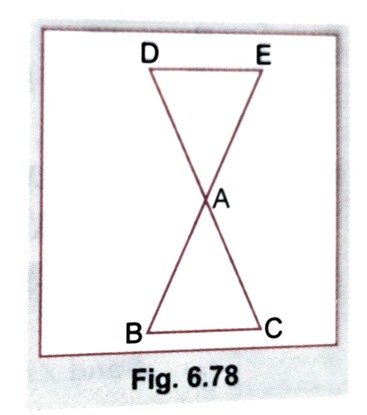
Assertion(A):In Fig. ABC~AED.If BC=8cm, AB=6.5cm, AD=2.8cm and DE=4cm, then AC=5.6 cm

Reason (R): If in two triangles, angles of one triangle are proportional to the angles of the other triangle, then their corresponding sides are equal, and hence, the two triangles are similar.

  • Both A and R are true, and R is the correct explanation of A.


  • Both A and R are true, but R is not the correct explanation of A.


  • A is true, but R is false.


  • A is false, but R is true


(3)

Given,ABC~AED

We have: BC = 8 cm, AB = 6.5 cm, AD = 2.8 cm, DE = 4 cm.

Now,ABAE=BCED=ACAD(ABC~AED)

FromBCED=ACAD84=AC2.8

2×2.8=ACC=5.6 cm