

Q 1 :

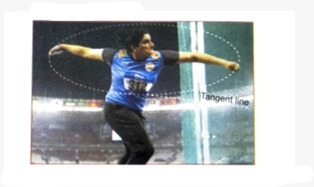
The discus throw is an event in which an athlete aims to throw a discus as far as possible. The athlete spins counterclockwise one and a half times within a circle before releasing the discus. Upon release, the discus travels along a tangent to the circular path of the spin.

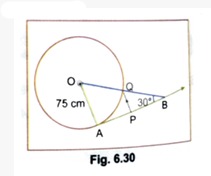
In the given figure, AB is one such tangent to a circle of radius 75 cm. Point O is centre of the circle and ABO = 30°.  PQ is parallel to OA

Based on the above information answer the following questions:


(i) Find the length of AB.


  • 753 cm


  • 752 cm


  • 653 cm


  • -753 cm


(1)

Since OA is radius and BA is tangent to the circle at point A

 OAB = 90°In ΔOAB,tan30°=OAAB13=75AB AB=753 cm


Q 2 :

The discus throw is an event in which an athlete aims to throw a discus as far as possible. The athlete spins counterclockwise one and a half times within a circle before releasing the discus. Upon release, the discus travels along a tangent to the circular path of the spin.

In the given figure, AB is one such tangent to a circle of radius 75 cm. Point O is centre of the circle and angle A B O space equals space 30 degree. space PQ is parallel to OA

Based on the above information answer the following questions:


(ii) Find the length of OB.

  • 150 cm 


  • 140


  • 130


  • 120


(1)

In ΔOAB, we havesin30°=OAOB12=75OBOB=150 cm


Q 3 :

The discus throw is an event in which an athlete aims to throw a discus as far as possible. The athlete spins counterclockwise one and a half times within a circle before releasing the discus. Upon release, the discus travels along a tangent to the circular path of the spin.

In the given figure, AB is one such tangent to a circle of radius 75 cm. Point O is centre of the circle and angle A B O space equals space 30 degree. space PQ is parallel to OA

Based on the above information answer the following questions:


(iii) (a) Find the length of AP

  • 7532cm


  • 7542cm


  • -7534cm


  • 7632cm


(1)

Since the radius of circle is perpendicular to the tangent at the point of contact  OAP = 90°

Since PQ  OA OAP = QPB = 90° (Corresponding angles)Now, OB = 150 cmOQ+QB=15075+QB=150QB=150-75=75 cmIn right ΔPBQ,cos30°=PBQB32=PB75PB=7532cmAP=AB-PB=753-7532AP=7532cm


Q 4 :

The discus throw is an event in which an athlete aims to throw a discus as far as possible. The athlete spins counterclockwise one and a half times within a circle before releasing the discus. Upon release, the discus travels along a tangent to the circular path of the spin.

In the given figure, AB is one such tangent to a circle of radius 75 cm. Point O is centre of the circle and angle A B O space equals space 30 degree. space PQ is parallel to OA

Based on the above information answer the following questions:


(iii) (b) Find the length of PQ.

  • 35.5


  • 37.5


  • 36.5


  • 33.5


(2)

In right ΔQPB,sin\funcapply30°=PQQB12=PQ75PQ=752=37.5 cm


Q 5 :

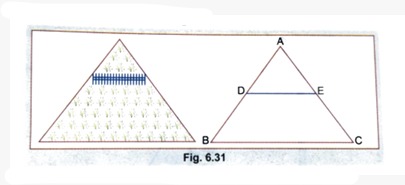
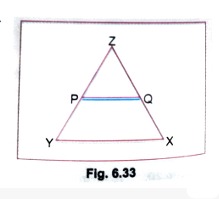
A farmer had a triangular piece of land. He put a fence, parallel to one of the sides of the field as shown in the figure.

Based on the above information answer the following questions:


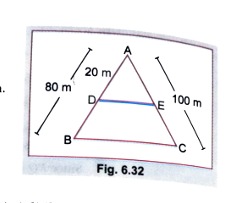
(i) If the point D is 20 m away from point A, whereas AB and AC are 80 m and 100 m respectively, find the length of AE.

  • 20 m


  • 15 m


  • 25 m


  • 10 m


(3)

In ΔABC, DE  BCADAB=AEAC(By BPT)2080=AE100AE=25 m


Q 6 :

A farmer had a triangular piece of land. He put a fence, parallel to one of the sides of the field as shown in the figure.

Based on the above information answer the following questions:


(ii) If AD = x + 1, DB = 3x – 1, AE = x + 3, EC = 3x + 4, then find the value of x.

  • 7


  • 5


  • 4


  • 3


(1)

Given, AD = x + 1, DB = 3x – 1, AE = x + 3, EC = 3x + 4.

Since, in ΔABC, DE  BCADDB=AEEC(Using BPT)x+13x-1=x+33x+4Cross multiplying:(x+1)(3x+4)=(3x-1)(x+3)3x2+7x+4=3x2+8x-37x+4=8x-3x=7


Q 7 :

A farmer had a triangular piece of land. He put a fence, parallel to one of the sides of the field as shown in the figure.

Based on the above information answer the following questions:


(iii) (a) State whether BDAD=AEEC or not. Give reason

  • BDADAEEC


  • ADDBAEEC


  • BDAEDEEC


  • BDAD=AEEC


(1)

No, because when in ΔABC, DE  BCADDB=AEEC(Using BPT)1AD/DB=1AE/ECBDAD=ECAEHence, BDADAEEC


Q 8 :

A farmer had a triangular piece of land. He put a fence, parallel to one of the sides of the field as shown in the figure.

Based on the above information answer the following questions:


(iii) (b) If P and Q are the midpoints of sides YZ and XZ respectively in ΔZYX, then state whether PQ  YX or not. Give reason.

  • PQ  YX


  • PX  YQ


  • QX  YP


  • -PX  YQ


(1)

In ΔZYX,  P and Q are midpoints of side YZ and XZ respectively.

ZPPY=1andZQQX=1ZPPY=ZQQXPQYX(By converse of BPT)Yes, PQ  YX.


Q 9 :

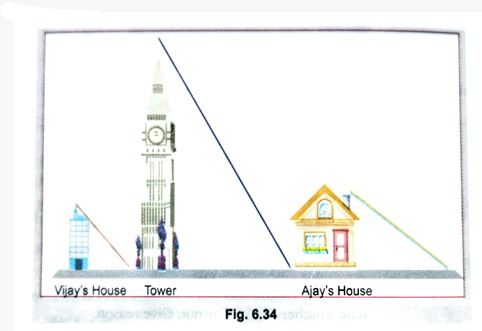
Vijay is trying to estimate the height of a tower near his house using the properties of similar triangles. His house, which is 20 m tall, casts a 10 m long shadow on the ground.

At the same time, the tower casts a 50 m long shadow on the ground, and Ajay’s house casts a 20 m long shadow on the ground.


Based on the above information, answer the following questions:


(i) What is the height of the tower?

  • 100 m


  • 150 m


  • 120 m


  • 140 m


(1)

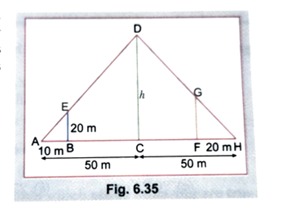
The figure can be drawn as Fig. 6.35.

Let CD = h m be the height of the tower, BE = 20 m be the height of Vijay’s house, and GF be the height of Ajay’s house.

Since, ACD~ABEACAB=CDEB5010=h20h=100 m


Q 10 :

Vijay is trying to estimate the height of a tower near his house using the properties of similar triangles. His house, which is 20 m tall, casts a 10 m long shadow on the ground.

At the same time, the tower casts a 50 m long shadow on the ground, and Ajay’s house casts a 20 m long shadow on the ground.


Based on the above information, answer the following questions:


(ii) What will be the length of the shadow of the tower when Vijay’s house casts a 12 m long shadow?

  • 50 m 


  • 60 m 


  • 40 m 


  • 30 m 


(2)

Given AB = 12 m, let AC = x.

In similar ΔABE and ΔACD:ABAC=BECD12x=20100x=12×10020=12×5=60 m