

Q 1 :

Assertion (A): The tangents drawn at the end points of a diameter of a circle, are parallel.

Reason (R): Diameter of a circle is the longest chord.

  • Both, Assertion (A) and Reason (R) are true and Reason (R) is correct explanation of Assertion (A).


  • Both, Assertion (A) and Reason (R) are true but Reason (R) is not correct explanation for Assertion (A).


  • Assertion (A) is true but Reason (R) is false.


  • Assertion (A) is false but Reason (R) is true.


(2)

Assertion: Two parallel tangents always lie at the end points of the diameter of the circle.

Reason: Diameter is the longest chord of a circle which passes through centre joining the two points on the circumference of a circle.

Both, Assertion (A) and Reason (R) are true but Reason (R) is not correct explanation for Assertion (A).


Q 2 :

Assertion (A): TA and TB are two tangents drawn from an external point T to a circle with centre ‘O’. If ∠TBA=75° then ∠ABO=25°.

Reason (R): The tangent drawn at any point of a circle is perpendicular to the radius through the point of contact.

  • Both Assertion (A) and Reason (R) are true and Reason (R) is the correct explanation of the Assertion (A).


  • Both Assertion (A) and Reason (R) are true, but Reason (R) is not the correct explanation of the Assertion (A).


  • Assertion (A) is true, but Reason (R) is false.


  • Assertion (A) is false, but Reason (R) is true.


(4)     Assertion (A) is false, but Reason (R) is true.


Q 3 :

Assertion (A): The tangents drawn at the end points of a diameter of a circle are parallel.

Reason (R): Diameter of a circle is the longest chord.

  • Both Assertion (A) and Reason (R) are true and Reason (R) is the correct explanation of the Assertion (A).


  • Both Assertion (A) and Reason (R) are true, but Reason (R) is not the correct explanation of the Assertion (A).


  • Assertion (A) is true, but Reason (R) is false.


  • Assertion (A) is false, but Reason (R) is true.


(2)

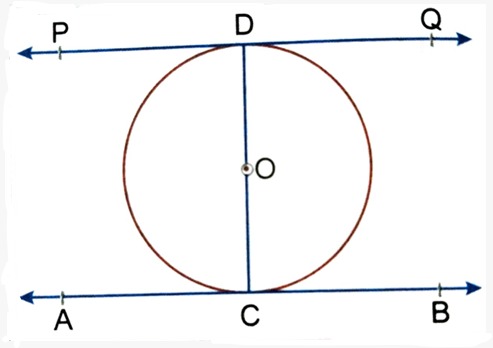
As PQ and AB are tangents and OD and OC are radius of the circle,

OD ⟂ PQ and OC ⟂ AB

⇒ ∠ODP = ∠OCA = 90°

∴ ∠ODP + ∠OCA = 180°

⇒ ∠ODP and ∠OCA are co-interior angles.

⇒ PQ and AB are parallel.

Assertion is true.

Also, diameter of a circle is the longest chord.

Both Assertion (A) and Reason (R) are true but Reason (R) is not the correct explanation of Assertion (A).


Q 4 :

Assertion (A): A tangent to a circle is perpendicular to the radius through the point of contact.

Reason (R): The lengths of tangents drawn from an external point to a circle are equal.

  • Both, Assertion (A) and Reason (R) are true and Reason (R) is correct explanation of Assertion (A).


  • Both, Assertion (A) and Reason (R) are true but Reason (R) is not correct explanation for Assertion (A).


  • Assertion (A) is true but Reason (R) is false.


  • Assertion (A) is false but Reason (R) is true.


(2)

Both Assertion (A) and Reason (R) are true statements but Reason (R) is not the correct explanation of Assertion (A).


Q 5 :

Assertion (A): The angle between the two tangents drawn from an external point to a circle is supplementary to the angle subtended by the line segments joining the points of contact to the centre.

Reason (R): The tangent to a circle is perpendicular to the radius through the point of contact.

  • Both, Assertion (A) and Reason (R) are true and Reason (R) is correct explanation of Assertion (A).


  • Both, Assertion (A) and Reason (R) are true but Reason (R) is not correct explanation for Assertion (A).


  • Assertion (A) is true but Reason (R) is false.


  • Assertion (A) is false but Reason (R) is true.


(1)

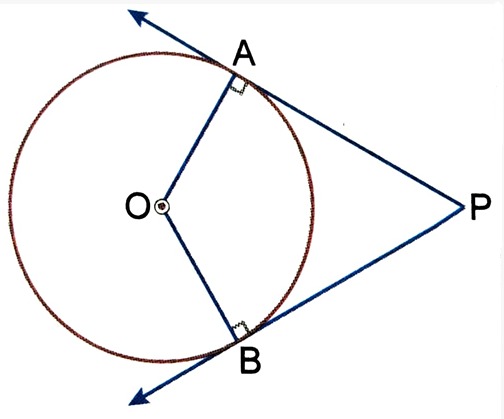
Let PA and PB be two tangents drawn from an external point P to the circle with centre O, as shown in Fig

PA⊥OA and PB⊥OB

(Tangents are perpendicular to the radius at point of contact.)

In quadrilateral OAPB, we have:

∠OAP+∠APB+∠PBO+∠AOB=360°

⇒90°+∠APB+90°+∠AOB=360°

⇒∠APB+∠AOB=180°

Both Assertion (A) and Reason (R) are true and Reason (R) is the correct explanation of Assertion (A).