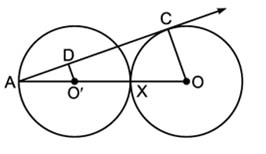
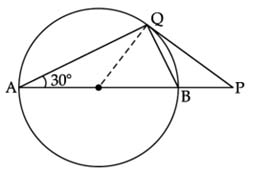
In the below figure, two equal circles, with centres O and O', touch each other at X. OO' produced meets the circle with centre O' at A. AC is tangent to the circle with centre O, at the point C. O'D is perpendicular to AC. Find the value of .

(1/3)
AC is tangent to circle with centre O.
Thus,
In and ,
(Common)
Now,
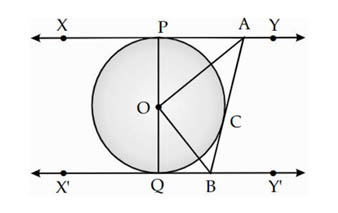
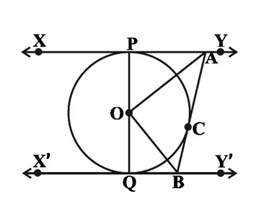
In the figure XY and X'Y' are two parallel tangents to a circle with centre O and another tangent AB with point of contact C interesting XY at A and X'Y' at B, what is the measure of AOB.

(90°)
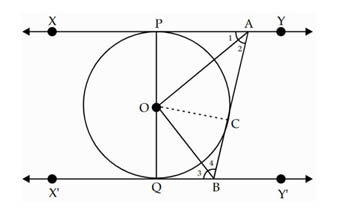
Join OC. Since, the tangents drawn to a circle from an external point are equal.
AP = AC

In PAO and AOC, we have:
AO = AO [Common]
OP = OC [Radii of the same circle]
AP = AC
...(i)
Similarly ...(2)
Again, we know that sum of internal angles on the same side of a transversal is 180°.
....(3)
Also
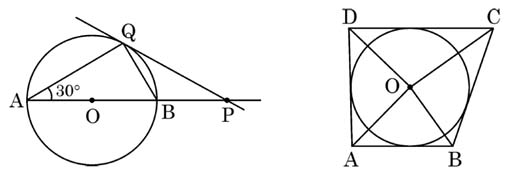
In the given figure, PQ is tangent to a circle at O and , show that BP = BQ.


As AB is a diameter, AQB is a Semicircle.
From figure,
In
From (i) and (ii) we get
Therefore, QB = BP
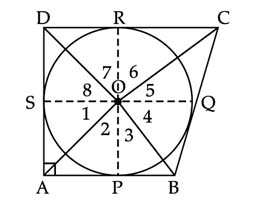
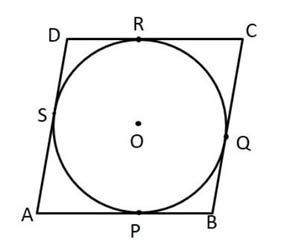
In the given figure, AB, BC, CD and DA are tangents to the circle with centre O forming a quadrilateral ABCD. Show that
Given A quad. ABCD circumscribes a circle with centre O.
To Prove:
and
Join OP, OQ, OR and OS.
We know that the tangent drawn from an external point of a circle subtends equal angles at the centre.

and
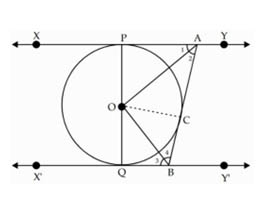
In the below figure, XY and X′Y′ are two parallel tangents to a circle with centre O and another tangent AB with point of contact C intersecting XY at A and X′Y′ at B. Prove that AOB = 90°.

Join OC. Since, the tangents drawn to a circle from an external point are equal.
AP = AC

In Δ PAO and Δ AOC, we have:
AO = AO [Common]
OP = OC [Radii of the same circle]
AP = AC
Δ PAO Δ AOC [SSS Congruency]
PAO = CAO = 1
PAC = 2 1 ...(1)
Similarly CBQ = 2 2 ...(2)
Again, we know that sum of internal angles on the same side of a transversal is .
PAC + CBQ =
2 1 + 2 2 = [From (1) and (2)]
1 + 2 = ...(3)
Also 1 + 2 + AOB = 180° [Sum of angles of a triangle]
90° + AOB =
AOB = AOB = .
Prove that a parallelogram circumscribing a circle is a rhombus
We have ABCD, a parallelogram which circumscribes a circle (i.e., its sides touch the circle) with centre O.

Since tangents to a circle from an external point are equal in length,
AP = AS, BP = BQ, CR = CQ and DR = DS
Adding, we get
(AP + BP) + (CR + DR) = (AS + DS) + (BQ + CQ)
AB + CD = AD + BC
But AB = CD [opposite sides of ABCD]
and BC = AD
AB + CD = AD + BC 2 AB = 2 BC
AB = BC
Similarly AB = DA and DA = CD
Thus, AB = BC = CD = AD
Hence ABCD is a rhombus.