

Q 1 :

Let the point, on the line passing through the points P(1, –2, 3) and Q(5, –4, 7), farther from the origin and at a distance of 9 units from the point P, be (α,β,γ). Then α2+β2+γ2 is equal to          [2024]

  • 160


  • 165


  • 150


  • 155


(4)

Line through PQ is given by

x–14=y+2–2=z–34=λ

Any point R on PQ will be R(4λ+1,–2λ–2,4λ+3)

Since, PR = 9 units ⇒(PR)2=81

⇒ (4λ+1–1)2+(–2λ–2+2)2+(4λ+3–3)2=81

⇒ 16λ2+4λ2+16λ2=81

⇒ 36λ2=81 ⇒ λ2=94 ⇒ λ=±32

∴  R can be (7, –5, 9) or (–5, 1, –3)

Distance from origin of the points be 49+25+81 and 25+1+9i.e., 155,35

∴  Distance of (7, –5, 9) is farthest from origin

⇒(α,β,γ)≡(7, –5, 9)

Hence α2+β2+γ2=72+(–5)2+92=155.


Q 2 :

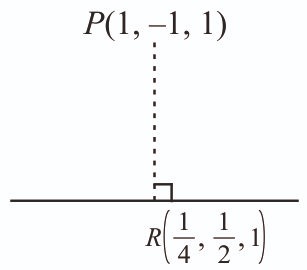
Let P be the point of intersection of the lines x–21=y–45=z–21 and x–32=y–23=z–32. Then, the shortest distance of P from the line 4x = 2y = z is          [2024]

  • 147


  • 5147


  • 6147


  • 3147


(4)

L1 : x–21=y–45=z–21=λ (say)

L2 : x–32=y–23=z–32=μ (say)

For point of intersection P,

(λ+2,5λ+4,λ+2)=(2μ+3,3μ+2,2μ+3)

⇒ λ+2=2μ+3,5λ+4=3μ+2,λ+2=2μ+3

⇒ λ=–1,μ=–1

∴  Point P is (1, –1, 1)

Distance of point P from L3 : 4x = 2y = z

L3 : x14=y12=z1

Any point on L3 be R(α4,α2,α)

D.r.'s of PR : (α4–1,α2+1,α–1)       ∵  PR⊥(14,12,1)

⇒ (α4–1)14+12(α2+1)+(α–1)=0

⇒ α16–14+α4+12+α–1=0 ⇒ 2116α=34 ⇒ α=47

∴  R(17,27,47)

Now, RP=(17–1)2+(27+1)2+(47–1)2

=3649+8149+949=1267=3147.


Q 3 :

Let d be the distance of the point of intersection of the lines x+63=y2=z+11 and x–74=y–93=z–42 from the point(7, 8, 9). Then d2+6 is equal to          [2024]

  • 72


  • 75


  • 78


  • 69


(2)

Let x+63=y2=z+11=λ

⇒ x=3λ–6, y=2λ, z=λ–1

and let x–74=y–93=z–42=μ

⇒ x=4μ+7, y=3μ+9, z=2μ+4

Since the given lines intersect so we have

3λ–6=4μ+7, 2λ=3μ+9, λ–1=2μ+4

⇒ 3λ–4μ=13 and λ=2μ+5

⇒ 3(2μ+5)–4μ=13 ⇒ 2μ=–2

⇒ μ=–1 and λ=3

So, point of intersection is (3, 6, 2)

∴  d=(3–7)2+(6–8)2+(2–9)2

      =16+4+49=69

∴  d2+6=69+6=75.


Q 4 :

If the line 2–x3=3y–24λ+1=4–z makes a right angle with the line x+33μ=1–2y6=5–z7, then 4λ+9μ is equal to :          [2024]

  • 13


  • 6


  • 5


  • 4


(2)

We have lines 2–x3=3y–24λ+1=4–z and x+33μ=1–2y6=5–z7 are perpendicular.

i.e., x–2–3=y–2/34λ+13=z–4–1 and x–(–3)3μ=y–1/2–62=z–5–7 are perpendicular.

⇒–3(3μ)+4λ+13(–3)+(–1)(–7)=0

⇒–9μ–4λ–1+7=0

⇒–9μ–4λ+6=0 ⇒ 4λ+9μ=6.


Q 5 :

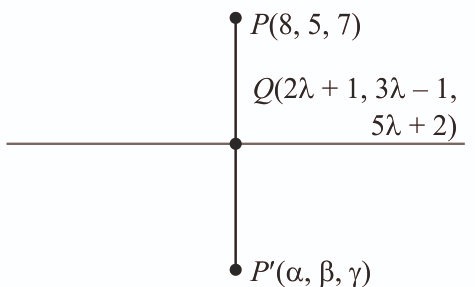
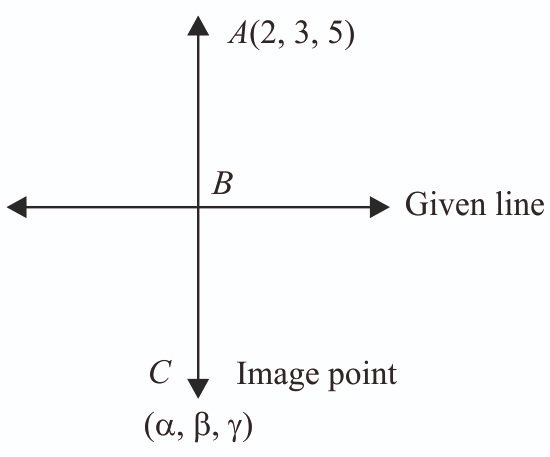
Let (α, β, γ) be the image of the point (8, 5, 7) in the line x–12=y+13=z–25. Then α+β+γ is equal to :          [2024]

  • 16


  • 14


  • 18


  • 20


(2)

Let x–12=y+13=z–25=λ

⇒ x=2λ+1, y=3λ–1 and z=5λ+2

Clearly, PQ→·(2i^+3j^+5k^)=0

⇒ (2λ–7)·2+(3λ–6)·3+(5λ–5)·5=0 

⇒ 38λ=57

⇒ λ=5738=32

∴  (4, 72, 192) are the coordinates of Q.

Now, Q is the midpoint of PP'.

∴  8+α2=4, 5+β2=72, 7+γ2=192

⇒ (α,β,γ)=(0,2,12)

∴  α+β+γ=14.


Q 6 :

The shortest distance between the lines x–32=y+15–7=z–95 and x+12=y–11=z–9–3 is          [2024]

  • 83


  • 53


  • 43


  • 63


(3)

L1 : x–32=y+15–7=z–95

L2 : x+12=y–11=z–9–3

a1→=3i^–15j^+9k^, a2→=–i^+j^+9k^

b1→=2i^–7j^+5k^, b2→=2i^+j^–3k^

Shortest distance = =|(a→2-a→1)·(b→1×b→2)||b→1×b→2|

=|(–4i^+16j^)·|i^j^k^2–7521–3|||b→1×b→2|

=|(–4i^+16j^)·(16i^+16j^+16k^)||16i^+16j^+16k^|=192163=43.


Q 7 :

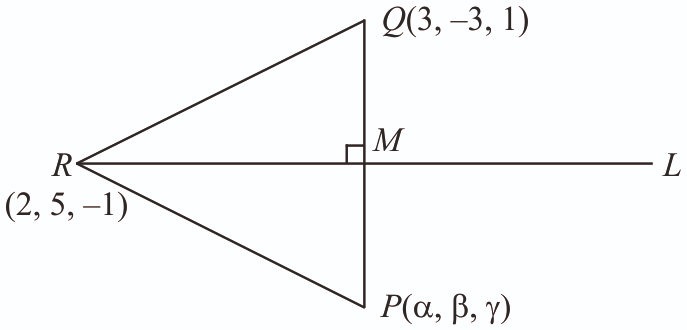
Let P(α, β, γ) be the image of the point Q(3, –3, 1) in the line x–01=y–31=z–1–1 and R be the point (2, 5, –1). If the area of the triangle PQR is λ and λ2=14K, then K is equal to :          [2024]

  • 81


  • 72


  • 36


  • 18


(1)

L : x–01=y–31=z–1–1=μ be the given line.

Any point on L is given by M(μ, μ+3, –μ+1)

Direction ratios of QM=(μ–3, μ+6, –μ)

Direction ratios of L = (1, 1, –1)

Now, QM ⊥ L

So, we have, 1·(μ–3)+1·(μ+6)–1·(–μ)=0

⇒ 3μ+3=0

⇒ μ=–1

So, M(–1, 2, 2) is mid point of PQ.

⇒ α+32=–1, β–32=2, γ+12=2

⇒ P(α,β,γ)≡(–5,7,3)

Area of △PQR=12|PQ→×QR→|

⇒ λ=12||i^j^k^8–10–2–18–2||

⇒ λ=12|36i^+18j^+54k^|

⇒ λ2=14(4536)

⇒ λ2=1134=14K ⇒ k=113414=81.


Q 8 :

If the shortest distance between the lines

L1:r→=(2+λ)i^+(1–3λ)j^+(3+4λ)k^, λ∈R 

L2:r→=2(1+μ)i^+3(1+μ)j^+(5+μ)k^, μ∈R

is mn, where gcd(m, n) = 1, then the value of m + n equals          [2024]

  • 384


  • 387


  • 390


  • 377


(2)

L1:x–21=y–1–3=z–34

L2:x–22=y–33=z–51

∴  a1=2i^+j^+3k^, a2=2i^+3j^+5k^

     n1=i^–3j^+4k^, n2=2i^+3j^+k^

Shortest distance = |(a→2–a→1)·(n→1×n→2)||n→1×n→2|

=|(2j^+2k^)·|i^j^k^1–34231|||n→1×n→2|

=|(2j^+2k^)·(–15i^+7j^+9k^)(15)2+72+92|=32355=mn

On comparing, we get m = 32 and n = 355.

So, m + n = 32 + 355 = 387.


Q 9 :

If the shortest distance between the lines x–λ2=y–43=z–34 and x–24=y–46=z–78 is 1329, then a value of λ is          [2024]

  • –1325


  • 1325


  • 1


  • –1


(3)

We have a→=λi^+4j^+3k^, b→=2i^+4j^+7k^ and p→=2i^+3j^+4k^

Shortest distance, d=|(b→–a→)×p→|p→||

b→–a→=(2–λ)i^+4k^

(b→–a→)×p→=|i^j^k^2–λ04234|

     =i^(–12)–j^(8–4λ–8)+k^(6–3λ)

     =–12i^+4λj^+3(2–λ)k^

∴  d=|144+16λ2+9(2–λ)24+9+16|=1329          (Given)

⇒ 144+16λ2+36+9λ2–36λ=13

⇒ 25λ2–36λ+180=169 ⇒ 25λ2–36λ+11=0

⇒ (25λ–11)(λ–1)=0 ⇒ λ=1125 or 1.


Q 10 :

The shortest distance between the lines x–34=y+7–11=z–15 and x–53=y–9–6=z+21 is           [2024]

  • 179563


  • 185563


  • 187563


  • 178563


(3)

Given lines can be written as

x–34=y–(–7)–11=z–15 and x–53=y–9–6=z–(–2)1

a→1=3i^–7j^+k^, a→2=5i^+9j^–2k^, b→1=4i^–11j^+5k^

and b→2=3i^–6j^+k^

∴  a→2–a→1=2i^+16j^–3k^ and b→1×b→2=|i^j^k^4–1153–61|=19i^+11j^+9k^

Shortest distance between two lines,

d=|(a→2–a→1)·(b→1×b→2)||(b→1×b→2)| ⇒ d=|38+176–27|361+121+81=187563.


Q 11 :

Let the line L intersect the lines x – 2 = – y = z – 1, 2(x + 1) = 2(y –1) = z + 1 and be parallel to the line x–23=y–11=z–22. Then which of the following points lis on L?          [2024]

  • (–13,–1,–1)


  • (–13,1,–1)


  • (–13,–1,1)


  • (–13,1,1)


(2)

L1 : x–21=y–1=z–11=λ

L2 : x+1(1/2)=y–1(1/2)=z+11=μ

Any point on L1 and L2 will be of the form (λ+2,–λ,λ+1) and (μ2–1,μ2+1,μ–1) respectively.

Now direction ratios of line L are given by

< λ–μ2+3, –λ–μ2–1, λ–μ+2>

Also L is parallel to line x–23=y–11=z–22

⇒ λ–μ2+33=–λ–μ2–11=λ–μ+22

⇒ λ–μ2+3=–3λ–3μ2–3        ... (i)    2(λ–μ2+3)=3(λ–μ+2)     ... (ii)}   λ=–43,  μ=–23

∴  Points will be (23,43,–13) and (–43,23,–53)

∴  L is given by x–233=y–431=z+132

Point (–13,1,–1) will satisfy this line L.


Q 12 :

Consider the line L passing through the points (1, 2, 3) and (2, 3, 5). The distance of the point (113,113,193) from the line L along the line 3x–112=3y–111=3z–192 is equal to         [2024]

  • 4


  • 3


  • 5


  • 6


(2)

Equation of line L is given by

x–12–1=y–23–2=z–35–3=λ

i.e., x–11=y–21=z–32=λ

∴  Any point on L is given by (λ+1, λ+2, 2λ+3)

Also, any point of L1 : 3x–112=3y–111=3z–192=μ

is given by (2μ+113,μ+113,2μ+193)

Now, λ+1=2μ+113, λ+2=μ+113, 2λ+3=2μ+193

⇒ 3λ–2μ=8 and 3λ–μ=5

On solving these two equations, we get λ=23 and μ=–3

Point on L is (53,83,133)

Required distance = (113–53)2+(113–83)2+(193–133)2

=4+1+1=3 units.


Q 13 :

If the shortest distance between the lines x–λ–2=y–21=z–11 and x–31=y–1–2=z–21 is 1, then the sum of all possible values of λ is:          [2024]

  • 23


  • 0


  • 33


  • –23


(1)

The shortest distance between the given lines is given by

d=||x2–x1y2–y1z2–z1a1b1c1a2b2c2|(a1b2–a2b1)2+(b1c2–b2c1)2+(c1a2–c2a1)2|

⇒ 1=||3–λ–11–2111–21|(3)2+(3)2+(3)2|

⇒ 1=|(3–λ)(3)+1(–3)+1(3)|27

⇒ 33=33–3λ  or  –33=33–3λ

⇒ λ=0 or 63=3λ ⇒ λ=23

∴  The sum of possible values of λ=0+23=23.


Q 14 :

Let P and Q be the points on the line x+38=y–42=z+12 which are at a distance of 6 units from the point R(1, 2, 3). If the centroid of the triangle PQR is (α,β,γ), then α2+β2+γ2 is :          [2024]

  • 18


  • 24


  • 26


  • 36


(1)

The given equation of line is,

x+38=y–42=z+12=λ (say)

∴  Any point on line is (8λ–3, 2λ+4, 2λ–1)

Now, distance of this point from R(1, 2, 3)

⇒ (8λ–4)2+(2λ+2)2+(2λ–4)2=36

⇒ 72λ2–72λ=0 ⇒ λ(λ–1)=0

⇒ λ=0  or  λ=1

So, coordinates of P = (–3, 4, –1) and coordinates of Q = (5, 6, 1).

Now, centroid of △PQR = (1, 4, 1) ⇒ α=1, β=4, γ=1

So, α2+β2+γ2=18.


Q 15 :

If the mirror image of the point P(3, 4, 9) in the line x-13=y+12=z-21 is (α,β,γ), then 14(α+β+γ) is :          [2024]

  • 102


  • 138


  • 132


  • 108


(4)

Given equation of line is

x–13=y+12=z–21=λ (say)

∴  Any point on line, say m=(3λ+1, 2λ–1, λ+2)

Now, d.r.'s of  PM=<3λ–2, 2λ–5, λ–7> and d.r.'s of given line = <3, 2, 1>  ∵ PM⊥line

∴  3(3λ–2)+2(2λ–5)+1(λ–7)=0

⇒ 14λ=23 ⇒ λ=2314

Now, M is the mid point of P(3, 4, 9) and Q(α,β,γ)

∴  8314=3+α2 ⇒ α=627 ⇒ 167=4+β2 ⇒ β=47

and  5114=9+γ2 ⇒ γ=–127

So, 14(α+β+γ)=14×547=108.


Q 16 :

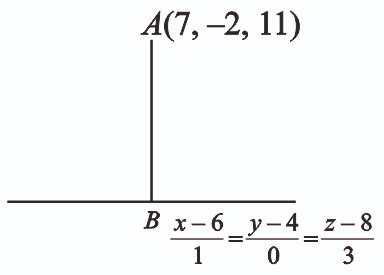
The distance of the point (7, –2, 11) from the line x–61=y–40=z–83 along the line x–52=y–1–3=z–56 is :          [2024]

  • 18


  • 12


  • 21


  • 14


(4)

Let A be the point (7, –2, 11).

Equation of line AB is x–72=y+2–3=z–116=λ

⇒ x=2λ+7, y=–3λ–2 and z=6λ+11

Point B is of the form (2λ+7, –3λ–2, 6λ+11).

Now, point B lies on the line x–61=y–40=z–83

⇒ 2λ+7–61=–3λ–2–40=6λ+11–83

⇒ –3λ–6=0 ⇒ λ=–2

Thus point B is (3, 4, –1).

∴  Required distance = AB=42+(–6)2+122

.=16+36+144=196=14 units.


Q 17 :

If the shortest distance between the lines x–41=y+12=z–3 and x–λ2=y+14=z–2–5 is 65, then the sum of all possible values of λ is :          [2024]

  • 5


  • 7


  • 8


  • 10


(3)

Here x1=4, y1=–1, z1=0 and x2=λ, y2=–1, z2=2

a1=1, b1=2, c1=–3 and a2=2, b2=4, c2=–5

∵  65=||λ–40212–324–5|(–10+12)2+(–6+5)2+(4–4)2|

⇒ 65=|2λ–85|⇒ λ=7 or 1.


Q 18 :

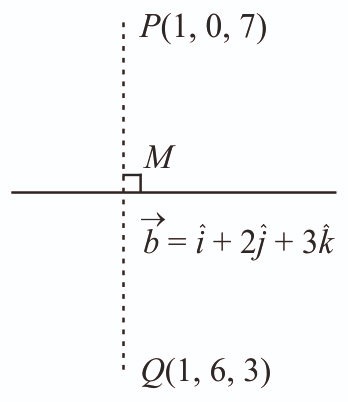
Let the image of the point (1, 0, 7) in the line x1=y–12=z–23 be the point (α, β, γ). Then which one of the following points lies on the line passing through (α, β, γ) and making angles 2π3 and 3π4 with y-axis and z-axis respectively and an acute angle with x-axis?          [2024]

  • (3,–4,3+22)


  • (1,–2,1+2)


  • (1,2,1–2)


  • (3,4,3–22)


(4)

Let L1 : x1=y–12=z–23=λ (say)

⇒ x=λ, y=2λ+1, z=3λ+2

Let the coordinates of M are (λ,2λ+1,3λ+2) lie on the given line.

Let given point is P(1, 0, 7).

∴  Direction ratio of PM are (λ–1,2λ+1,3λ–5) PM is perpendicular the given line L1.

∴  1(λ–1)+2(2λ+1)+3(3λ–5)=0

⇒ λ–1+4λ+2+9λ–15=0

⇒ 14λ–14=0 ⇒ λ=1

∴  The coordinates of M are (1, 3, 5).

∵  M is mid point of PQ.

So, α+12=1,β2=3 and γ+72=5

⇒ α=1, β=6 and γ=3

∴  The image of point P(1, 0, 7) is Q(1, 6, 3).

Now the direction cosine of the line are

m=cos 2π3=cos(π–π3)=–cosπ3=–12

n=cos(3π4)=cos(π–π4)=–12

We know that, l2+m2+n2=1

⇒ l2+14+12=1

⇒ l2=1–14–12=4–1–24=14 ⇒ l=±12

⇒ l=12        (∵  Line make an acute angle with x-axis)

The equation of line passing through (1, 6, 3) with direction cosines 12, –12 and –12 is given by

r→=i^+6j^+3k^+λ(12i^–12j^–12k^)

=(1+λ2)i^+(6–λ2)j^+(3–λ2)k^

Only option (4) satisfied the above equation for λ = 4.


Q 19 :

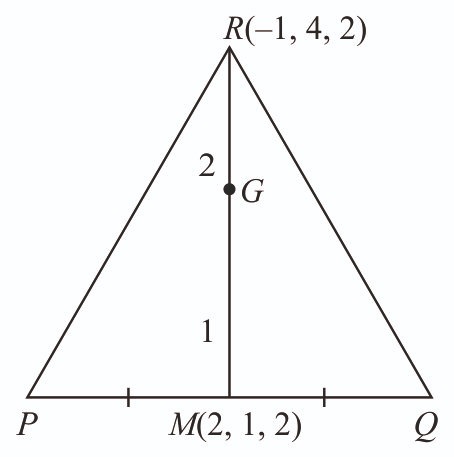
Let PQR be a triangle with R(–1, 4, 2). Suppose M(2, 1, 2) is the mid point of PQ. The distance of the centroid of △PQR from the point of intersection of the lines x–20=y2=z+3–1 and x–11=y+3–3=z+11 is          [2024]

  • 69


  • 69


  • 99


  • 9


(1)

Let centroid G divides MR in the ratio 1 : 2.

So, centroid is given by

 ∴  G(4–13,2+43,4+23) i.e., G(1, 2, 2)

Let l1 : x–20=y2=z+3–1=λ (say)

⇒ x=2,y=2λ,z=–λ–3

l2 : x–11=y+3–3=z+11=r (say)

⇒ x = r + 1, y = –3r – 3, z = r – 1

Now, 2=r+1 ⇒ r=1 and 2λ=–3r–3 ⇒ λ=–3.

∴  Point of intersection of lines l1 and l2 is given by A(2, –6, 0).

∴  Required distance, AG=1+64+4=69.


Q 20 :

Let P(3, 2, 3), Q(4, 6, 2) and R(7, 3, 2) be the vertices of △PQR. Then the angle ∠QPR is          [2024]

  • cos–1(718)


  • cos–1(118)


  • π3


  • π6


(3)

Direction ratios of line PQ = <4 – 3, 6 – 2, 2 – 3> = <1, 4, –1>

Direction ratios of line PR = <7 – 3, 3 – 2, 2 – 3> = <4, 1, –1>

Let θ be the required angle.

∴  cos θ=|1×4+4×1+(–1)×(–1)1+16+116+1+1|=|918|=12

⇒ θ=cos–1(12)=π3      ∴  ∠QPR=π3.


Q 21 :

Let (α, β, γ) be the foot of the perpendicular from the point (1, 2, 3) on the line x+35=y–12=z+43. Then 19(α+β+γ) is equal to          [2024]

  • 100


  • 99


  • 101


  • 102


(3)

Let x+35=y–12=z+43=λ

⇒ (α, β, γ)=(5λ–3,2λ+1,3λ–4)

Let B(α, β, γ) be the foot of perpendicular from A on the given line

Now, 5i^+2j^+3k^ is the direction vector of given line.

⇒ AB→·(5i^+2j^+3k^)=0

⇒ (5λ–4)5+(2λ–1)2+(3λ–7)3=0

⇒ 25λ+4λ+9λ=20+2+21

⇒ 38λ=43 ⇒ λ=4338

∴  19(α+β+γ)=19(5λ–3+2λ+1+3λ–4)=19(10λ–6)

=19(10×4338–6)=215–114=101.


Q 22 :

Let L1:r→=(i^–j^+2k^)+λ(i^–j^+2k^), λ∈R

L2:r→=(j^–k^)+μ(3i^+j^+pk^), μ∈R

L3:r→=δ(li^+mj^+nk^), δ∈R

be three lines such that L1 is perpendicular to L2 and L3 is perpendicular to both L1 and L2. Then, the point which lies on L3 is          [2024]

  • (1, –7, 4)


  • (–1, 7, 4)


  • (–1, –7, 4)


  • (1, 7, –4)


(2)

Given, L1 : r→=(i^–j^+2k^)+λ(i^–j^+2k^), λ∈R

L2 : r→=(j^–k^)+μ(3i^+j^+pk^), μ∈R

and L3 : r→=δ(li^+mj^+nk^), δ∈R

since, L1 is perpendicular to L2.

∴  (i^–j^+2k^)·(3i^+j^+pk^)=0

⇒ 3–1+2p=0 ⇒ p=–1

Also, L3 is perpendicular to both L1 and L2.

∴  L3 is parallel to (i^–j^+2k^)×(3i^+j^+pk^)

Now, (i^–j^+2k^)×(3i^+j^+pk^)

=|i^j^k^1–1231p|=i^(–p–2)–j^(p–6)+k^(1+3)

=–i^+7j^+4k^                                                           (∵p=-1)

∴  li^+mj^+nk^=–i^+7j^+4k^

⇒ l=–1, m=7 and n=4

∴  (–1,7,4) lies on L3.


Q 23 :

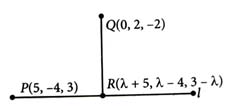
The distance of the point Q(0, 2, –2) from the line passing through the point P(5, –4, 3) and perpendicular to the lines r→=(–3i^+2k^)+λ(2i^+3j^+5k^), λ∈R and r→=(i^–2j^+k^)+μ(–i^+3j^+2k^), μ∈R is :          [2024]

  • 74


  • 54


  • 86


  • 20


(1)

Given, r→=(–3i^+2k^)+λ(2i^+3j^+5k^)

and r→=(i^–2j^+k^)+μ(–i^+3j^+2k^)

b→1×b→2=|i^j^k^235–132|

b→1×b→2=i^(6–15)–j^(4+5)+k^(6+3)

b→1×b→2=–9i^–9j^+9k^

Then the equation of the line

l=x–51=y+41=z–3–1=λ

x=λ+5; y=λ–4; z=3–λ

∴  QR→·l=0

    (λ+5)·1+(λ–6)1+(3–λ+2)(–1)=0

    λ+5+λ–6+(–5)+λ=0

    λ+5+λ–6–5+λ=0

    3λ–6=0

    λ=63

    λ=2

Then, R = (7, –2, 1)

      QR=49+16+9 ⇒ QR=74.


Q 24 :

Let (α, β, γ) be the mirror image of the point (2, 3, 5) in the line x–12=y–23=z–34. Then 2α+3β+4γ is equal to          [2024]

  • 34


  • 32


  • 31


  • 33


(4)

Given equation of the line is x–12=y–23=z–34

Let A(2, 3, 5) be the given point and let B be the foot of the perpendicular drawn from the point A on the line

x–12=y–23=z–34=λ, λ∈R

⇒ x=2λ+1,y=3λ+2,z=4λ+3

∴  B≡(2λ+1,3λ+2,4λ+3)

Direction ratios of AB are 2λ–1,3λ–1,4λ–2.

Now, AB is perpendicular to the given line.

∴  2(2λ–1)+3(3λ–1)+4(4λ–2)=0

⇒ 4λ–2+9λ–3+16λ–8=0

⇒ 29λ–13=0 ⇒ λ=1329

∴  Coordinates of B are (5529,9729,13929)

Now, using mid point formula,

5529=2+α2; 9729=3+β2;13929=5+γ2

⇒ α=5229, β=10729, γ=13329

∴  2α+3β+4γ=2×5229+3×10729+4×13329=95729=33.


Q 25 :

The shortest distance, between lines L1 and L2, where L1:x–12=y+1–3=z+42 and L2 is the line, passing through the points A(–4, 4, 3), B(–1, 6, 3) and perpendicular to the line x–3–2=y3=z–11, is          [2024]

  • 141221


  • 42117


  • 121221


  • 24117


(1)

We have, L1=x–12=y+1–3=z+42

Equation of the line passing through the points A(–4, 4, 3) and B(–1, 6, 3) is

L2=x+43=y–42=z–30

Here, a1=2,b1=–3,c1=2; x1=1,y1=–1,z1=–4

a2=3,b2=2,c2=0; x2=–4,y2=4,z2=3

∴  Required shortest distance

d=||–5572–32320|(4+9)2+(0–4)2+(6–0)2|

=|–5(0–4)–5(0–6)+7(4+9)169+16+36|=|20+30+91221|=141221.


Q 26 :

If the shortest distance between the lines x+22=y+33=z–54 and x–31=y–2–3=z+42 is 3835k, and ∫0k[x2]dx=α–α, where [x] denotes the greatest integer function, then 6α3 is equal to __________.          [2024]


(48)

L1 : x+22=y+33=z–54

L2 : x–31=y–2–3=z+42

∴  a→1=–2i^–3j^+5k^, a→2=3i^+2j^–4k^

  b→1=2i^+3j^+4k^, b→2=i^–3j^+2k^

Now,   a→2–a→1=5i^+5j^–9k^

Shortest distance between the lines = |(a→2–a→1)·(b→1×b→2)|b→1×b→2|| and |b→1×b→2|=|i^j^k^2341–32|

=i^(6+12)–j^(4–4)+k^(–6–3)=18i^–9k^

d=|(5i^+5j^–9k^)·(18i^–9k^)324+81|=|90+8195|=17195

From the question, we get 3835k=17195 ⇒ k=32

∴  ∫0k[x2]dx=∫032[x2]dx=∫010dx+∫121dx+∫2322dx

=0+(2–1)+2(32–2)=2–1+3–22=2–2

=α–α          (Given)

Hence, α=2

∴  6α3=6×8=48.


Q 27 :

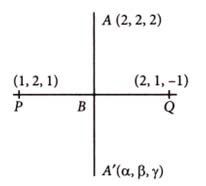
Consider a line L passing through the points P(1, 2, 1) and Q(2, 1, –1). If the mirror image of the point A(2, 2, 2) in the line L is (α, β, γ), then α+β+6γ is equal to __________.          [2024]


(6)

PQ : x–11=y–2–1=z–1–2=λ (say)

Any point on the line PQ is of the form

B(λ+1,–λ+2,–2λ+1)

 AB→=(λ+1–2)i^+(–λ+2–2)j^+(–2λ+1–2)k^

⇒ AB→=(λ–1)i^–λj^+(–2λ–1)k^  and  PQ→=1i^–j^–2k^

AB→·PQ→=0

⇒ (λ–1)+λ+2(2λ+1)=0

⇒ λ–1+λ+4λ+2=0

⇒ 6λ=–1 ⇒ λ=–16

∴  B(–16+1,16+2,–2(–16)+1)=B(56,136,86)

Now B is mid point of AA'

⇒ (56,136,86)=(α+22,β+22,γ+22)

⇒ α+2=106, β+2=266, γ+2=166

⇒ α=–13, β=73, γ=23

Hence, α+β+6γ=–13+73+6×23=183=6.


Q 28 :

Let the point (–1, α, β) lie on the line of the shortest distance between the lines x+2–3=y–24=z–52 and x+2–1=y+62=z–10. Then (α–β)2 is equal to _________.          [2024]


(25)

Let L1 : x+2–3=y–24=z–52 and L2 : x+2–1=y+62=z–10

Let P(–3λ–2,4λ+2,2λ+5) be point on L1 and Q(–μ–2,2μ–6,1) be point on L2.

Direction ratios of PQ = (3λ–μ,2μ–4λ–8,–2λ–4)

Also, PQ→=|i^j^k^–342–120|=–4i^–2j^–2k^

i.e., 2i^+j^+k^

⇒ 3λ–μ2=2μ–4λ–81=–2λ–41

⇒ 3λ–μ=–4λ–8 and 2μ–4λ–8=–2λ–4

⇒ μ=7λ+8 and μ=λ+2

⇒ λ=–1 and μ=1

∴  Equation of PQ is, x+32=y+41=z–11

Now, (–1, α, β) lies on PQ

⇒ 1=α+4=β–1

⇒ α=–3, β=2

∴  (α–β)2=25.


Q 29 :

Let P be the point (10, –2, –1) and Q be the foot of the perpendicular drawn from the point R(1, 7, 6) on the line passing through the points (2, –5, 11) and (–6, 7, –5). Then the length of the line segment PQ is equal to __________.          [2024]


(13)

Equation of line passing through (2, –5, 11) and (–6, 7, –5) is

L : x+68=y–7–12=z+516

i.e., x+62=y–7–3=z+54=λ          ... (i)

⇒ any point Q on the given line is (2λ–6,–3λ+7,4λ–5)

Now, D.r.'s of QR = (2λ–7,–3λ,4λ–11)

Since QR is perpendicular to L

⇒ 2(2λ–7)–3(–3λ)+4(4λ–11)=0

⇒ 29λ–58=0 ⇒ λ=2

So Q(–2, 1, 3) is the required point

and |PQ→|=(–2–10)2+(1+2)2+(3+1)2 = 169=13.


Q 30 :

If the shortest distance between the lines x–λ3=y–2–1=z–11 and x+2–3=y+52=z–44 is 4430, then the largest possible value of |λ| is equal to __________.          [2024]


(43)

We have, a1→=λi^+2j^+k^, a2→=–2i^–5j^+4k^

n1→=3i^–j^+k^, n2→=–3i^+2j^+4k^

Now, n1→×n2→=|i^j^k^3–11–324|=–6i^–15j^+3k^

Shortest distance between lines = |(a2→–a1→)·(n1→×n2→)|n1→×n2→||

⇒ 4430=|(–2–λ)i→–7j→+3k→)·(–6i→–15j→+3k→)36+225+9|

⇒ 4430=|–6(–2–λ)+105+9270|⇒|6λ+126270|=4430

⇒ |6λ+126|=132 ⇒|λ+21|=22

⇒ λ+21=±22 ⇒ |λ|max=43.