

Q 1 :

If a substance ‘A’ dissolves in solution of a mixture of ‘B’ and ‘C’ with their respective number of moles as nA,nB and nC. Mole fraction of C in the solution is   [2024]

  • nCnA×nB×nC


  • nCnA+nB+nC


  • nCnA-nB-nC


  • nBnA+nB


(2)

Mole fraction of any substance = Moles of that substanceTotal number of moles


Q 2 :

The Molarity (M) of an aqueous solution containing 5.85 g of NaCl in 500 mL water is:
(Given: Molar Mass Na : 23 and Cl : 35.5 gmol-1)                     [2024]

  • 0.2


  • 20


  • 4


  • 2


(1)

Assuming volume of solution same as volume of water,

Vsolution=500mL=0.5L

nsolute=WsoluteMsolute=5.85g58.5g mol-1=0.1mol

M=nsoluteVsolution(in L)=0.1mol0.5L=0.2M


Q 3 :

The density of ‘x’ M solution (‘x’ molar) of NaOH is 1.12 g mL-1, while in molality, the concentration of the solution is 3 m (3 molal). Then x is (Given: Molar mass of NaOH is 40 g/mol)                        [2024]

  • 3.8


  • 3.5


  • 2.8


  • 3.0


(4)

molality=1000×Molarity1000×density-Molarity×Msolute

3=1000x1000×1.12-x×40

3360-120x=1000x

1120x=3360

x=3


Q 4 :

Molality (m) of 3 M aqueous solution of NaCl is:
(Given: Density of solution = 1.25 g mL-1, Molar mass in g mol-1: Na - 23, Cl - 35.5)                  [2024]

  • 2.90 m


  • 2.79 m


  • 1.90 m


  • 3.85 m


(2)

     3M aqueous NaCl means:

     3 mol NaCl in 1000 mL solution

     3×58.5g=175.5g NaCl in 1.25g mL-1×1000mL-1250g solution

     3mol NaCl in (1250-175.5)g=1074.5g=1.074kg solution

     m=nsoluteVsolvent(in kg)=31.0745m=2.79m


Q 5 :

Volume of 3 M NaOH (formula weight 40 g mol-1) which can be prepared from 84 g of NaOH is ______ ×10-1 dm3.               [2024]


(7)

     Moles of NaOH (nNaOH)=Given massMolar mass=84g40g mol-1=2.1mol

     Molarity of NaOH×Volume of NaOH in L=Moles of NaOH

     3mol L-1×Volume of NaOH in L=2.1mol

     Volume of NaOH in L=0.7L or 0.7dm3=7×10⁻¹dm3


Q 6 :

A solution of H2SO4 is 31.4% H2SO4 by mass and has a density of 1.25 g/mL. The molarity of the H2SO4 solution is _____ M (nearest integer)

[Given molar mass of H2SO4 = 98 g mol-1]                     [2024]


(4)

       31.4%H2SO4by mass means:

       31.4gm H2SO4in 100gm solution

       31.498mol=0.32mol H2SO4in100g1.25g mL-1

                                  =80mL solution

        Molarity=nsoluteVsolution(in mL)×1000=0.3280×1000M=4M


Q 7 :

Molality of 0.8 M H2SO4 solution (density 1.06 g cm-3) is ______ ×10-3 m.                   [2024]


(815)

           m=M×1000d×1000-M×Msolute=0.8×10001.06×1000-0.8×98m

                                                               =815×10-3m


Q 8 :

The mass of sodium acetate (CH3COONa) required to prepare 250 mL of 0.35 M aqueous solution is _____ g.
(Molar mass of CH3COONa is 82.02 g mol-1)                     [2024]


(7)

       Volume of solution (V)=250mL=0.25L.

        Moles of CH3COONa (n)

                 =Molarity×volume=0.35molL×0.25L=0.0875mol

        Mass of CH3COONa

                 =n×molar mass=0.0875mol×82.02gmol=7.177g


Q 9 :

The molarity of 1 L orthophosphoric acid (H3PO4) having 70% purity by weight (specific gravity 1.54 g cm-3) is ______ M.
(Molar mass of H3PO4 = 98 g mol-1)                       [2024]


(11)

        70% w/w H3PO4 solution means:

        70 g H3PO4 in 100 g solution

       7098 mol H3PO4 in 1001.54 mL solution

         M=nsoluteVsolution(in mL)×1000

        M=70/98100/1.54×1000 M=70×1.54×100098×100 M=11M


Q 10 :

Molality of an aqueous solution of urea is 4.44 m. Mole fraction of urea in solution is x×10-3. Value of x is _____ (integer answer)             [2024]


(74)

            m=xsolute×1000xsolvent×Msolvent

            4.44=xurea×1000xwater×18

           xureaxwater=79.921000

            xurea=79.9279.92+1000=74×10-3


Q 11 :

A solution is prepared by adding 1 mole ethyl alcohol in 9 mole water. The mass percent of solute in the solution is ______ (Integer Answer)

(Given: Molar mass in g mol-1 Ethyl alcohol : 46, water : 18)                      [2024]


(22)

             WC2H5OH=nC2H5OH×MC2H5OH=1mol×46g mol-1=46g

             WH2O=nH2O×MH2O=9mol×18g mol-1=162g

             Mass percent of solute=WsoluteWsolution×100

                                                        =WC2H5OHWH2O+WC2H5OH×100

                                                        =46162+46×100=22.11%22%


Q 12 :

Molarity (M) of an aqueous solution containing x g of anhyd. CuSO4 in 500 mL solution at 32°C is 2×10⁻¹ M. Its molality will be _____ ×10-3m. (nearest integer).


[Given density of the solution = 1.25 g/mL]                       [2024]


(164)

                Wsolution=dsolution×Vsolution=1.25gmL×500mL=625g

                nsolute=Molaritysolution×Vsolution=2×10-1M×0.5L=0.1mol

               Wsolute=nsolute×molar mass of solute=0.1mol×159.5gmol-1=15.95g

              Wsolvent=Wsolution-Wsolute=625g-15.95g=609.05g

              m=nsolute×1000Wsolvent(in g)=0.1×1000609.05m=0.1642m=164×10-3m


Q 13 :

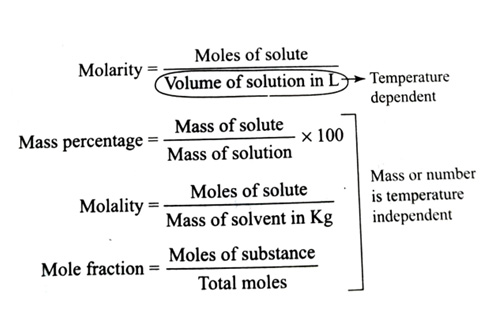
The quantity which changes with temperature is:                       [2024]

  • Molarity


  • Mass percentage


  • Molality


  • Mole fraction


(1)


Q 14 :

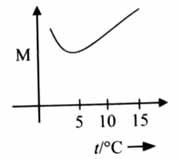
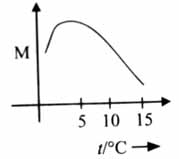
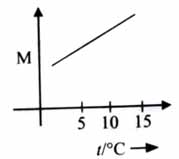
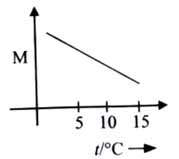
‘x’ g of NaCl is added to water in a beaker with a lid. The temperature of the system is raised from 1°C to 25°C. Which out of the following plots, is best suited for the change in the molarity (M) of the solution with respect to temperature?

[Consider the solubility of NaCl remains unchanged over the temperature range]             [2025]

  •  

  •  

  •  

  •  

(2)

Density of water is maximum at 4°C. This is because from 0°C to 4°C, hydrogen bonds break and molecules come closer. After 4°C volume increases due to thermal expansion. Thus from 1°C to 4°C, volume of solution decreases and hence molarity increases. Heating the solution beyond 4°C increases its volume hence the molarity decreases.


Q 15 :

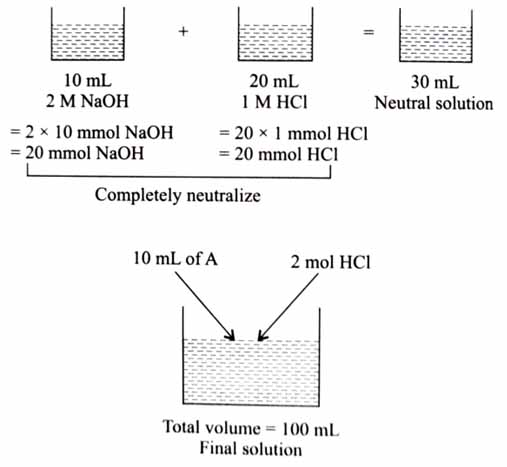
10 mL of 2 M NaOH solution is added to 20 mL of 1 M HCl solution kept in a beaker. Now, 10 mL of this mixture is poured into a volumetric flask of 100 mL containing 2 moles of HCl and made the volume upto the mark with distilled water. The solution in this flask is :                 [2025]

  • 0.2 M NaCl solution


  • 20 M HCl solution


  • 10 M HCl solution


  • Neutral solution


(2)

Final solution contains 2 mol HCl in 100 mL of solution (0.1 L solution). So concentration of final solution is nHClVsolution (inL) =20.1M =20 M


Q 16 :

20 mL of 2 M NaOH solution is added to 400 mL of 0.5 M NaOH solution. The final concentration of the solution is ______ ×10-2 M. (Nearest integer)           [2025]


(57)

Final concentration=M1V1+M2V2V1+V2

                                     =2×20+0.5×40020+400M

                                     =240420M=0.571 M=57.1×10⁻²M


Q 17 :

Fortification of food with iron is done using FeSO4.7H2O. The mass in grams of the FeSO4.7H2O required to achieve 12 ppm of iron in 150 kg of wheat is _____ (Nearest integer)

[Given: Molar mass of Fe, S and O respectively are 56, 32 and 16 g mol-1]               [2025]


(9)

ppm=wironwwheat×106

12=wiron150×106

wiron=12×150106kg=12×150106×1000 g=1.8 g

Moles of iron=WironMiron=1.856mol

Moles of FeSO4.7H2O=Moles of iron=1.856mol

Molar mass of FeSO4.7H2O=56+32+4×16+7×18=278 g/mol

Mass of FeSO4.7H2O=moles of FeSO4.7H2O×molar mass of FeSO4.7H2O=1.856×278 g=8.935 gm9 gm


Q 18 :

Sea water, which can be considered as a 6 molar (6 M) solution of NaCl, has a density of 2 g mL-1.

The concentration of dissolved oxygen (O2) in sea water is 5.8 ppm. Then the concentration of dissolved oxygen (O2) in sea water, is x×10-4 m.

x = _______. (Nearest integer)

Given: Molar mass of NaCl is 58.5 g mol-1

Molar mass of O2 is 32 g mol-1                             [2025]


(2)

(i) 6M NaCl solution means 6 mol NaCl in 1000 mL solution

i.e. 6mol NaCl in 1000 mL×2g mL-1solution

i.e. 6mol NaCl in 2000 g solution

i.e. 6×58.5g NaCl in 2000 g solution

i.e. 351g NaCl in 2000 g water.

(ii) ppm of O2=WO2Wsolvent×106

5.8=WO22000×106

WO2=5.8×2000106=0.0116 g

(iii) Mass of solvent in 2000 g solution (Wsolvent)

=Wsolution-WNaCl-WO2

=2000-351-0.0116=1648.9884 g

Molality of oxygen (m)=WO2×1000MO2×Wsolvent

=0.0116×100032×1648.9884=2.19×10⁻⁴


Q 19 :

What is the mass ratio of ethylene glycol (C2H6O2, molar mass = 62 g/mol) required for making 500 g of 0.25 molal aqueous solution and 250 mL of 0.25 molal aqueous solution?             [2023]

  • 1 : 2


  • 1 : 1


  • 3 : 1


  • 2 : 1


(4)

Millimoles of 1st caseMillimoles of 2nd case=500×0.25250×0.25=21=2:1


Q 20 :

A solution is prepared by adding 2 g of “X” to 1 mole of water. Mass percent of “X” in the solution is                 [2023]

  • 20%


  • 5%


  • 2%


  • 10%


(4)

Mass % of A in solution=WASsolution×100

                                              =220×100=10%


Q 21 :

Given below are two statements: one is labelled as Assertion A and the other is labelled as Reason R

Assertion A: 3.1500 g of hydrated oxalic acid dissolved in water to make 250.0 mL solution will result in 0.1 M oxalic acid solution.

Reason R: Molar mass of hydrated oxalic acid is 126 g mol-1.

In the light of the above statements, choose the correct answer from the options given below:              [2023]

  • A is true but R is false


  • Both A and R are true and R is the correct explanation of A


  • A is false but R is true


  • Both A and R are true but R is not the correct explanation of A


(2)

Molarity (M)=wtM.wt×1000V(mL)

                        =3.15126×1000250=0.1

Reason is correct as it is used as a fact in the explanation of Assertion.


Q 22 :

The density of 3 M solution of NaCl is 1.0 g mL-1. Molality of the solution is ______ ×10-2 m. (Nearest Integer).

Given: Molar mass of Na and Cl is 23 and 35.5 g mol-1 respectively.                          [2023]


(364)

Molality (m)=M×10001000×d-M×Msolute

                       =(3×10001000×1-3×58.5)

                        =3.6386 m

                        =363.86×10⁻²m=364


Q 23 :

A 300 mL bottle of soft drink has 0.2 M CO2 dissolved in it. Assuming CO2 behaves as an ideal gas, the volume of the dissolved CO2 at STP is ______ mL. (Nearest Integer)

Given: At STP, molar volume of an ideal gas is 22.7 L mol-1.                     [2023]


(1362)

Number of moles of CO2=M×V×10-3

                                                 =0.2×300×10-3=0.06 mole

Volume of CO2 (at STP)=0.06×22.7

                                                =1.362 L=1362 mL


Q 24 :

20 mL of calcium hydroxide was consumed when it was reacted with 10 mL of unknown solution of H2SO4. Also 20 mL standard solution of 0.5 M HCl containing 2 drops of phenolphthalein was titrated with calcium hydroxide, the mixture showed pink colour when burette displayed the value of 35.5 mL whereas the burette showed 25.5 mL initially.
The concentration of H2SO4 is ______ M. (Nearest integer)                   [2023]


(1)

(i)               Ca(OH)2+2HClCaCl2+2H2O

Millimole           M1×10    (2×M1)10

Millimole of HCl = (2×M1)10=0.5×20

                          MCa(OH)2 of HCl=0.5 M

(ii) With H2SO4⇒Ca(OH)2+H2SO4CaSO4+2H2O

                                 0.5×2    (M2×10)

                                 M2×10=0.5×20

                                 M2=1

Molarity of H2SO4=1


Q 25 :

The number of units, which are used to express concentration of solution from the following is ______. Mass percent, Mole fraction, Molarity, ppm, Molality          [2023]


(5)

Mole fraction, molarity, molality, mass % and ppm describes the concentration of solution.


Q 26 :

A solution of sugar is obtained by mixing 200 g of its 25% solution and 500 g of its 40% solution (both by mass). The mass percentage of the resulting sugar solution is ______ (Nearest integer).                             [2023]


(36)

Total mass of sugar in mixture of 25% of 200 and 40% of 500 g

Sugar in solution=0.25×200+0.40×500

                                  =50+200=250 g

Total mass of solution=200+500=700 g

Mass of sugar in solution=250700×100=35.7%

                                                 36%


Q 27 :

Assume a living cell with 0.9% (ω/ω) of glucose solution (aqueous). This cell is immersed in another solution having equal mole fraction of glucose and water.

(Consider the data upto first decimal place only) The cell will :                [2025]

  • shrink since solution is 0.5% (ω/ω)


  • shrink since solution is 0.45% (ω/ω) as a result of association of glucose molecules (due to hydrogen bonding)


  • swell up since solution is 1% (ω/ω)


  • show no change in volume since solution is 0.9% (ω/ω)


(4)