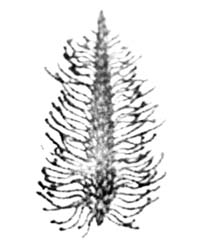


Q 1 :

Identify the set of correct statements                                                                    [2024]

A. The flowers of Vallisneria are colourful and produce nectar.
B. The flowers of water lily are not pollinated by water.
C. In most of water-pollinated species, the pollen grains are protected from wetting.
D. Pollen grains of some hydrophytes are long and ribbon like.
E. In some hydrophytes, the pollen grains are carried passively inside water.

Choose the correct answer from the options given below

  • C, D and E only


  • A, B, C and D only


  • A, C, D and E only


  • B, C, D and E only


(4)

Vallisneria is a water-pollinated plant, therefore flowers are neither colourful nor produce nectar for pollination. These characters are attributed to insect pollinated flowers.


Q 2 :

Identify the correct description about the given figure.                             [2024]

  • Wind pollinated plant inflorescence showing flowers with well exposed stamens.


  • Water pollinated flower showing stamens with mucilaginous covering.


  • Cleistogamous flowers showing autogamy.


  • Compact inflorescence showing complete autogamy.


(1)

The given figure represents a compact inflorescence with well-exposed stamens of wind-pollinated plant.


Q 3 :

In which of the following sets of families, the pollen grains are viable for months?                 [2023]

  • Solanaceae, Poaceae and Liliaceae


  • Brassicaceae, Liliaceae and Poaceae


  • Rosaceae, Liliaceae and Poaceae


  • Leguminosae, Solanaceae and Rosaceae


(4)

In some members of Families Rosaceae, Leguminosae and Solanaceae, pollen grains maintain viability for months.


Q 4 :

Transfer of pollen grains from anther to stigma of another flower of same plant is known as             [2023]

  • geitonogamy


  • xenogamy


  • autogamy


  • cleistogamy


(1)

Geitonogamy involves transfer of pollen grains from the anther to the stigma of another flower of the same plant. Autogamy is a type of self-pollination in which an intersexual or perfect flower is pollinated by its own pollen, i.e., it involves the transfer of pollen grains from anther to stigma of the same flower. Xenogamy involves transfer of pollen grains from anther to the stigma of a different plant. Cleistogamy is a phenomenon in which flowers do not open at all, therefore show self-fertilisation and autogamy.


Q 5 :

In angiosperms, the correct sequence of events in formation of female gametophyte in the ovule is                    [2023]

(A) 3 successive free nuclear divisions of functional megaspore.
(B) Degeneration of 3 megaspores.
(C) Meiotic division in megaspore mother cell.
(D) Migration of 3 nuclei towards each pole.
(E) Formation of wall resulting in seven celled embryo sac.

Choose the correct answer from the options given below.

  • (A), (B), (C), (D), (E)


  • (C), (E), (A), (D), (B)


  • (B), (C), (A), (D), (E)


  • (C), (B), (A), (D), (E)


(4)

The sequence of events in formation of female gametophyte in the ovule in an angiosperm is as follows:
(i) Megaspore mother cell or megasporocyte is a diploid (2n) cell which undergoes meiosis to form a linear tetrad of four haploid megaspores (n).

(ii) Normally, the chalazal megaspore is the functional megaspore while the other three degenerate. The functional megaspore is the first cell of female gametophyte.

(iii) The nucleus of the functional megaspore divides mitotically to form two nuclei which move to the opposite poles, forming 2-nucleate embryo sac. Two more sequential mitotic nuclear divisions result in the formation of the 4-nucleate and later the 8-nucleate stages of the embryo sac. These mitotic divisions are strictly free nuclear, which means nuclear divisions are not followed immediately by cell wall formation.

(iv) Out of 8 nuclei, 4 nuclei are arranged at each pole. One nucleus from each pole migrates to the centre to form two polar nuclei. Cell walls are laid down leading to the organisation of the typical female gametophyte or embryo sac with 7-cells.


Q 6 :

What is the function of tassels in the corn cob?               [2023]

  • To disperse pollen grains


  • To protect seeds


  • To attract insects


  • To trap pollen grains


(4)

The tassels in the corn cob are stigma and style that wave in the wind to trap pollen grains.


Q 7 :

Large, colourful, fragrant flowers with nectar are seen in                      [2023]

  • bat pollinated plants


  • wind pollinated plants


  • insect pollinated plants


  • bird pollinated plants


(3)


Q 8 :

Identify the incorrect statement related to pollination.                    [2022]

  • Pollination by water is quite rare in flowering plants.


  • Pollination by wind is more common amongst abiotic pollination.


  • Flowers produce foul odours to attract flies and beetles to get pollinated.


  • Moths and butterflies are the most dominant pollinating agents among insects.


(4)

Among the animals, insects, particularly bees are the dominant biotic pollinating agents.


Q 9 :

The term used for transfer of pollen grains from anthers of one plant to stigma of a different plant which, during pollination, brings genetically different types of pollen grains to stigma, is                     [2021]

  • cleistogamy


  • xenogamy


  • geitonogamy


  • chasmogamy


(2)


Q 10 :

A typical angiosperm embryo sac at maturity is                 [2021]

  • 8-nucleate and 8-celled


  • 8-nucleate and 7-celled


  • 7-nucleate and 8-celled


  • 7-nucleate and 7-celled


(2)

A typical angiosperm embryo sac is 7 celled and 8 nucleate structure.


Q 11 :

In some members of which of the following pairs of families, pollen grains retain their viability for months after release?          [2021]

  • Rosaceae : Leguminosae


  • Poaceae : Rosaceae


  • Poaceae : Leguminosae


  • Poaceae : Solanaceae


(1)

In some members of families Rosaceae, Leguminosae and Solanaceae, pollen grains maintain viability for months.


Q 12 :

The plant parts which consist of two generations—one within the other                      [2020]
(1) pollen grains inside the anther
(2) germinated pollen grain with two male gametes
(3) seed inside the fruit
(4) embryo sac inside the ovule

  • (1) only


  • (1), (2), and (3)


  • (3) and (4)


  • (1) and (4)


(4)


Q 13 :

In water hyacinth and water lily, pollination takes place by                [2020]

  • insects or wind


  • water currents only


  • wind and water


  • insects and water.


(1)

In many aquatic plants with emergent flowers, pollination occurs by wind or insects, e.g., lotus, water lily, water hyacinth.


Q 14 :

Which is the most common type of embryo sac in angiosperms?             [2019]

  • Tetrasporic with one mitotic stage of divisions


  • Monosporic with three sequential mitotic divisions


  • Monosporic with two sequential mitotic divisions


  • Bisporic with two sequential mitotic divisions


(2)


Q 15 :

What type of pollination takes place in Vallisneria?                [2019]

  • Pollination occurs in submerged condition by water.


  • Flowers emerge above surface of water, and pollination occurs by insects.


  • Flowers emerge above water surface, and pollen is carried by wind.


  • Male flowers are carried by water currents to female flowers at surface of water.


(4)

In Vallisneria, the female flower reaches the surface of water by the long stalk and the male flowers or pollen grains are released on to the surface of water. They are carried passively by water currents, some of them eventually reach the female flowers and the stigma.


Q 16 :

In which one of the following, both autogamy and geitonogamy are prevented?                   [2019]

  • Wheat  


  • Papaya


  • Castor  


  • Maize


(2)


Q 17 :

Pollen grains can be stored for several years in liquid nitrogen having a temperature of                 [2018]

  • –120°C 


  • –80°C


  • –196°C 


  • –160°C


(3)

Pollen grains can be stored for several years in liquid nitrogen at -196°C. This is also known as cryopreservation.


Q 18 :

Which of the following has proved helpful in preserving pollen as fossils?                     [2018]

  • Pollenkitt  


  • Cellulosic intine


  • Oil content 


  • Sporopollenin


(4)

Exine of pollen grain is made up of highly resistant fatty substance called sporopollenin, which is not degraded by any enzyme. It is not affected by high temperature, strong acid or strong alkali. Because of the sporopollenin, pollen grains are well preserved as microfossils.


Q 19 :

Winged pollen grains are present in                     [2018]

  • mustard  


  • Cycas


  • mango   


  • Pinus


(4)

Each pollen grain of Pinus has two wing like structures which enable it to float in air, as an adaptation for dispersal by wind. Pollen grains of mustard, Cycas and mango are not winged.


Q 20 :

Functional megaspore in an angiosperm develops into an                       [2017]

  • endosperm  


  • embryo sac


  • embryo 


  • ovule


(2)

In angiosperms, the functional megaspore is the first cell of female gametophyte. It enlarges and undergoes three nuclear mitotic divisions to form embryo sac.


Q 21 :

Attractants and rewards are required for               [2017]

  • entomophily  


  • hydrophily


  • cleistogamy  


  • anemophily


(1)

Entomophily is the most common type of zoophily where pollination takes place through the agency of insects. Entomophilous flowers are brightly coloured and secrete nectar to attract visiting insects.
Anemophily (wind pollination) and hydrophily (water pollination) do not require attractants or rewards due to the involvement of abiotic pollinating agents. Cleistogamy is self-pollination in closed flowers.


Q 22 :

Flowers which have single ovule in the ovary and are packed into inflorescence are usually pollinated by                 [2017]

  • bee  


  • wind


  • bat  


  • water


(2)

Single ovule in the ovary and flowers packed into inflorescence are characteristics of wind pollinated flowers.


Q 23 :

A dioecious flowering plant prevents both                                       [2017]

  • autogamy and geitonogamy


  • geitonogamy and xenogamy


  • cleistogamy and xenogamy


  • autogamy and xenogamy


(1)

Dioecious plants are those plants in which male flowers and female flowers are borne on different plants. Therefore, they prevent both autogamy and geitonogamy.


Q 24 :

In majority of angiosperms,                              [2016]

  • egg has a filiform apparatus


  • there are numerous antipodal cells


  • reduction division occurs in the megaspore mother cells


  • a small central cell is present in that embryo sac


(3)


Q 25 :

Pollination in water hyacinth and water lily is brought about by the agency of                  [2016]

  • water  


  • insects or wind


  • birds  


  • bats


(2)


Q 26 :

The ovule of an angiosperm is technically equivalent to               [2016]

  • megasporangium


  • megasporophyll


  • megaspore mother cell


  • megaspore


(1)

The ovule of an angiosperm is equivalent to integumented megasporangium.


Q 27 :

Which one of the following statements is not true?                      [2016]

  • Pollen grains of many species cause severe allergies.


  • Stored pollen in liquid nitrogen can be used in the crop breeding programmes.


  • Tapetum helps in the dehiscence of anther.


  • Exine of pollen grains is made up of sporopollenin.


(3)

Tapetum is the innermost wall layer of microsporangium that nourishes developing pollen grains.


Q 28 :

Which of the following statements is not correct?

  • Pollen germination and pollen tube growth are regulated by chemical components of pollen interacting with those of the pistil.


  • Some reptiles have also been reported as pollinators in some plant species.


  • Pollen grains of many species can germinate on the stigma of a flower, but only one pollen tube of the same species grows into the style.


  • Insects that consume pollen or nectar without bringing about pollination are called pollen/nectar robbers.


(3)

Pollen-pistil interaction is the group of events that occur from the time of pollen deposition over the stigma to the time of pollen tube entry into ovule. It is a safety measure to ensure that illegitimate crossing does not occur. Pollen grains of number of plants may settle over a stigma. The pollens belonging to same species would germinate while other fail to do so, but the pollen tube of the compatible pollen will grow through the style to reach the ovule whereas growth of incompatible pollens will be arrested at stigmatic disc or sometimes in the beginning part of style.


Q 29 :

Proximal end of the filament of stamen is attached to the                       [2016]

  • placenta


  • thalamus or petal


  • anther


  • connective


(2)


Q 30 :

Filiform apparatus is characteristic feature of                    [2015]

  • aleurone cell


  • synergids


  • generative cell


  • nucellar embryo


(2)

Filiform apparatus is a mass of finger-like projections of the wall into the cytoplasm. It is present in synergids (help cells) of the embryo sac, in the micropylar region. It guides the pollen tube inside the ovule towards the embryo sac.