

Q 1 :

If the domain of the function sin-1(3x-222x-19)+loge(3x2-8x+5x2-3x-10) is (α,β], then 3α+10β is equal to            [2024]

  • 95


  • 97


  • 98


  • 100


(2)

sin-1(3x-222x-19)+loge(3x2-8x+5x2-3x-10)

Since, -1sin-1x1

   -13x-222x-191

3x-222x-19+10 and 3x-222x-19-10

3x-22+2x-192x-190 and 3x-22-2x+192x-190

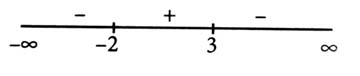
5x-412x-190 and x-32x-190

x(-,415](192,) and x[3,192)

x[3,415]                                          ...(i)

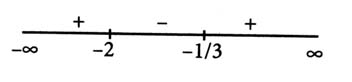
and 3x2-8x+5x2-3x-10>0 ; (3x-5)(x-1)(x-5)(x+2)>0

x(-,-2)(1,53)(5,)                    ...(ii)

Taking intersection of individual domains

x(5,415]α=5 and β=415

Hence, 3α+10β=15+82=97


Q 2 :

Given that the inverse trigonometric function assumes principal values only. Let x,y be any two real numbers in [-1,1] such that cos-1x-sin-1y=α, -π2απ. Then, the minimum value of x2+y2+2xy sinα is                   [2024]

  • -1


  • 0


  • 12


  • -12


(2)

cos-1x-π2+cos-1y=α

cos-1x+cos-1y=π2+α

 π2+α(0,3π2)                          [α[-π2,π]]

       cos-1(xy-1-x21-y2)=π2+α

xy-1-x21-y2=-sinα

xy+sinα=1-x21-y2

x2y2+sin2α+2xy sinα=1-x2-y2+x2y2

x2+y2+2xy sinα=cos2α

Thus, required minimum value is 0.


Q 3 :

If the domain of the function f(x)=sin-1(x-12x+3) is R-(α,β), then 12αβ is equal to :                       [2024]

  • 24


  • 32


  • 40


  • 36


(2)

We have, f(x)=sin-1(x-12x+3), since domain of sin-1x is [-1,1],x.

-1x-12x+31x-12x+3+10 and x-12x+3-10

x-1+2x+32x+30 and x-1-2x-32x+30

3x+22x+30 and -x-42x+30

Now, 3x+22x+30x<-32 or x-23

x(-,-32)[-23,)

and -x-42x+30x-4 or x>-32

x(-,-4](-32,)

Hence, x(-,-4][-23,) i.e., xR-(-4,-23)

So, Domain : R-(-4,-23)α=-4 and β=-23

 12×β=12×(-4)×(-23)=32


Q 4 :

Considering only the principal values of inverse trigonometric functions, the number of positive real values of x satisfying tan-1(x)+tan-1(2x)=π4 is:      [2024]

  • 1


  • more than 2


  • 2


  • 0


(1)

Given, tan-1(x)+tan-1(2x)=π4

tan-1(3x1-2x2)=π4                                        ( tan-1x+tan-1y=tan-1(x+y1-xy))

3x1-2x2=tanπ43x1-2x2=12x2+3x-1=0

x=-3±174                   Possible value of x=-3+174

Hence, only 1 positive real value of x satisfies the equation.


Q 5 :

Let x=mn (m,n are co-prime natural numbers) be a solution of the equation cos(2sin-1x)=19 and let α,β(α>β) be the roots of the equation mx2-nx-m+n=0.  Then the point (α,β) lies on the line                    [2024]

  • 3x-2y=-2


  • 5x-8y=-9


  • 3x+2y=2


  • 5x+8y=9


(4)

We have, cos(2sin-1x)=19

Put sin-1x=θ

cos2θ=191-2sin2θ=19

sinθ=23   (x>0 and sinθ lies in the first quadrant)

x=23=mn.    So, m=2 and n=3

The given equation becomes, 2x2-3x-2+3=0

2x2-3x+1=02x2-2x-x+1=0

(2x-1)(x-1)=0 x=12 or x=1

α=1 and β=12,which lies on the line 5x+8y=9


Q 6 :

If the domain of the function f(x)=cos-1(2-|x|4)+{loge(3-x)}-1 is [-α,β)-{γ}, then α+β+γ is equal to                   [2024]

  • 9


  • 8


  • 11


  • 12


(3)

We have, f(x)=cos-1(2-|x|4)+{loge(3-x)}-1

For f(x) be defined -12-|x|41

-42-|x|4-6-|x|2

6|x|-2

Since, |x|-2 so -6x6          ...(i)

Also, 3-x>0 and 3-x1

x<3 and x2                              ...(ii)

Taking intersection of (i) and (ii), we get x[-6,3)-{2}

α=6, β=3, and γ=2

α+β+γ=6+3+2=11


Q 7 :

For α,β,γ0, if sin-1α+sin-1β+sin-1γ=π and (α+β+γ)(α-γ+β)=3αβ, then γ equals              [2024]

  • 32


  • 3


  • 12


  • 3-122


(1)

Given, sin-1α+sin-1β+sin-1γ=π

and (α+β+γ)(α+β-γ)=3αβ

Let sin-1α=A,  sin-1β=B,  sin-1γ=C

A+B+C=π and (α+β+γ)(α+β-γ)=3αβ

     α2+β2+2αβ-γ2=3αβ,  α2+β2-γ2=αβ

     α2+β2-γ22αβ=12

cosC=12C=60°sinC=32=γ

So, γ=32


Q 8 :

If a=sin-1(sin(5)) and b=cos-1(cos(5)), then a2+b2 is equal to                      [2024]

  • 25


  • 8π2-40π+50


  • 4π2-20π+50


  • 4π2+25


(2)

We have, a=sin-1(sin(5)) and b=cos-1(cos(5))

a=-2π+5                     ( sin-1(sinx)=-2π+x, if 3π2x5π2)

b=2π-5,                           ( cos-1(cosx)=2π-x, πx2π)

   a2+b2=(-2π+5)2+(2π-5)2

=4π2+25-20π+4π2+25-20π=8π2-40π+50


Q 9 :

For nN, if cot-13+cot-14+cot-15+cot-1n=π4, then n is equal to ______.           [2024]


(47)

cot-13+cot-14+cot-15+cot-1n=π4

tan-113+tan-114+tan-115+tan-11n=π4

tan-1(13+141-112)+tan-115+tan-11n=π4

tan-1(711)+tan-115+tan-11n=tan-11

tan-1((711+15)1-711·15)+tan-11n=tan-11

tan-1(2324)+tan-11n=tan-11

tan-11n=tan-11-tan-12324

tan-11n=tan-1(1-23241+2324)1n=147n=47


Q 10 :

Let the inverse trigonometric functions take principal values. The number of real solutions of the equation 2sin-1x+3cos-1x=2π5, is _____.    [2024]


(0)

We have, 2sin-1x+3cos-1x=2π5

2(π2-cos-1x)+3cos-1x=2π5

π+cos-1x=2π5  cos-1x=-3π5

Which is not possible as cos-1x[0,π]

No solution exists.


Q 11 :

If the domain of the function f(x)=loge(2x+34x2+x-3)+cos-1(2x-1x+2) is (α,β],  then the value of 5β-4α is equal to              [2024]

  • 12


  • 10


  • 11


  • 9


(1)

Given function,

f(x)=loge(2x+34x2+x-3)+cos-1(2x-1x+2)

Here, log(2x+34x2+x-3) will be defined, if

2x+34x2+x-3>02x+3(4x-3)(x+1)>0

  x(-32,-1)(34,)                                           ...(i)

Also, cos-1(2x-1x+2) will be defined, if -12x-1x+2103x+1x+2

  x([-,-2][-13,])                                ...(ii)

Also, x-3x+20

   x[-2,3]                                                             ...(iii)

From (i), (ii) and (iii), we get

β=3 and α=345β-4α=12


Q 12 :

Considering the principal values of the inverse trigonometric functions, sin1(32x+121x2), 12<x<12, is equal to          [2025]

  • 5π6sin1x


  • π4+sin1x


  • 5π6sin1x


  • π6+sin1x


(4)

Let sin1x=θ,π4<θ<π4

 x=sinθ

Now, sin1(32x+121x2)

=sin1(sinθ cosπ6+cosθ sinπ6)

=sin1(sin(θ+π6))=θ+π6=sin1x+π6


Q 13 :

The sum of the infinite series cot1(74)+cot1(194)+cot1(394)+cot1(674)+... is:          [2025]

  • π2+cot1(12)


  • π2tan1(12)


  • π2+tan1(12)


  • π2cot1(12)


(2)

The given infinite series is :

cot1(74)+cot1(194)+cot1(394)+cot1(674)+...

 Tn=cot1(4n2+34)

               =tan1(44n2+3)=tan1(1n2+34)

               =tan1(1n214+1)=tan1((n+12)(n12)1+(n+12)(n12))

               =tan1(n+12)tan1(n12)

T1=tan132tan112

T2=tan152tan132 and so on.

 r=1nTr=tan1(n+12)tan112

      as n

r=1Tr=π2tan112


Q 14 :

The value of cot1(1+tan2(2)1tan(2))cot1(1+tan2(12)+1tan(12)) is equal to          [2025]

  • π+32


  • π54


  • π32


  • π+52


(2)

We have,

cot1(1+tan2(2)1tan(2))cot1(1+tan2(12)+1tan(12))

=cot1(|sec(2)|1tan(2))cot1(|sec(12)|+1tan(12))

=cot1(1cos2sin2)cot1(1+cos(12)sin(12))

=cot1(2cos2(1)2cos(1)sin(1))cot1(2cos2(14)2cos(14)sin(14))

=cot1(cot(1))cot1(cot14)

=π114=π54.


Q 15 :

Let the domains of the functions f(x)=log4log3 log7(8log2(x2+4x+5)) and g(x)=sin1(7x+10x2) be (α,β) and [γ,δ], respectively. Then α2+β2+γ2+δ2 is equal to :           [2025]

  • 13


  • 16


  • 15


  • 14


(3)

We have,

f(x)=log4log3log7(8log2(x2+4x+5))

For f(x) to be defined we need,

log3log7(8log2(x2+4x+5))>0

log7(8log2(x2+4x+5))>1

 8log2(x2+4x+5)>7

 log2(x2+4x+5)<1

 x2+4x+5<2

 x2+4x+3<0

 (x+1)(x+3)<0

 x(3,1) i.e., α=3, β=1          ... (i)

Also, x2+4x+5>0, but D=1620=4<0

Also, we have g(x)=sin1(7x+10x2)

 17x+10x21  17(x2)+24x21

 824x26  16x22418

 4x23  2x1

 x[2,1] i.e., γ=2, δ=1

 α2+β2+γ2+δ2=(3)2+(1)2+(2)2+(1)2=15


Q 16 :

Using the principal values of the inverse trigonometric functions, the sum of the maximum and the minimum values of 16((sec1x)2+(cosec1x)2) is :          [2025]

  • 22π2


  • 24π2


  • 18π2


  • 31π2


(1)

f(x)=16((sec1x)2+(cosec1x)2)

            =16[(sec1x+cosec1x)22sec1x cosec1x]

            =16[(π2)22(π2cosec1x)cosec1x]

             =16[π24π cosec1x+2(cosec1x)2]

              =32[(cosec1x)2π2cosec1x+π28]

 f(x)=32[(cosec1xπ4)2+π216]

f(x) is maximum when x = –1

  fmax=32×10π216

f(x) is minimum when x=2

  fmin=32×π216

  Required sum =32×10π216+32×π216=22π2


Q 17 :

If π2x3π4, then cos1(1213cosx+513sinx) is equal to          [2025]

  • xtan1512


  • x+tan1512


  • x+tan145


  • xtan143


(1)

Given, π2x3π4

Let cosα=1213        [ cos1(1213cosx+513sinx)]

=cos1(cosx cosα+sinx sinα)=cos1(cos(xα))=xα

=xtan1(512)


Q 18 :

If α>β>γ>0, then the expression cot1{β+(1+β2)(αβ)}+cot1{γ+(1+γ2)(βγ)}+cot1{α+(1+α2)(γα)} is equal to:          [2025]

  • 3π


  • 0


  • π2(α+β+γ)


  • π


(4)

β+(1+β2)αβ=αββ2+1+β2αβ=αβ+1αβ

Similarly, γ+(1+γ2)βγ=βγ+1βγ and α+(1+α2)γα=αγ+1γα

 cot1(αβ+1αβ)+cot1(βγ+1βγ)+cot1(αγ+1γα)

=tan1(αβ1+αβ)+tan1(βγ1βγ)+πcot1(αγ+1αγ)

=tan1(αβ1+αβ)+tan1(βγ1+βγ)tan1(γ+α1+γα)+π

=tan1(α)tan1(β)+tan1(β)tan1(γ)+tan1(γ)tan1(α)+π=π


Q 19 :

cos(sin135+sin1513+sin13365) is equal to :          [2025]

  • 1


  • 0


  • 3265


  • 3365


(2)

cos(sin135+sin1513+sin13365)

=cos(tan134+tan1512+tan13356)

=cos(tan1(34+512)(134·512)+tan13356)

=cos(tan15633+tan13356)

=cos[cot1(3356)+tan1(3356)]

=cos(π2)=0          ( tan1x + cot1x=π2)


Q 20 :

Let [x] denote the greatest integer less than or equal to x. Then the domain of f(x) = sec1(2[x] + 1) is :          [2025]

  • (,)


  • (,){0}


  • (,1][0,)


  • (,1][1,)


(1)

We have, 2[x]+11 or 2[x]+11

 [x]1 or [x]0

 x(,0) or x[0,)

 x(,)


Q 21 :

If y=cos(π3+cos1x2), then (xy)2+3y2 is equal to           [2025]


(3)

We have, y=cos(π3+cos1x2)

=cosπ3cos(cos1x2)sinπ3sin(cos1x2)

=12×x232sin(sin11x24)

=x4324x22

 4y=x3(4x2)  (x4y)=3(4x2)

On squaring both sides, we get

x2+16y28xy=123x2

 4x2+16y28xy=12  x2+4y22xy=3

 (xy)2+3y2=3


Q 22 :

Let the domain of the function f(x)=cos1(4x+53x7) be [α,β] and the domain of g(x)=log2(26 log27(2x+5)) be (γ,δ). Then |7(α+β)+4(γ+δ)| is equal to __________.         [2025]


(96)

We have, f(x)=cos1(4x+53x7)

Since, domain of cos1x is [–1, 1].

 14x+53x71

For, 4x+53x71  4x+5+3x73x70

 7x23x70 x(,27](73,)           ... (i)

Now, for 4x+53x71  4x+53x+73x70

 x+123x70 x[12,73)           ... (ii)

On combining (i) and (ii), we get domain of f(x) is [12,27].

 α=12 and β=27

Now, g(x)=log2(26 log27(2x+5))

For g(x) to be defined, we have

26 log27(2x+5)>0  6 log27(2x+5)<2

 log27(2x+5)<13  (2x+5)<(27)13

 2x+5<3  2x<2  x<1

Also, 2x + 5 > 0          [For log27(2x+5) to be defined]

 x>52

  Domain of g(x) is (52,1)            γ=52 and δ=1

 |7(α+β)+4(γ+δ)|=|7(12+27)+4(521)|

                                                                =|8214|=96


Q 23 :

If for some α,β;αβ,α+β=8 and sec2(tan1α)+cosec2(cot1β)=36, then α2+β is __________.          [2025]


(14)

Given, sec2(tan1α)+cosec2(cot1β)=36

 1+tan2(tan1α)+1+cot2(cot1β)=36

 α2+β2=34

Given, α+β=8          ... (i)

 α2+β2+2αβ=64

 2αβ=30  αβ=15

 βα=(α+β)24αβ          [ βα]

βα=2          ... (ii)

From (i) and (ii), we get

α=3, β=5

 α2+β=9+5=14


Q 24 :

Let S={x : cos1x=π+sin1x+sin1(2x+1)}. Then xS(2x1)2 is equal to __________.          [2025]


(5)

We have, cos1x=π+sin1x+sin1(2x+1)

 2cos1xsin1(2x+1)=3π2

 2αβ=3π2, where cos1x=α, sin1(2x+1)=β

 2α=3π2+β  cos 2α=sin β  2cos2α1=sinβ

 2x21=2x+1          [ x=cosα and 2x+1=sinβ]

 x2x1=0

 x=1±52

 x=152          ( x=1+52 rejected as cosα1)

Now, xS(2x1)2=xS(4x2+14x)=5


Q 25 :

The range of f(x)=4sin-1(x2x2+1) is                [2023]

  • [0,2π)


  • [0,π]


  • [0,2π]


  • [0,π)


(1)

Given,  4sin-1(x2x2+1)

x2x2+1=x2+1-1x2+1=1-1x2+1

x20; x2+11    0<1x2+11-1-1x2+1<0;

01-1x2+1<1; 04sin-1(x2x2+1)<2π


Q 26 :

Let S  be the set of all solutions of the equation cos-1(2x)-2cos-1(1-x2)=π, x[-12,12]. Then xS2sin-1(x2-1) is equal to            [2023]

  • 0


  • -2π3


  • π-2sin-1(34)


  • π-sin-1(34)


(2)


Q 27 :

Let S={xR:0<x<1 and 2tan-1(1-x1+x)=cos-1(1-x21+x2)}. If n(S) denotes the number of elements in S, then             [2023]

  • n(S)=2 and only one element in S is less than 12


  • n(S)=1 and the element in S is less than 12


  • n(S)=1 and the element in S is more than 12


  • n(S)=0


(2)

0<x<1

2tan-1(1-x1+x)=cos-1(1-x21+x2)                        ...(i)

Let tan-1x=θ(0,π4)x=tanθ

2tan-1(tan(π4-θ))=cos-1(cos2θ)

2(π4-θ)=2θ

4θ=π2   θ=π8  x=tanπ8x=2-10.414


Q 28 :

tan-1(1+33+3)+sec-1(8+436+33) is equal to              [2023]

  • π2


  • π4


  • π6


  • π3


(4)

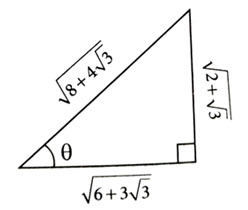
tan-1(1+33+3)+sec-1(8+436+33)

tan-1(1+33(3+1))+tan-1(2+36+33)

tan-1(13)+tan-1(2+33(2+3))

tan-1(13)+tan-1(13)=π6+π6=π3


Q 29 :

If the domain of the function f(x)=loge(4x2+11x+6)+sin-1(4x+3)+cos-1(10x+63) is (α,β], then 36|α+β| is equal to          [2023]

  • 45


  • 63


  • 72


  • 54


(1)

We have,

f(x)=loge(4x2+11x+6)+sin-1(4x+3)+cos-1(10x+63)

Let f1(x)=loge(4x2+11x+6)

f2(x)=sin-1(4x+3)

and f3(x)=cos-1(10x+63)

Now, we will find the domain of f1,f2 and f3

Consider, f1(x)=log(4x2+11x+6)

Now, 4x2+11x+6>0

  x>-11+121-968 and x<-11-121-968

  x>-34 and x<-2

Consider, f2(x)=sin-1(4x+3)

So, -14x+31

-44x-2-1x-12

  D(f2(x)) is [-1,-12]

Consider, f3(x)=cos-1(10x+63)

So, -110x+631

-310x+63-910x-310

D(f3(x)) is [-910,-310]

Now, D(f(x)) is D(f1(x))D(f2(x))D(f3(x))

=(-,-2)(-34,)[-1,-12][-910,-310]=(-34,-12]

So, α=-34 and β=-12

So, 36|α+β|=36|-34-12|=36×54=45


Q 30 :

If sin-1α17+cos-145-tan-17736=0, 0<α<13, then sin-1(sinα)+cos-1(cosα) is equal to              [2023]

  • 16-5π


  • 16


  • 0


  • π


(4)

We have,

sin-1α17+cos-145-tan-17736=0;  0<α<13

sin-1α17=tan-17736-cos-145=tan-17736-sin-135

α17=sin(tan-17736-sin-135)

=sin(tan-17736)·cos(sin-135)-cos(tan-17736)sin(sin-135)

α17=sin(sin-17785)·cos(cos-145)-cos(cos-13685)(35)

            =7785×45-3685×35α=8

Now, sin-1(sinα)+cos-1(cosα)=sin-1(sin8)+cos-1(cos8)

       =3π-8+8-2π [ 3π-8[-π2,π2]]=π