
Q 1 :

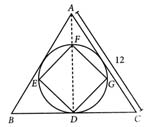
A circle is inscribed in an equilateral triangle of side of length 12. If the area and perimeter of any square inscribed in this circle are m and n, respectively, then m+n2 is equal to                                [2024]

  • 396


  • 408


  • 414


  • 312


(2)

Let radius of inscribed circle be r.

r=13AD

=13a2-a24,  a is side of triangle.

=a23=1223=23

Area of square DEFG, m=12×(diagonal)2

        =12×(2r)2=12×4×12=24 sq. units

Side of square =26

Perimeter of square, n=4×26=86

∴  m+n2=24+384=408


Q 2 :

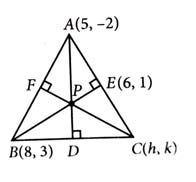
If P(6,1) be the orthocentre of the triangle whose vertices are A(5, -2), B(8, 3) and C(h, k), then the point C lies on the circle                    [2024]

  • x2+y2-65=0


  • x2+y2-74=0


  • x2+y2-52=0


  • x2+y2-61=0


(1)

Slope of AP=1+26-5=3

Slope of BC=-1Slope of AD

=-1Slope of AP

=-13

Equation of line BC is given by (y-3)=-13(x-8)

⇒3y+x-17=0                                        ...(i)

Now, slope of BP=1-36-8=1

Slope of AC=-1

Equation of AC is y+2=-1(x-5)

i.e., y+x-3=0                                           ...(ii)

C is the point of intersection of AC and BC, then solving equation (i) and (ii), we get

C=(-4,7), which lies on the circle x2+y2-65=0.


Q 3 :

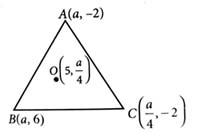
Let (5,a4) be the circumcenter of a triangle with vertices A(a,-2), B(a,6)  and C(a4,-2). Let α denote the circumradius, β denote the area, and γ denote the perimeter of the triangle. Then α+β+γ is              [2024]

  • 62


  • 60


  • 30


  • 53


(4)

The circumcentre of the triangle ABC is O(5,a4)       ∵  OA2=OB2

⇒(5-a)2+(a4+2)2=(5-a)2+(a4-6)2

⇒4a=32⇒a=8

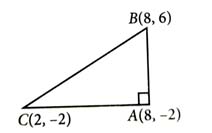
∴   A≡(8,-2), B≡(8,6) and C≡(2,-2)

AC=36+0=6, BC=36+64=10, AB=64=8

Perimeter, γ=6+10+8=24

Circumradius, α=OA=9+16=5

Area, β=12×6×8=24

∴   α+β+γ=5+24+24=53


Q 4 :

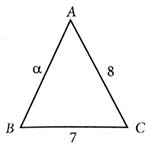
In a triangle ABC, BC = 7, AC = 8, AB=α∈N and cosA=23. If 49cos(3C)+42=mn, where gcd(m,n)=1, then m+n is equal to ________ .         [2024]


(39)

cosA=b2+c2-a22bc=82+α2-722·8·α

⇒23=α2+1516α

⇒32α=3α2+45

⇒3α2-32α+45=0⇒α=53,9

⇒α=9  [∵α∈N]

Now, cosC=72+82-922×7×8⇒cosC=27

Now, cos3C=4cos3C-3cosC=4×873-67

So, 49cos3C+42=49(4×873-67)+42=327-42+42=mn

⇒m=32, n=7; m+n=32+7=39


Q 5 :

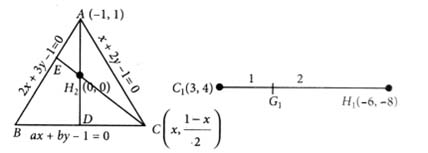
If the orthocentre of the triangle formed by the lines 2x+3y-1=0, x+2y-1=0 and ax+by-1=0, is the centroid of another triangle, whose circumcentre and orthocentre respectively are (3, 4) and (-6, -8), then the value of |a-b| is _________ .            [2024]


(16)

Let ∆ABC be the given triangle with sides 2x+3y=1, x+2y=1 and ax+by=1

Let ∆PQR be another triangle whose circumcentre, orthocentre and centroid be C1,H1 and G1 respectively. We know centroid divides circumcentre and orthocentre in the ratio 1 : 2.

∴   Coordinates of G1=(6-63,8-83)=(0,0)

∴  Orthocentre of ∆ABC, H2=(0,0)

Slope of AH2=-1Slope of BC⇒1-0-1-0=-1-ab⇒-a=b

Slope of AB=-23

Now, slope of CH2=32

∴   Equation of CH2 is given by y=32x

Now, C is the point of intersection of y=32x and x+2y-1=0

∴   C(14,38) are the coordinates of C which will also satisfy the equation of BC.

⇒a4-38a-1=0⇒a=-8, b=8

⇒|a-b|=|-8-8|=16


Q 6 :

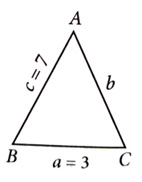
In a triangle ABC, if cosA+2cosB+cosC=2 and the lengths of the sides opposite to angles A and C are 3 and 7 respectively, then cosA-cosC is equal to          [2023]

  • 57


  • 107


  • 37


  • 97


(2)

We have, cosA+2cosB+cosC=2

∴  [b2+c2-a22bc]+2[c2+a2-b22ac]+[a2+b2-c22ab]=2

⇒[b2+49-914b]+2[49+9-b242]+[9+b2-496b]=2     [∵a=3, c=7]

⇒b2+4014b+58-b221+-40+b26b=2

⇒ b3-5b2-16b+80=0

⇒ (b-4)(b+4)(b-5)=0

⇒ b=-4 or 4 or 5

b≠-4                     (∵ b cannot be -4)

For b=4, triangle cannot be constructed

∴  b=5

Now, cosA-cosC=b2+c2-a22bc-a2+b2-c22ab

=49+25-92×7×5-9+25-492×3×5=1314+12=107


Q 7 :

For a triangle ABC, the value of cos2A+cos2B+cos2C is least. If its inradius is 3 and incentre is M, then which of the following is NOT correct?         [2023]

  • area of ∆ABC is 2732


  • sin2A+sin2B+sin2C=sinA+sinB+sinC


  • perimeter of ∆ABC is 183


  • MA→·MB→=-18


(1)

Here, cos2A+cos2B+cos2C=-32

⇒ 2A=2B=2C=120° ⇒A=B=C=60°

Now, inradius=Area of ∆ABCSemiperimeter

3=34a23a2                                           [Where a=side of ∆]

⇒a=183=63

Perimeter of ∆ABC=183

Area of ∆ABC=34×(63)2=273

A=60⇒2A=120

sin2A=sinA

∑sin2A=∑sinA

|MA→|=|MB→|⇒6=2r

MA→·MB→=36cos120°=-18


Q 8 :

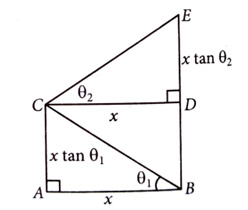
In the figure, θ1+θ2=π2 and 3 (BE)=4(AB). If the area of ∆CAB is 23-3 unit2, when θ2θ1 is the largest, then the perimeter (in unit) of ∆CED is equal to ______ .              [2023]


(6)

Given, 3(BE)=4(AB)

ar(∆CAB)=23-3

So, 12x2tanθ1=23-3

BE=BD+DE

=x(tanθ1+tanθ2)

BE=AB(tanθ1+cotθ1)

43=tanθ1+cotθ1⇒tanθ1=3,13

θ1=π6,θ2=π3;  θ1=π3,θ2=π6

as θ2θ1 is largest

∴  θ1=π6, θ2=π3

∴ x2=(23-3)×2tanθ1=3(2-3)×2tanπ6

⇒ x2=12-63=(3-3)2⇒x=3-3

Perimeter of ∆CED=CD+DE+CE

=3-3+(3-3)3+(3-3)×2=6 units