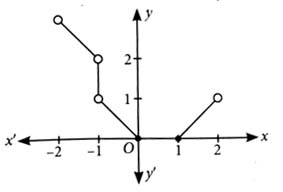


Q 51 :

If y(x)=xx,x>0, then y''(2)-2y'(2) is equal to            [2023]

  • 4(loge2)2-2


  • 8loge2-2


  • 4(loge2)2+2


  • 4loge2+2


(1)

Given, y=xx

Taking log on both sides

logy=xlogex, y'=xx(1+logex)

y''=xx(1+logex)2+xx·1x

Now, find y''(2) and y'(2)

y''(2)=4(1+loge2)2+2

y'(2)=4(1+loge2)

Now, y''(2)-2y'(2)=4(1+loge2)2+2-2[4(1+loge2)]

=4(1+loge2)2+2-8(1+loge2)

=4(1+loge2)[1+loge2-2]+2

=4(loge2)2-1+2=4(loge2)2-2


Q 52 :

Let f(x)={x2sin(1x),x00,x=0 Then at x = 0               [2023]

  • f is continuous but not differentiable


  • f is continuous but f' is not continuous


  • f' is continuous but not differentiable


  • f and f' both are continuous


(2)

f(x)={x2sin(1x),x00,x=0

LHD = limh0f(0-h)-(0)-h=limh0--h2sin(1/h)-h=0

RHD = limh0f(0+h)-f(0)h=limh0+h2sin(1/h)h=0

f(x) is continuous and differentiable at x=0.

Now, f'(x)={2xsin(1x)-cos(1x),x00,x=0

limx0f'(x)=limx0[2xsin(1x)-cos(1x)]=0-[-1,1]0

     f'(0)=0

f'(x) is discontinuous at x=0.


Q 53 :

If f(x)=x3-x2f'(1)+xf''(2)-f'''(3),xR, then              [2023]
 

  • 2f(0)-f(1)+f(3)=f(2)


  • f(3)-f(2)=f(1)


  • 3f(1)+f(2)=f(3)


  • f(1)+f(2)+f(3)=f(0)


(1)

Given, f(x)=x3-x2f'(1)+xf''(2)-f'''(3)

f'(x)=3x2-2xf'(1)+f''(2)          ...(i)

f''(x)=6x-2f'(1)                           ...(ii)

f'''(x)=6f'''(3)=6                    ...(iii)

From (iii),

     f''(2)=12-2f'(1)                      ...(iv)

From (ii),

f'(1)=3(1)2-2f'(1)+f''(2)

f''(2)=3f'(1)-3              ...(v)

12-2f'(1)=3f'(1)-3

f'(1)=3; f''(2)=12-6=6 and f'(1)=3

     f(x)=x3-3x2+6x-6f(0)=-6

f(1)=-2,  f(2)=2,  f(3)=12

  2f(0)-f(1)+f(3)=2=f(2)


Q 54 :

Let y(x)=(1+x)(1+x2)(1+x4)(1+x8)(1+x16).  Then y'-y'' at x=-1 is equal to              [2023]

  • 976


  • 944


  • 496


  • 464


(3)

Given, y(x)=(1+x)(1+x2)(1+x4)(1+x8)(1+x16)

=1-x321-x=1+x+x2+x3++x31

y'(x)=1+2x+3x2+4x3++31x30

y'(-1)=1-2+3-4+-30+31

=-1-1-1(upto 15 times)+31=16

y''(x)=2+6x+12x2+20x3++31×30x29

y''(-1)=2-6+12-20+-31×30

=-4-8-12-(15 terms)=-4×15×162=-480

y'-y''=16+480=496


Q 55 :

If the function

f(x)={(1+|cosx|)λ|cosx|,0<x<π2μ,x=π2cot6xecot4x,π2<x<π

is continuous at x=π2, then 9λ+6logeμ+μ6-e6λ is equal to             [2023]

  • 2e4+8


  • 11


  • 8


  • 10


(4)

Given question is incorrect. It should be e(cot6xcot4x) in place of cot6xecot4x.

f(x)={(1+|cosx|)λ|cosx|,0<x<π2μ,x=π2cot6xecot4x,π2<x<π

Since f(x) is continuous at x=π2

R.H.L. at x=π2

limxπ/2+e(cot6xcot4x) =limxπ/2+e(cos6xsin6x×sin4xcos4x)=e2/3

L.H.L.=limxπ/2(1+|cosx|)λ|cosx|=eλ

Value of the function, f(π/2)=μ                    (given)

By the definition of continuity, e2/3=eλ=μ    [ R.H.L = L.H.L = value of the function]

 λ=23,  μ=e2/3

  9λ+6logeμ+μ6-e6λ

=9×23+6×23+(e2/3)6-e6×23=6+4+e4-e4=10


Q 56 :

Let a and [t] be the greatest integer t. Then the number of points, where the function f(x)=[a+13sinx], x(0,π) is not differentiable, is _______.      [2023]


(25)

Let f(x)=[a+13sinx]

 a and x(0,π) and p is prime.

Total number of points of non-differentiability of [a+psinx]=2p-1

Here p=13

Thus, total number of non-differentiability points are 2×13-1=25.


Q 57 :

Let f and g be twice differentiable functions on such that

f''(x)=g''(x)+6x,

f'(1)=4g'(1)-3=9,

f(2)=3g(2)=12.

Then which of the following is NOT true?                        [2023]

  • |f'(x)-g'(x)|<6-1<x<1


  • If -1<x<2, then |f(x)-g(x)|<8


  • There exists x0(1,3/2) such that f(x0)=g(x0)


  • g(-2)-f(-2)=20


(2)

Suppose f and g be twice differentiable on  such that

f''(x)=g''(x)+6x                                           ...(1)

f'(1)=4g'(1)-3=9                                      ...(2)

f(2)=3g(2)=12                                             ...(3)

Firstly, we integrate equation (1).

So, f'(x)=g'(x)+6·x22+C At x = 1, we have

f'(1)=g'(1)+3+C, where C is the constant of integration.

9=3+3+C    C=3  (Using equation (2))

  f'(x)=g'(x)+3x2+3

Again, by integrating, f(x)=g(x)+3x33+3x+D, D is another constant of integration.

At x = 2, we have f(2)=g(2)+8+6+D

12=4+8+6+DD=-6  (from (3))

So, f(x)=g(x)+x3+3x-6

At x=-2g(-2)-f(-2)=20

Hence, option (4) is true.

Now, for -1<x<2

Let b(x)=f(x)-g(x)=x3+3x-6b'(x)=3x2+3

So, b(-1)<b(x)<b(2)-10<b(x)<8|b(x)|<10

So, option (2) is not true.

Now, b'(x)=f'(x)-g'(x)=3x2+3

If |b'(x)|<6|3x2+3|<6

3x2+3<6x2<1-1<x<1

So, option (1) is also true.

For x(-1,1), we have |f'(x)-g'(x)|<6

We have to solve the equation f(x)-g(x)=0

x3+3x-6=0  b(x)=x3+3x-6=0

b(x)=x3+3x-6

Here we have b(1)=-ve and b(32)=+ve

So, there exists x0(1,32) such that f(x0)=g(x0)

Hence, option (3) is also true.


Q 58 :

If aα is the greatest term in the sequence an=n3n4+147, n=1,2,3,, then α is equal to ________.           [2023]


(5)

We have, an=n3n4+147

Differentiate both sides w.r.t. n, we get

an'=(n4+147)3n2-n3·4n3(n4+147)2

Put an'=0

n2{3(n4+147)-4n4}(n4+147)2=0

3n4+441-4n4=0n4=441n2=21n=21

4<21<5a5>a4

So, α=5


Q 59 :

Let k and m be positive real numbers such that the function f(x)={3x2+kx+1,0<x<1mx2+k2,x1 is differentiable for all x>0. Then 8f'(8)f'(18) is equal to ______ .        [2023]


(309)


Q 60 :

Let f:(-2,2)R be defined by f(x)={x[x],-2<x<0(x-1)[x],0x<2 where [x] denotes the greatest integer function. If m and n respectively are the number of points in (- 2, 2) at which y=|f(x)| is not continuous and not differentiable, then m+n is equal to _____.            [2023]


(4)

f(x) or |f(x)|={-2x,-2<x<-1-x,-1x<00,0x1x-1,1x<2

Point of discontinuity: m=-1 i.e., one in number Point of non-differentiability: n=-1,0,1 i.e., 3 in number.


  m+n=1+3=4