Q 1 :

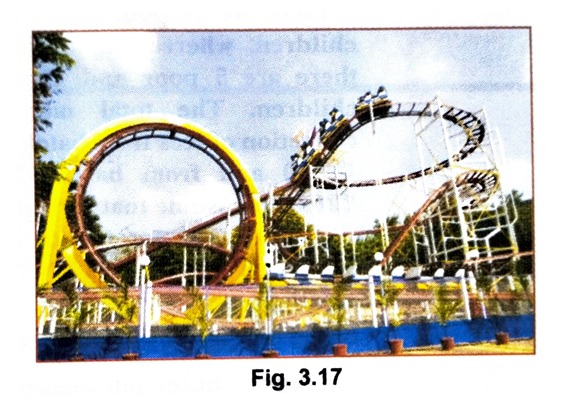
Essel World is one of India’s largest amusement parks that offers a diverse range of thrilling rides, water attractions and entertainment options for visitors of all ages. The park is known for its iconic “Water Kingdom” section, making it a popular destination for family outings and fun-filled adventure. The ticket charges for the park are Rs150 per child and Rs250 per adult.
On a day, the cashier of the park found that 300 tickets were sold and an amount of Rs55,000 was collected.

Based on the above information, answer the following questions:

(i) If the number of children visited is x and the number of adults visited is y, then write the given situation algebraically.

  • 300


  • 400


  • 250


  • 100


(1)

Number of children visited = x

     Number of adults visited = y

     According to question,

     The algebraic equation is x + y = 300 ...........(i)


Q 2 :

Essel World is one of India’s largest amusement parks that offers a diverse range of thrilling rides, water attractions and entertainment options for visitors of all ages. The park is known for its iconic “Water Kingdom” section, making it a popular destination for family outings and fun-filled adventure. The ticket charges for the park are Rs150 per child and Rs250 per adult.
On a day, the cashier of the park found that 300 tickets were sold and an amount of Rs55,000 was collected.

Based on the above information, answer the following questions:


(ii) (a) How many children visited the amusement park that day?

  • 100


  • 200


  • 150


  • 300


(2)

(a) The amount collected = ?55,000

     The algebraic equation is 150x + 250y = 55000 ...........(ii)

     15x + 25y = 5500

     OR

Putting y = 300 – x from (i) in (ii), we get

     15x + 25(300 – x) = 5500

     ⇒ –10x + 7500 = 5500

     ⇒ 2000 = 10x

     ⇒ x = 200

So, the number of children visited is 200.


Q 3 :

Essel World is one of India’s largest amusement parks that offers a diverse range of thrilling rides, water attractions and entertainment options for visitors of all ages. The park is known for its iconic “Water Kingdom” section, making it a popular destination for family outings and fun-filled adventure. The ticket charges for the park are Rs150 per child and Rs250 per adult.

On a day, the cashier of the park found that 300 tickets were sold and an amount of Rs55,000 was collected.

Based on the above information, answer the following questions:


(ii) (b) How many adults visited the amusement park that day?

  • 100


  • 150
     

  • 120


  • 110


(1)

(b)       Putting x = 200 in (i), we get

     200 + y = 300 ⇒ y = 100

So, the number of adults visited is 100.


Q 4 :

Essel World is one of India’s largest amusement parks that offers a diverse range of thrilling rides, water attractions and entertainment options for visitors of all ages. The park is known for its iconic “Water Kingdom” section, making it a popular destination for family outings and fun-filled adventure. The ticket charges for the park are Rs150 per child and Rs250 per adult.

On a day, the cashier of the park found that 300 tickets were sold and an amount of Rs55,000 was collected.

Based on the above information, answer the following questions:


(iii) How much amount will be collected if 250 children and 100 adults visit the amusement park?

  • 62,500


  • 60,500


  • 63,500


  • 59,500


(1)

The amount collected = (250 × 150 + 100 × 250)

     = (37,500 + 25,000) = ?62,500

Hence, the amount collected is Rs 62,500.


Q 5 :

A coaching institute of Mathematics conducts classes in two batches I and II and fees for rich and poor children are different. In batch I, there are 20 poor and 5 rich children, whereas in batch II, there are 5 poor and 25 rich children. The total monthly collection of fees from batch I is Rs9000 and from batch II is Rs26,000. Assume that each poor child pays Rs x per month and each rich child pays Rs y per month.

Based on the above information, answer the following questions:


(i) Represent the information given above in terms of x and y.

  • x = 9000, y = 26000


  • x = -9000, y = -26000


  • y = 9000, x = 26000


  • x = 8000, y = 25000


(1) 

20x + 5y = 9000 ...........(i)
 5x + 25y = 26000 ...........(ii)


Q 6 :

A coaching institute of Mathematics conducts classes in two batches I and II and fees for rich and poor children are different. In batch I, there are 20 poor and 5 rich children, whereas in batch II, there are 5 poor and 25 rich children. The total monthly collection of fees from batch I is Rs9000 and from batch II is Rs26,000. Assume that each poor child pays Rs x per month and each rich child pays Rs y per month.

Based on the above information, answer the following questions:


(ii) (a) Find the monthly fee paid by a poor child.

  • 100


  • 200


  • 150


  • 180


(2)

(a) Multiplying (i) by 5 and subtracting (ii) from it, we get

     100x + 25y = 45000

     5x + 25y = 26000

     -------------------

     95x = 19000

     ⇒ x = 19000 / 95 = 200

∴ Monthly fee paid by poor child = Rs 200


Q 7 :

A coaching institute of Mathematics conducts classes in two batches I and II and fees for rich and poor children are different. In batch I, there are 20 poor and 5 rich children, whereas in batch II, there are 5 poor and 25 rich children. The total monthly collection of fees from batch I is Rs9000 and from batch II is Rs26,000. Assume that each poor child pays Rs x per month and each rich child pays Rs y per month.

Based on the above information, answer the following questions:


(ii) (b) Find the difference in the monthly fee paid by a poor child and a rich child.

  • 400


  • 500


  • 800


  • -800


(3)

Multiplying (ii) by 4 and subtracting from (i), we get

     20x + 5y = 9000 ...........(i)

     20x + 100y = 104000 ...........(ii)

     -------------------

     -95y = -95000 ⇒ y = ?1000

∴ Difference in monthly fee paid by a poor child and a rich child = ?(1000 – 200) = Rs 800


Q 8 :

A coaching institute of Mathematics conducts classes in two batches I and II and fees for rich and poor children are different. In batch I, there are 20 poor and 5 rich children, whereas in batch II, there are 5 poor and 25 rich children. The total monthly collection of fees from batch I is Rs9000 and from batch II is Rs26,000. Assume that each poor child pays Rs x per month and each rich child pays Rs y per month.

Based on the above information, answer the following questions:


(iii) If there are 10 poor and 20 rich children in batch II, what is the total monthly collection of fees from batch II?

  • 22,000


  • 20,000


  • 23,000


  • 24,000


(1)

(iii) Monthly collection of batch II for 10 poor and 20 rich children

     = 10 × 200 + 20 × 1000

     = ?(2000 + 20000) = Rs 22,000


Q 9 :

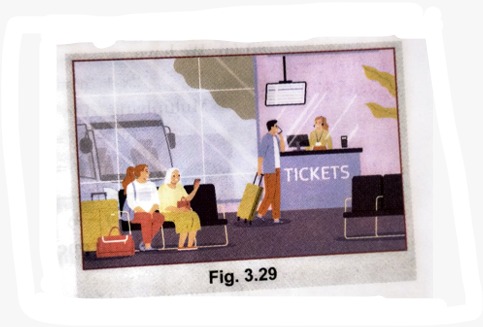
From Bengaluru bus stand, if Riddhima buys 2 tickets to Malleswaram and 3 tickets to Yeswanthpur, then the total cost of the tickets is Rs 46; but if she buys 3 tickets to Malleswaram and 5 tickets to Yeswanthpur, then the total cost is Rs 74.

Consider the fares from Bengaluru to Malleswaram and that to Yeswanthpur as Rs x and Rs y respectively and answer the following questions:

(i) Find the algebraic equation which represents the first situation.

  • 46


  • 45


  • 44


  • 40


(1)

1st situation can be represented algebraically as 2x + 3y = 46.


Q 10 :

From Bengaluru bus stand, if Riddhima buys 2 tickets to Malleswaram and 3 tickets to Yeswanthpur, then the total cost of the tickets is Rs 46; but if she buys 3 tickets to Malleswaram and 5 tickets to Yeswanthpur, then the total cost is Rs 74.

Consider the fares from Bengaluru to Malleswaram and that to Yeswanthpur as Rs x and Rs y respectively and answer the following questions:

(ii) Find the algebraic equation which represents the second situation.

  • 74


  • 75


  • 72


  • 71


(1)

2nd situation can be represented algebraically as 3x + 5y = 74.


Q 11 :

From Bengaluru bus stand, if Riddhima buys 2 tickets to Malleswaram and 3 tickets to Yeswanthpur, then the total cost of the tickets is Rs 46; but if she buys 3 tickets to Malleswaram and 5 tickets to Yeswanthpur, then the total cost is Rs 74.

Consider the fares from Bengaluru to Malleswaram and that to Yeswanthpur as Rs x and Rs y respectively and answer the following questions:

(iii) (a) What is the fare from Bengaluru to Malleswaram?

  • 8


  • 5


  • 4


  • 3


(1)

(a) We have, 2x + 3y = 46 ...........(i)

          3x + 5y = 74 ...........(ii)

Multiplying (i) by 5 and (ii) by 3, then

          10x + 15y = 230

          9x + 15y = 222

Subtracting, we get

          10x – 9x = 230 – 222 ⇒ x = 8

∴ Fare from Bengaluru to Malleswaram is ?8.


Q 12 :

From Bengaluru bus stand, if Riddhima buys 2 tickets to Malleswaram and 3 tickets to Yeswanthpur, then the total cost of the tickets is Rs 46; but if she buys 3 tickets to Malleswaram and 5 tickets to Yeswanthpur, then the total cost is Rs 74.

Consider the fares from Bengaluru to Malleswaram and that to Yeswanthpur as Rs x and Rs y respectively and answer the following questions:

(iii) (b) What is the fare from Bengaluru to Yeswanthpur?

  • 12


  • 10


  • 5


  • 7


(2)

Putting the value of x in (i), we get

          3y = 46 – 2 × 8 = 30 ⇒ y = 10

∴ Fare from Bengaluru to Yeswanthpur is ?10.


Q 13 :

From a shop, Sudhir bought 2 Mathematics books and 3 Physics books for Class X for Rs 850, while Suman bought 3 Mathematics books and 2 Physics books for Class X for Rs 900. Consider the price of one Mathematics book and that of one Physics book as Rs x and Rs y respectively.

Based on the above information, answer the following questions:

(i) Find the algebraic equation which represents the situation faced by Sudhir.

  • 850


  • 750


  • 800


  • 820


(1)

Situation faced by Sudhir represented algebraically as 2x + 3y = 850.


Q 14 :

From a shop, Sudhir bought 2 Mathematics books and 3 Physics books for Class X for Rs 850, while Suman bought 3 Mathematics books and 2 Physics books for Class X for Rs 900. Consider the price of one Mathematics book and that of one Physics book as Rs x and Rs y respectively.

Based on the above information, answer the following questions:

(ii) Find the algebraic equation which represents the situation faced by Suman.

  • 500


  • 600


  • 750


  • 900


(4)

Situation faced by Suman represented algebraically as 3x + 2y = 900.


Q 15 :

From a shop, Sudhir bought 2 Mathematics books and 3 Physics books for Class X for Rs 850, while Suman bought 3 Mathematics books and 2 Physics books for Class X for Rs 900. Consider the price of one Mathematics book and that of one Physics book as Rs x and Rs y respectively.

Based on the above information, answer the following questions:

(iii) (a) Determine the price of a single Physics book.

  • 120


  • 140


  • 132


  • 150


(4)

(a) We have, 2x + 3y = 850 ...........(i) and 3x + 2y = 900 ...........(ii)

Multiplying (i) by 3 and (ii) by 2, we get

     6x + 9y = 2550

     6x + 4y = 1800 (Subtracting)

     9y – 4y = 2550 – 1800 ⇒ 5y = 750 ⇒ y = 150

Thus, price of one Physics book is Rs150.


Q 16 :

From a shop, Sudhir bought 2 Mathematics books and 3 Physics books for Class X for Rs 850, while Suman bought 3 Mathematics books and 2 Physics books for Class X for Rs 900. Consider the price of one Mathematics book and that of one Physics book as Rs x and Rs y respectively.

Based on the above information, answer the following questions:

(iii)  (b) Determine the price of a single Mathematics book

  • 100


  • 150


  • 170


  • 200


(4)

Putting y = 150 in (i), we get

     2x + 3 × 150 = 850 ⇒ 2x = 850 – 450 = 400 ⇒ x = 200

Hence, cost of one Mathematics book is Rs200.


Q 17 :

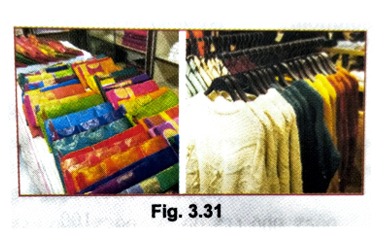
Piyush sells a saree with an 8% profit and a sweater with a 10% discount, earning a total of Rs 1008. If he had sold the saree with a 10% profit and the sweater with an 8% discount, he would have earned Rs 1028. Denote the original price of a saree and a sweater by Rs x and Rs y respectively and answer the following questions:

(i) Find the algebraic equation which represents the first situation.

  • 1008


  • 1059


  • 1001


  • 1005


(1)

Price of a saree at 8% profit + Price of a sweater at 10% discount = ?1008

∴ (100 + 8)% of x + (100 – 10)% of y = 1008

⇒ 108% of x + 90% of y = 1008

⇒ 1.08x + 0.9y = 1008 ...........(i)


Q 18 :

Piyush sells a saree with an 8% profit and a sweater with a 10% discount, earning a total of Rs 1008. If he had sold the saree with a 10% profit and the sweater with an 8% discount, he would have earned Rs 1028. Denote the original price of a saree and a sweater by Rs x and Rs y respectively and answer the following questions:

(ii) Find the algebraic equation which represents the second situation.

  • 1028


  • 1029


  • 1025


  • 1020


(1)

Price of a saree at 10% profit + Price of a sweater at 8% discount = ?1028

∴ (100 + 10)% of x + (100 – 8)% of y = 1028

⇒ 110% of x + 92% of y = 1028

⇒ 1.1x + 0.92y = 1028 ...........(ii)


Q 19 :

Piyush sells a saree with an 8% profit and a sweater with a 10% discount, earning a total of Rs 1008. If he had sold the saree with a 10% profit and the sweater with an 8% discount, he would have earned Rs 1028. Denote the original price of a saree and a sweater by Rs x and Rs y respectively and answer the following questions:

(iii) (a) Where does the linear equation represented by the first situation intersect the X-axis?

  • 2800/3


  • -2800/3


  • 2500/3


  • 2800/30


(1)

(a) At x-axis, y = 0 ⇒ 1.08x = 1008 ⇒ x = 1008 / 1.08 = 2800/3


Q 20 :

Piyush sells a saree with an 8% profit and a sweater with a 10% discount, earning a total of Rs 1008. If he had sold the saree with a 10% profit and the sweater with an 8% discount, he would have earned Rs 1028. Denote the original price of a saree and a sweater by Rs x and Rs y respectively and answer the following questions:

(iii) (b) Where does the linear equation represented by the second situation intersect the Y-axis?

  • -25700/23


  • 25700/23


  • 26700/23


  • 22700/23


(2)

At y-axis, x = 0 ⇒ 0.92y = 1028 ⇒ y = 1028 / 0.92 = 25700/23