Q 1 :

Raju installed a fence around a circular field, with the total cost amounting to Rs 6,000 at a rate of Rs 30 per m. He now plans to plough the field.

Based on the above information answer the following questions:


(i) What is the perimeter of the field?

  • 200 m


  • 400 m


  • 600 m


  • 300 m


(1)

Let r m be the radius of the circular field.

Length of fence=Perimeter of circle=2πrTotal cost of fencing=2πr×306000=60πr100=πrr=100π(i) Perimeter of the field2πr=2π×100π=200 m


Q 2 :

Raju installed a fence around a circular field, with the total cost amounting to Rs 6,000 at a rate of Rs 30 per m. He now plans to plough the field.

Based on the above information answer the following questions:


(ii) What is the radius of the field?

  • 1811 m


  • 1911 m


  • 1910 m


  • 2911 m


(2)

Radius of the field 

r=100π=70022=35011=31911 m


Q 3 :

Raju installed a fence around a circular field, with the total cost amounting to Rs 6,000 at a rate of Rs 30 per m. He now plans to plough the field.

Based on the above information answer the following questions:


(iii) (a) What is the area of the field?

  • 2181.81 m2


  • 3181.82 m2


  • 3180.82 m2


  • 3181.81 m2


(4)

Area of the field

πr2=π×100π2=π×100×100π2=10000π=10000227=70000223181.81 m2


Q 4 :

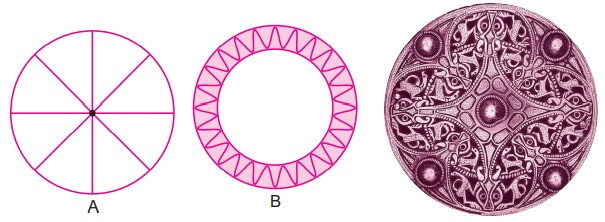
A brooch is a small piece of jewelry that features a pin on the back, allowing it to be fastened to a dress, blouse, or coat. Below are designs for some brooches.

Design A: Brooch A is crafted from silver wire in the shape of a circle with a diameter of 28 mm. The wire is also used to create 4 diameters, dividing the circle into 8 equal parts.

Design B: Brooch B is made with two colors, gold and silver. The outer portion is made of gold. The circumference of the silver section is 44 mm, and the gold section is uniformly 3 mm wide.

Based on the above information answer the following questions:


(i) In design A, what is the total length of the wire required?

  • 200 m

  • 400 m

  • 600 m

  • 500 m

(1)

In design A, diameter of the circle is 28 mm.

Circumference of the circle=π×28 mm=227×28 mm=88 mm

Length of the wire used in 4 diameters

=4×28 mm=112 mm

Total length of the required wire=112+88 mm=200 mm


Q 5 :

Raju installed a fence around a circular field, with the total cost amounting to Rs 6,000 at a rate of Rs 30 per m. He now plans to plough the field.

Based on the above information answer the following questions:


(iii) (b) Find the cost of ploughing the field at the rate of Rs 0.50 per m².

  • 1591.90


  • -1590.90


  • 1490.90


  • 1590.90


(4)

Total cost of ploughing the field

3181.81×0.50 = Rs 1590.90


Q 6 :

A brooch is a small piece of jewelry that features a pin on the back, allowing it to be fastened to a dress, blouse, or coat. Below are designs for some brooches.

Design A: Brooch A is crafted from silver wire in the shape of a circle with a diameter of 28 mm. The wire is also used to create 4 diameters, dividing the circle into 8 equal parts.

Design B: Brooch B is made with two colors, gold and silver. The outer portion is made of gold. The circumference of the silver section is 44 mm, and the gold section is uniformly 3 mm wide.

Based on the above information answer the following questions:


(ii) In design A, what is the area of each part of the brooch?

  • 77 mm2


  • 55 mm2


  • 70 mm2


  • 72 mm2


(1)

Area of each part of brooch

=18Area of the circle=18×227×142mm2=77 mm2


Q 7 :

A brooch is a small piece of jewelry that features a pin on the back, allowing it to be fastened to a dress, blouse, or coat. Below are designs for some brooches.

Design A: Brooch A is crafted from silver wire in the shape of a circle with a diameter of 28 mm. The wire is also used to create 4 diameters, dividing the circle into 8 equal parts.

Design B: Brooch B is made with two colors, gold and silver. The outer portion is made of gold. The circumference of the silver section is 44 mm, and the gold section is uniformly 3 mm wide.

Based on the above information answer the following questions:


(iii) (a) In design B, find the circumference of the outer part (golden).

  • 7 mm


  • 6 mm


  • 5 mm


  • 4 mm


(1) 

Let mm be the radius of the silver part. Then,

2×227×r=44r=7 mm.


Q 8 :

A brooch is a small piece of jewelry that features a pin on the back, allowing it to be fastened to a dress, blouse, or coat. Below are designs for some brooches.

Design A: Brooch A is crafted from silver wire in the shape of a circle with a diameter of 28 mm. The wire is also used to create 4 diameters, dividing the circle into 8 equal parts.

Design B: Brooch B is made with two colors, gold and silver. The outer portion is made of gold. The circumference of the silver section is 44 mm, and the gold section is uniformly 3 mm wide.

Based on the above information answer the following questions:


(iii) (b) A boy is playing with brooch B. He makes revolutions with it along its edge. How many complete revolutions must it take it cover 80π mm?

  • n = 6


  • n = 4


  • n = 3


  • n = 2


(2)

Outer circumference of Brooch B:

 =2π×10 mm=20π mmSuppose to cover 80π mm brooch B takes ncomplete revolutions. Then,20π×n=80πn=4


Q 9 :

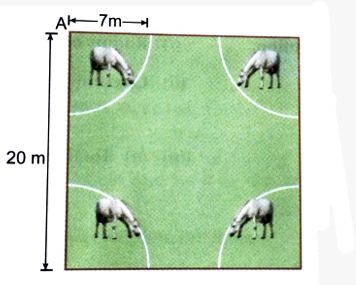
A stable owner has four horses. He usually ties these horses with 7 m long rope to pegs at each corner of a square shaped grass field of 20 m length, to graze in his farm. But tying with rope sometimes results in injuries to his horses, so he decided to build fence around the area so that each horse can graze.

Based on the above information answer the following questions:


(i) Find the area of the square shaped grass field.

  • 200 m2


  • 400 m2


  • 100 m2


  • 250 m2


(2)

Area of the square shaped grass field =20 m×20 m=400 m2


Q 10 :

A stable owner has four horses. He usually ties these horses with 7 m long rope to pegs at each corner of a square shaped grass field of 20 m length, to graze in his farm. But tying with rope sometimes results in injuries to his horses, so he decided to build fence around the area so that each horse can graze.

Based on the above information answer the following questions:


(ii) (a) Find the area of the total field in which these horses can graze.

  • 150 m2


  • 152 m2


  • 145 m2


  • 154 m2


(4)

Area of the total field in which these horses can graze 

=4×90°360°×πr2=πr2=227×(7)2=154 m2


Q 11 :

A stable owner has four horses. He usually ties these horses with 7 m long rope to pegs at each corner of a square shaped grass field of 20 m length, to graze in his farm. But tying with rope sometimes results in injuries to his horses, so he decided to build fence around the area so that each horse can graze.

Based on the above information answer the following questions:


(ii) (b) If the length of the rope of each horse is increased from 7 m to 10 m, find the area grazed by one horse. (Use π = 3.14)

  • 78.5 m2


  • 68.5 m2


  • 73.5 m2


  • 69.5 m2


(1)

When length of rope is increased, we have r = 10 m

Area grazed by one horse 

=90360×πr2=14×3.14×(10)2=14×3.14×100=3144=78.5 m2


Q 12 :

A stable owner has four horses. He usually ties these horses with 7 m long rope to pegs at each corner of a square shaped grass field of 20 m length, to graze in his farm. But tying with rope sometimes results in injuries to his horses, so he decided to build fence around the area so that each horse can graze.

Based on the above information answer the following questions:


(iii) What is area of the field that is left ungrazed, if the length of the rope of each horse is 7 m?

  • 246 m2


  • 245 m2


  • 235 m2


  • -246 m2


(1)

Area of the field left ungrazed 

=Area of square field-4×area of field in which horses can graze=(20)2-4×90360×227×(7)2=400-154=246m2


Q 13 :

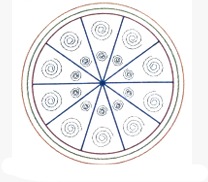
A brooch is crafted from silver wire in the shape of a circle with a diameter of 35 mm. The wire is also used to create 5 diameters, dividing the circle into 10 equal sectors, as shown in the figure.

Based on the above information, answer the following questions:


(i) What is the radius of the circle?

  • 17.5 mm


  • 16.5 mm


  • 13.5 mm


  • 10.5 mm


(1)

Radius of the circle =352 mm=17.5 mm


Q 14 :

A brooch is crafted from silver wire in the shape of a circle with a diameter of 35 mm. The wire is also used to create 5 diameters, dividing the circle into 10 equal sectors, as shown in the figure.

Based on the above information, answer the following questions:


(ii) What is the circumference of the brooch?

  • 110 mm


  • 120 mm


  • 115 mm


  • 129 mm


(1)

Circumference of the brooch =2πr

=2×227×17.5=44×2.5=110 mm


Q 15 :

A brooch is crafted from silver wire in the shape of a circle with a diameter of 35 mm. The wire is also used to create 5 diameters, dividing the circle into 10 equal sectors, as shown in the figure.

Based on the above information, answer the following questions:


(iii) (a) What is the total length of silver wire required?

  • 250 mm


  • 282 mm


  • 285 mm


  • 200 mm


(3)

Total length of the required wire

=2πr+5d=110+5×35=110+175=285 mm


Q 16 :

A brooch is crafted from silver wire in the shape of a circle with a diameter of 35 mm. The wire is also used to create 5 diameters, dividing the circle into 10 equal sectors, as shown in the figure.

Based on the above information, answer the following questions:


(iii) (b) What is the area of each sector of the brooch?

  • 96.25 mm2


  • 86.25 mm2


  • 94.25 mm2


  • 93.25 mm2


(1)

Angle subtended by arc at each sector =360°10=36°

∴ Area of each sector =36°360°×π×3522=110×227×352×352=96.25 mm2


Q 17 :

A pendulum clock uses a swinging weight as its timekeeping element. Invented in 1656 by Christiaan Huygens, the pendulum clock was the most precise timekeeper in the world, which is why it became so widely used. Its accuracy helped support the faster pace of life necessary for the Industrial Revolution. By the 1930s and 40s, home pendulum clocks were largely replaced by more affordable synchronous electric clocks. Today, pendulum clocks are mostly valued for their decorative and antique qualities.

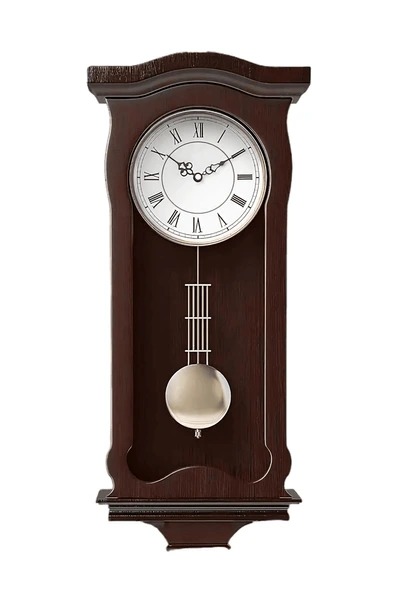
Dhaani bought a pendulum clock for her living room. The clock features a small pendulum with a length of 45 cm. The minute hand is 14 cm long, while the hour hand is 6 cm long.

Based on the above information, answer the following questions


(i) What is the area swept by the minute hand in 14 minutes?

  • 143.73 cm2


  • 143.72 cm2


  • 140.73 cm2


  • 139.73 cm2


(1)

Angle described by a minute hand in 14 minutes =6°×14=84°

Radius r=14cm (length of minute hand)Area swept by the minute hand=84°360°×227×(14)2=215615143.73 cm2


Q 18 :

A pendulum clock uses a swinging weight as its timekeeping element. Invented in 1656 by Christiaan Huygens, the pendulum clock was the most precise timekeeper in the world, which is why it became so widely used. Its accuracy helped support the faster pace of life necessary for the Industrial Revolution. By the 1930s and 40s, home pendulum clocks were largely replaced by more affordable synchronous electric clocks. Today, pendulum clocks are mostly valued for their decorative and antique qualities.

Dhaani bought a pendulum clock for her living room. The clock features a small pendulum with a length of 45 cm. The minute hand is 14 cm long, while the hour hand is 6 cm long.

Based on the above information, answer the following questions


(ii) What is the angle described by hour hand in 10 minutes?

  • 2°


  • 5°


  • 3°


  • 1°


(2)

Since in 12 hours, a hour hand describes 360°,

In 1 hour, angle described=360°12=30°Therefore, angle described by hour hand in 10 minutes=(30×1060)°=5°


Q 19 :

A pendulum clock uses a swinging weight as its timekeeping element. Invented in 1656 by Christiaan Huygens, the pendulum clock was the most precise timekeeper in the world, which is why it became so widely used. Its accuracy helped support the faster pace of life necessary for the Industrial Revolution. By the 1930s and 40s, home pendulum clocks were largely replaced by more affordable synchronous electric clocks. Today, pendulum clocks are mostly valued for their decorative and antique qualities.

Dhaani bought a pendulum clock for her living room. The clock features a small pendulum with a length of 45 cm. The minute hand is 14 cm long, while the hour hand is 6 cm long.

Based on the above information, answer the following questions


(iii) (a) What is the distance covered by the tip of hour hand in 3.5 hours?

  • 11 cm


  • 13 cm


  • 12 cm


  • 5 cm


(1)

Angle described by the tip of hour hand in 3.5 hours

=30°×3.5=105°Distance covered=105°360°×2×227×6=11 cm


Q 20 :

A pendulum clock uses a swinging weight as its timekeeping element. Invented in 1656 by Christiaan Huygens, the pendulum clock was the most precise timekeeper in the world, which is why it became so widely used. Its accuracy helped support the faster pace of life necessary for the Industrial Revolution. By the 1930s and 40s, home pendulum clocks were largely replaced by more affordable synchronous electric clocks. Today, pendulum clocks are mostly valued for their decorative and antique qualities.

Dhaani bought a pendulum clock for her living room. The clock features a small pendulum with a length of 45 cm. The minute hand is 14 cm long, while the hour hand is 6 cm long.

Based on the above information, answer the following questions


(iii) (b) If the tip of pendulum covers a distance of 66 cm in complete oscillation, what is the angle described by pendulum at the centre?

  • 44°


  • 39°


  • 42°


  • 40°


(3)

Length of the pendulum

 r=45 cmLet θ be the angle described by pendulum at the centreDistance covered by a pendulum in complete oscillation=2×θ360°×2πrGiven distance = 66 cm66=2×θ360°×2×227×4566=88×457×360°×θ66=117θθ=66×711=42°


Q 21 :

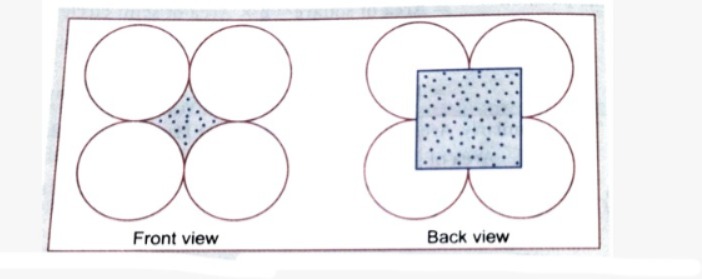
Pragati made a paper flower using 4 identical circles and a dotted square. The front view and back view of the flower is as shown below.

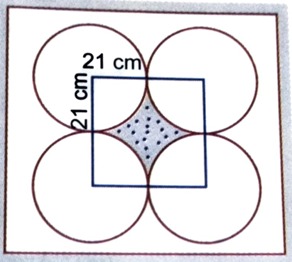
The diameter of each circle is the same as the length of the side of the square, 42 m.

Based on the above information, answer the following questions:


(i) Find the perimeter of the flower in the back view. Show your work.

  • 564 m


  • 555 m


  • 552 m


  • 550 m


(1)

We have,
Length of the side of the square = 42 m
Radius of the circle = 21 m

Arc length of four sectors of circle (overlapped by square)

=4×90°360°×2π(21)=2×227×21=132 m Arc length of four circles without square portion=4×2πr-132=8×227×21-132=528-132=396 mAlso, perimeter of square =4×42=168 m Required perimeter of the flower=396+168=564 m


Q 22 :

Pragati made a paper flower using 4 identical circles and a dotted square. The front view and back view of the flower is as shown below.

The diameter of each circle is the same as the length of the side of the square, 42 m.

Based on the above information, answer the following questions:


(ii) Find the area of the dotted region from the front view. Show your work.

  • 375 m2


  • 378 m2


  • 373 m2


  • 370 m2


(2)

Area of dotted region (front view)

Area of square Area of four sectors

=(42)2-4×90°360°×227×(21)2=1764-227×21×21=1764-1386=378 m2


Q 23 :

Pragati made a paper flower using 4 identical circles and a dotted square. The front view and back view of the flower is as shown below.

The diameter of each circle is the same as the length of the side of the square, 42 m.

Based on the above information, answer the following questions:


(iii) (a) Is the area of the flower the same in the front and back view? Justify your answer with proper working. (Take π = 22/7)

  • View are equal


  • View are not equal


  • none of these


  • Only Front 


(1)

We have,

Area of the flower from front view

=Area of the four circles Area of dotted region

=4×πr2+378=4×227×(21)2+378=887×21×21+378=5544+378=5922 m2

Area of the flower from back view

=4×34×Area of a circle+Area of a square=3×πr2+(42)2

=3×227×21×21+1764=4158+1764=5922 m2

Yes, area of the flower from front view and back view are equal.


Q 24 :

Pragati made a paper flower using 4 identical circles and a dotted square. The front view and back view of the flower is as shown below.

The diameter of each circle is the same as the length of the side of the square, 42 m.

Based on the above information, answer the following questions:


(iii) (b) Find the total area of dotted and non-dotted region in back view.

  • 5920 m2


  • 5910 m2


  • 5820 m2


  • 5922 m2


(4)

Total area of back view

=Area of square +4  × Area of one longer sector of circle

Each longer sector angle:

(360°-90°)=270°=(42)2+4×270°360°×227×212=1764+4×4158=(1764+4158)=5922 m2


Q 25 :

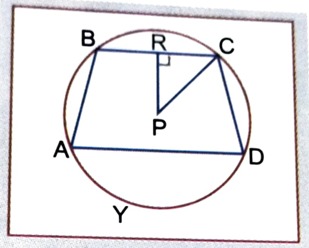
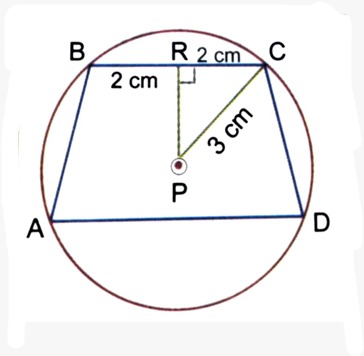
The diagram alongside shows a trapezium enclosed within a circle with a radius of 3 cm.

The length of AD is 5.5 cm and length of BC is 4 cm.

Based on the above information, answer the following questions:


(i) What is the length of RP?

  • 5 cm


  • 4 cm


  • 1 cm


  • 2 cm


(1) 

We have radius of the circle PC = 3 cm, r = 3 cm

Also, ABCD is a trapezium such that AD  BC and BC=4 cm

 PR bisects the chord BC of the circle because PR  BC. 

BR=RC=2 cmIn right triangle PRC,we have: PC2=PR2+RC2

(3)2=PR2+(2)29=PR2+4PR2=5PR=5 cm


Q 26 :

The diagram alongside shows a trapezium enclosed within a circle with a radius of 3 cm.

The length of AD is 5.5 cm and length of BC is 4 cm.

Based on the above information, answer the following questions:


(ii) Find area of trapezium ABCD.

  • 16.624 cm2


  • 16.615 cm2


  • 16.625 cm2


  • 15.625 cm2


(3)

We have distance between parallel lines AD and BC = 3.5 cm, h = 3.5 cm

Also, AD=5.5 cm, BC=4 cmArea of trapezium:=12×(AD+BC)×h=12×(5.5+4)×3.5=12×9.5×3.5=16.625 cm2


Q 27 :

The diagram alongside shows a trapezium enclosed within a circle with a radius of 3 cm.

The length of AD is 5.5 cm and length of BC is 4 cm.

Based on the above information, answer the following questions:


(iii) The distance between AD and BC is 3.5 cm. What is the area of the circle outside the trapezium?

(Useπ=227)

  • 11.60 cm2


  • 11.66 cm2


  • 11.35 cm2


  • 11.56 cm2


(2)

Area of the circle:

π×(3)2=227×9=28.285 cm2

Area of the circle outside the trapezium:

=Area of circle-Area of trapezium

=28.285-16.625=11.66 cm2