

Q 1 :

Assertion (A): If the circumference of the circle is 176 cm, then its radius is 28 cm.

Reason (R): Circumference of a circle with radius r=2πr

  • Both Assertion (A) and Reason (R) are true and Reason (R) is the correct explanation of Assertion (A)


  • Both Assertion (A) and Reason (R) are true but Reason (R) is not the correct explanation of Assertion (A).


  • Assertion (A) is true but Reason (R) is false.


  • Assertion (A) is false but Reason (R) is true.


(1)

We have,
circumference of a circle = 176 cm

2πr=1762×227×r=176r=176×744=28 cmr=28 cmBoth Assertion (A) and Reason (R) are true and Reason (R) is the correct explanation of Assertion (A).


Q 2 :

Assertion (A): A wire is looped in the form of a circle of radius 28 cm. It is bent into a square. Then the area of the square is 1936 cm2.

Reason (R): Angle described by a minute hand in 1 minute =6°

  • Both Assertion (A) and Reason (R) are true and Reason (R) is the correct explanation of Assertion (A)


  • Both Assertion (A) and Reason (R) are true but Reason (R) is not the correct explanation of Assertion (A).


  • Assertion (A) is true but Reason (R) is false


  • Assertion (A) is false but Reason (R) is true.


(2)

We have radius of circle = 28  cm, therefore length of wire = circumference of circle

Length of wire=2πr=2×227×28=176 cm

Since, this wire is bent to form a square

Perimeter of square=length of wire

4x=176x=44 cm  (Where x is the length of the side of the square)

Area of square=x2=(44)2=1936 cm2

Also, Angle described by a minute hand in a minute =6°

Both Assertion (A) and Reason (R) are true but Reason (R) is not the correct explanation of Assertion (A).


Q 3 :

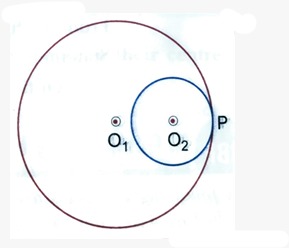
Assertion (A): Two circles touch internally. The sum of their areas is 116π cm2 and the distance between their centres is 6 cm. Then, radii of the circles are 4 cm and 10 cm.

Reason (R): When two circles touch internally, then difference of their radii is equal to distance between their centres.

  • Both A and R are true, and R is the correct explanation of A.


  • Both A and R are true, but R is not the correct explanation of A


  • A is true, but R is false.


  • A is false, but R is true.


(1)

Let two circles having centres O1,O2 and radii r1,r2 touch internally at point .

Sum of their areas=116π cm2πr12+πr22=116πr12+r22=116...(i)Also,r1-r2=6...(ii)The values r1=10 cm and r2=4 cm satisfy both equations(i)and(ii).

∴ Both Assertion (A) and Reason (R) are true and Reason (R) is the correct explanation of Assertion (A).


Q 4 :

Assertion (A): The length of the minute hand of a clock is 7 cm. Then the area swept by the minute hand in 5 minutes is 776 cm2.

Reason (R): The length of an arc of a sector of angle θ and radius r is given by l=2πr×θ360°

  • Both Assertion (A) and Reason (R) are true and Reason (R) is the correct explanation of Assertion (A).


  • Both Assertion (A) and Reason (R) are true but Reason (R) is not the correct explanation of Assertion (A).


  • Assertion (A) is true but Reason (R) is false


  • Assertion (A) is false but Reason (R) is true.


(2)

We have the length of the minute hand = 7 cm
∴ Radius of the sector of the circle = 7 cm 

and angle made by minute hand in 5 minutes = θ = 30° Area swept by the minute hand in 5 minutes=30°360°×π×(7)2=112×227×7×7=776 cm2Also, the length of an arc of a sector of angle θ and radius r is given byl=2πr×θ360° Both Assertion (A) and Reason (R) are true but Reason (R) is not the correct explanation of Assertion (A).


Q 5 :

Assertion (A): In a circle of radius 6 cm, the angle of a sector 60°. Then the area of the sector is 1867 cm2.

Reason (R): Circumference of the circle with radius r is  2πr.

  • Both Assertion (A) and Reason (R) are true and Reason (R) is the correct explanation of Assertion (A)


  • Both Assertion (A) and Reason (R) are true but Reason (R) is not the correct explanation of Assertion (A).


  • Assertion (A) is true but Reason (R) is false.


  • Assertion (A) is false but Reason (R) is true.


(2)

We have

 r=6 cm and central angle θ=60° Area of sector=θ360°×πr2=60°360°×227×(6)2=16×227×36=1327 cm2=1867 cm2Also, circumference of the circle with radius r is 2πrBoth Assertion (A) and Reason (R) are true but Reason (R) is not the correct explanation of Assertion (A).


Q 6 :

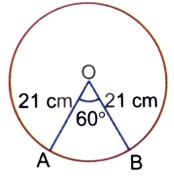
Assertion (A): A chord of a circle of radius 14 cm makes a right angle at the centre. The area of the minor segment is 56 cm².

Reason (R): Angle described by the minute hand in 5 minutes = 6°

  • Both Assertion (A) and Reason (R) are true and Reason (R) is the correct explanation of Assertion (A)


  • Both Assertion (A) and Reason (R) are true but Reason (R) is not the correct explanation of Assertion (A)


  • Assertion (A) is true but Reason (R) is false.


  • Assertion (A) is false but Reason (R) is true.


(3)

Area of minor segmen

=Area of sector-Area of OAB=90°360°×π×(14)2 -12×14×14

=14×227×14×14- 7×14=154-98=56 cm2 Assertion (A) is true.

Angle described by the minute hand in 5 minutes = 5 × 6° = 30° So Reason (R) is false.


Q 7 :

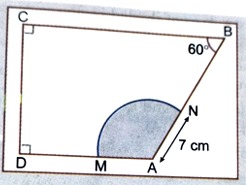
Assertion (A): Area of shaded region =1543cm2

Reason (R): MAN=120°area of sector=θ360°πr2.

  • Both Assertion (A) and Reason (R) are true and Reason (R) is the correct explanation of Assertion (A).


  • Both Assertion (A) and Reason (R) are true but Reason (R) is not the correct explanation of Assertion (A).


  • Assertion (A) is true but Reason (R) is false.


  • Assertion (A) is false but Reason (R) is true.


(1)

From the figure, 

DCB+CDA+MAB+ABC=360°Sum of angles of a quadrilateral90°+90°+MAB+ABC=360°MAB+ABC=180°MAN=180°-ABC=120°Area of the shaded region=120°360°×227×7×7=1543cm2

Thus, Assertion (A) and Reason (R) both are true and Reason (R) is correct explanation of Assertion (A).


Q 8 :

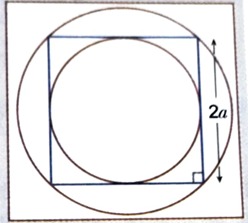
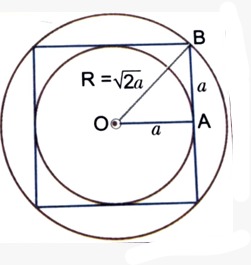
In the figure shown alongside, side length of the square is 2a units.

Assertion (A): Area of smaller circle = Area enclosed between two circles.

Reason (R):Radius of outer circle =2×(Radius of inner circle).

  • Both Assertion (A) and Reason (R) are true and Reason (R) is the correct explanation of Assertion (A).


  • Both Assertion (A) and Reason (R) are true but Reason (R) is not the correct explanation of Assertion (A).


  • Assertion (A) is true but Reason (R) is false.


  • Assertion (A) is false but Reason (R) is true.


(1)

Let R and r be the radii of outer and inner circle respectively. 
Diameter of inner circle = 2a


r=aR=a2+a2=2aArea enclosed between two circles=Area of outer circle-Area of inner circle=πR2-πr2=π(2a)2-πa2=2πa2-πa2=πa2=Area of smaller circle

Both Assertion (A) and Reason (R) are true and Reason (R) is correct explanation of Assertion (A).


Q 9 :

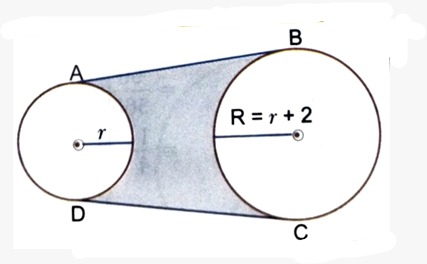
Consider the figure shown alongside:

Assertion (A): Area of shaded region = Area of quadrilateral ABCD − Area of smaller semi-circle − Area of larger semi-circle.

Reason (R): AB  is not parallel to CD.

  • Both Assertion (A) and Reason (R) are true and Reason (R) is the correct explanation of Assertion (A).


  • Both Assertion (A) and Reason (R) are true but Reason (R) is not the correct explanation of Assertion (A).


  • Assertion (A) is true but Reason (R) is false.


  • Assertion (A) is false but Reason (R) is true.


(2)

Here, we can say,
Area of shaded region 
=Area of quadrilateral ABCD-Area of smaller semi-circle-Area of larger semi-circle

Also,if R=r,then only ABCDBut here R=r+2AB is not parallel to CD

Thus, both Assertion (A) and Reason (R) are true but Reason (R) is not the correct explanation of Assertion (A).