

These are regarded as major causes of biodiversity loss: [2024]
A. Over exploitation
B. Co-extinction
C. Mutation
D. Habitat loss and fragmentation
E. Migration
Choose the correct option.
A, C and D only
A, B, C and D only
A, B and E only
A, B and D only
(4)
The major causes of biodiversity loss (accelerated rates of species extinctions) is largely due to 'The Evil Quartet' which includes over-exploitation, co-extinction, alien species invasion and habitat loss and fragmentation.
List of endangered species was released by [2024]
GEAC
WWF
FOAM
IUCN
Tropical regions show greatest level of species richness because [2024]
A. tropical latitudes have remained relatively undisturbed for millions of years, hence more time was available for species diversification.
B. tropical environments are more seasonal.
C. more solar energy is available in tropics.
D. constant environments promote niche specialisation.
E. tropical environments are constant and predictable.
Choose the correct answer from the options given below.
A, C, D and E only
A and B only
A, B and E only
A, B and D only
(1)
Tropical regions show greatest level of species richness because of the following reasons:
(I) Tropical latitudes have remained relatively undisturbed for millions of years and thus, had a long evolutionary time for species diversification.
(II) Tropical environments are less seasonal, relatively more constant and predictable. Such constant environments promote niche specialisation and lead to a greater species diversity.
(III) There is more solar energy available in the tropics, which contributes to higher productivity; this in turn might contribute indirectly to greater diversity.
Match List I with List II. [2024]
| List I | List II |
|---|---|
| A. Robert May | I. Species-area relationship |
| B. Alexander von Humboldt | II. Long term ecosystem experiment using outdoor plots |
| C. Paul Ehrlich | III. Global species diversity at about 7 million |
| D. David Tilman | IV. Rivet popper hypothesis |
Choose the correct answer from the options given below:
A-II, B-III, C-I, D-IV
A-III, B-I, C-IV, D-II
A-I, B-III, C-II, D-IV
A-III, B-IV, C-II, D-I
In 'Rivet Popper hypothesis', Paul Ehrlich compared the rivets in an airplane to [2023]
species within a genus
genetic diversity
ecosystem
genera within a family
(1)
The Rivet popper hypothesis was proposed by Stanford ecologist Paul Ehrlich as an analogy. He compared the rivets in an airplane to species within a genus. According to him, in an airplane (ecosystem), all parts are joined together using thousands of rivets (species). If every passenger travelling in it starts popping a rivet (causing a species to become extinct), it may not affect flight safety (proper functioning of the ecosystem) initially, but as more and more rivets are removed, the plane becomes dangerously weak over a period of time. Loss of rivets on the wings (species that drive major ecosystem functions) is obviously a more serious threat to flight safety than loss of a few rivets on the seats or windows inside the plane.
The species of plants that plays a vital role in controlling the relative abundance of other species in a community is called ______. [2023]
alien species
endemic species
exotic species
keystone species
(4)
Keystone species are those species which has significant and disproportionately large influence on the community structure and characteristics. It has often considerably low abundance and biomass as compared to dominant species. Removal of such species causes serious disruption in structure and function of community.
Which of the following is/are cause(s) of biodiversity losses? [2023]
Over-exploitation, habitat loss and fragmentation
Climate change only
Over-exploitation only
Habitat loss and fragmentation only
(1)
There are four major causes of biodiversity losses which are collectively called as the evil quartet. These are habitat loss and fragmentation, over-exploitation, alien species invasion and co-extinctions. However, other factors are also intensifying extinctions like disturbance and degradation, pollution, intensive agriculture and forestry.
Among 'The Evil Quartet', which one is considered the most important cause driving extinction of species? [2023]
Alien species invasions
Co-extinctions
Habitat loss and fragmentation
Over exploitation for economic gain
(3)
Habitat loss and fragmentation is the most important cause driving animals and plants to extinction. The most dramatic examples of habitat loss come from Amazon tropical rain forest.
Habitat loss and fragmentation, over exploitation, alien species invasion and co-extinction are causes for [2022]
population explosion
competition
biodiversity loss
natality
(3)
There are four major causes (The Evil Quartet) of biodiversity losses: habitat loss and fragmentation, over exploitation, alien species invasion and co-extinctions.
Which of the following regions of the globe exhibits highest species diversity? [2020]
Western Ghats of India
Madagascar
Himalayas
Amazon forests
According to Robert May, the global species diversity is about [2020]
1.5 million
20 million
50 million
7 million
Which of the following is the most important for animals and plants being driven to extinction? [2019]
Alien species invasion
Habitat loss and fragmentation
Drought and floods
Economic exploitation
(2)
Habitat loss and fragmentation is the most important cause of driving the animals and plants to extinction. When large habitats are broken into small fragments due to various human activities, mammals and birds requiring large territories and certain animals with migratory habitats are badly affected, leading to population declines. The same can be applicable to the plant (forest) loss and degradation as millions of species are being cut and cleared for the expansion of agricultural land, harvesting timber, forest fire, as well as overgrazing.
Decline in the population of Indian native fishes due to introduction of Clarias gariepinus in river Yamuna can be categorised as [2019]
co-extinction
habitat fragmentation
over-exploitation
alien species invasion
Alexander von Humboldt described for the first time [2017]
laws of limiting factor
species area relationships
population growth equation
ecological biodiversity.
(2)
Alexander von Humboldt described species area relationship for the first time. He observed that within a region, species richness increases with increasing explored area, but only upto a limit.
Which of the following is correctly matched? [2016]
Aerenchyma – Opuntia
Age pyramid – Biome
Parthenium hysterophorus – Threat to biodiversity
Stratification – Population
(3)
Parthenium hysterophorus is commonly known as congress grass or carrot weed. It is herbaceous annual plant of Family Asteraceae. It is a deadly invasive, noxious weed infesting cropped and non-cropped areas. It rapidly colonises area replacing the native vegetation and causes a number of human health related problems such as skin allergy, rhinitis and eye irritations. Also, being toxic and unpalatable it causes fodder scarcity. Hence, it is considered a threat to the biodiversity.
Red list contains data or information on [2016]
all economically important plants
plants whose products are in international trade
threatened species
marine vertebrates only
(3)
A red data book or red list is a catalogue of taxa facing risk of extinction. Red data book or red list was initiated in 1963.
Which is the national aquatic animal of India? [2016]
Blue whale
Sea-horse
Gangetic shark
River dolphin
(4)
River dolphin found in holy river Ganga, Brahmaputra, Indus and its tributaries is the National aquatic animal of India. Presence of river dolphin in Ganga indicates pure and freshwater.
Which of the following is the most important cause of animals and plants being driven to extinction? [2016]
Habitat loss and fragmentation
Co-extinctions
Over-exploitation
Alien species invasion
(1)
Destruction of natural habitat causes the most serious threat to the biodiversity. Over-population, urbanisation and industrialisation lead to the destruction or fragmentation of natural habitats to fulfill the requirement of additional land. Loss of habitat results in annihilation of plants, microorganisms and forcing out of animals which in alien lands die out after some time. Fragmentation of habitats results in disruption of complex interactions amongst species, destruction of species in the cleared regions, annihilation of species restricted to deeper undisturbed parts of forests and decreased biodiversity in the habitat fragments.
A species facing extremely high risk of extinction in the immediate future is called [2014]
vulnerable
endemic
critically endangered
extinct
(3)
The taxon under critically endangered category are facing very high risk of extinction in the wild and can become extinct at any moment in the immediate future.
The organization which publishes the Red list of species is [2014]
ICFRE
IUCN
UNEP
WWF
(2)
IUCN is International Union of Conservation of Nature and Natural Resources which is now called World Conservation Union (WCU). It has its headquarters at Morges, Switzerland. It maintains a red data book or red list which is a catalogue of taxa facing risk of extinction. Red data book or red list was initiated in 1963. The Red list of year 2000 has made assessment of 18,000 species.
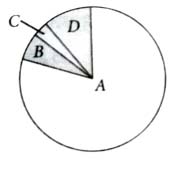
Given below is the representation of the extent of global diversity of invertebrates. What groups the four portions (A-D) represent respectively? [2014]

A - Insects, B - Crustaceans, C - Other animal groups, D - Molluscs
A - Crustaceans, B - Insects, C - Molluscs, D - Other animal groups
A - Molluscs, B - Other animal groups, C - Crustaceans, D - Insects
A - Insects, B - Molluscs, C - Crustaceans, D - Other animal groups