

Q 1 :

Which one of the following compounds will readily react with dilute NaOH?                           [2024]

  • C6H5OH


  • C6H5CH2OH


  • (CH3)3COH


  • C2H5OH


(1)

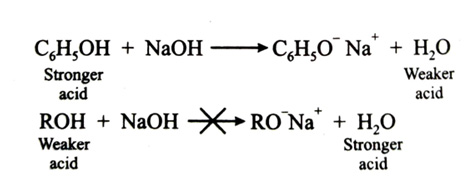
Acidic strength order is:
Phenols > CH3OH > water > alcohols

Acid-base reactions proceed from stronger to weaker side.


Q 2 :

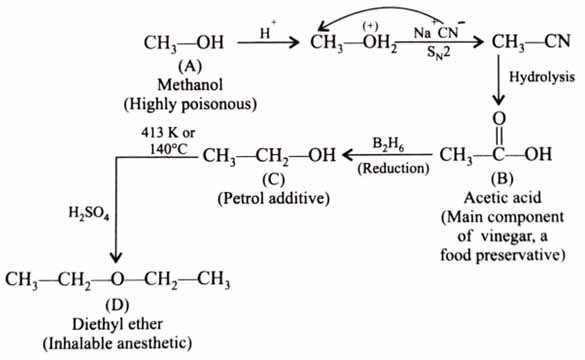
A toxic compound “A” when reacted with NaCN in aqueous acidic medium yields an edible cooking component and food preservative ‘B’. ‘B’ is converted to ‘C’ by diborane and can be used as an additive to petrol to reduce emission. “C” upon reaction with oleum at 140°C yields an inhalable anesthetic “D”. Identify “A”, “B”, “C” and “D”, respectively.          [2025]

  • Methanol; formaldehyde; methyl chloride; chloroform


  • Ethanol; acetonitrile; ethylamine; ethylene


  • Methanol; acetic acid; ethanol; diethyl ether


  • Acetaldehyde; 2-hydroxypropanoic acid; propanoic acid; dipropyl ether


(3)


Q 3 :

Given below are two statements:                   [2025]

Statement I: Dimethyl ether is completely soluble in water. However, diethyl ether is soluble in water to a very small extent.

Statement II: Sodium metal can be used to dry diethyl ether and not ethyl alcohol.

In the light of given statements, choose the correct answer from the options given below:

  • Statement I is false but Statement II is true.


  • Both Statement I and Statement II are false.


  • Statement I is true but Statement II is false.


  • Both Statement I and Statement II are true.


(4)

Statement I: Due to hydrogen bonding with water dimethyl ether is completely soluble in water. However due to increased hydrophobic part in diethyl ether, its solubility in water is less than that of dimethyl ether.

Statement II: Ethyl alcohol reacts with Na metal to evolve hydrogen.

C2H5OH+NaC2H5ONa+12H2


Q 4 :

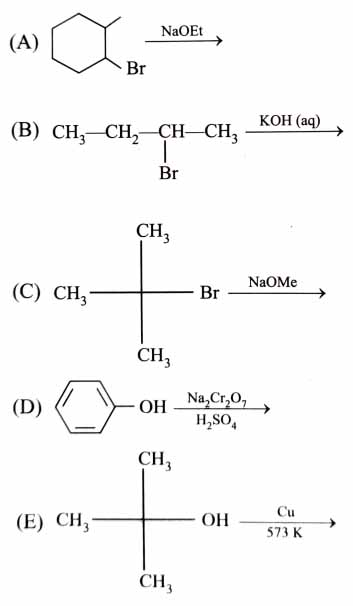
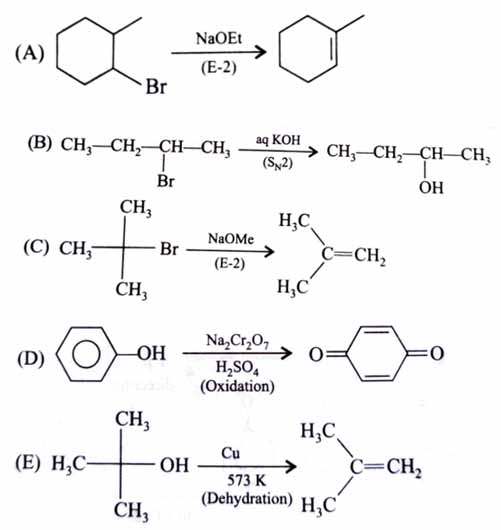
The reactions which cannot be applied to prepare an alkene by elimination, are           [2025]

Choose the correct answer from the options given below:

  • B and E only


  • B, C and D only


  • A, C and D only


  • B and D only


(4)


Q 5 :

The correct order for acidity of the following hydroxyl compound is:

Choose the correct answer from the options given below:                      [2023]

  • D > E > C > A > B


  • C > E > D > B > A


  • E > C > D > A > B


  • E > D > C > B > A


(3)

Greater the stability of conjugate base, greater the acidity.

For phenols, −M group (−NO2) present at para position stabilizes the conjugate base, whereas hyperconjugation of −CH3 decreases the stability.

Hence the correct order is E > C > D > A > B.


Q 6 :

Match List-I with List-II.                      [2026]

  List-I   List-II
  (Functional group — detection)   (Change observed during detection)
A. Unsaturation (Baeyer’s test) I. Red colour appears
B. Alcoholic group (Ceric ammonium nitrate test) II. Silver mirror appears
C. Aldehyde group (Tollen’s reagent) III. Violet colour appears
D. Phenolic group (FeCl3 test) IV. Discharge of pink colour


Choose the correct answer from the options given below:

  • A–III, B–IV, C–I, D–II


  • A–III, B–IV, C–II, D–I


  • A–IV, B–I, C–II, D–III


  • A–IV, B–III, C–II, D–I


(3)


Q 7 :

Given below are two statements:                                [2026]

Statement I: Phenol on treatment with CHCl3/aq. KOH under refluxing condition, followed by acidification produces p-hydroxybenzaldehyde as the major product and o-hydroxybenzaldehyde as the minor product.

Statement II: The mixture of p-hydroxybenzaldehyde and o-hydroxybenzaldehyde can be easily separated through steam distillation.

In the light of the above statements, choose the correct answer from the options given below:

  • Statement I is false but Statement II is true


  • Both Statement I and Statement II are false


  • Statement I is true but Statement II is false


  • Both Statement I and Statement II are true


(1)


Q 8 :

A mixed ether (P), when heated with excess of hot concentrated hydrogen iodide produces two different alkyl iodides which when treated with aq. NaOH give compounds (Q) and (R). Both (Q) and (R) give yellow precipitate with NaOI. Identify the mixed ether (P).   [2026]

  •  

  •  

  •  

  •  

(4)