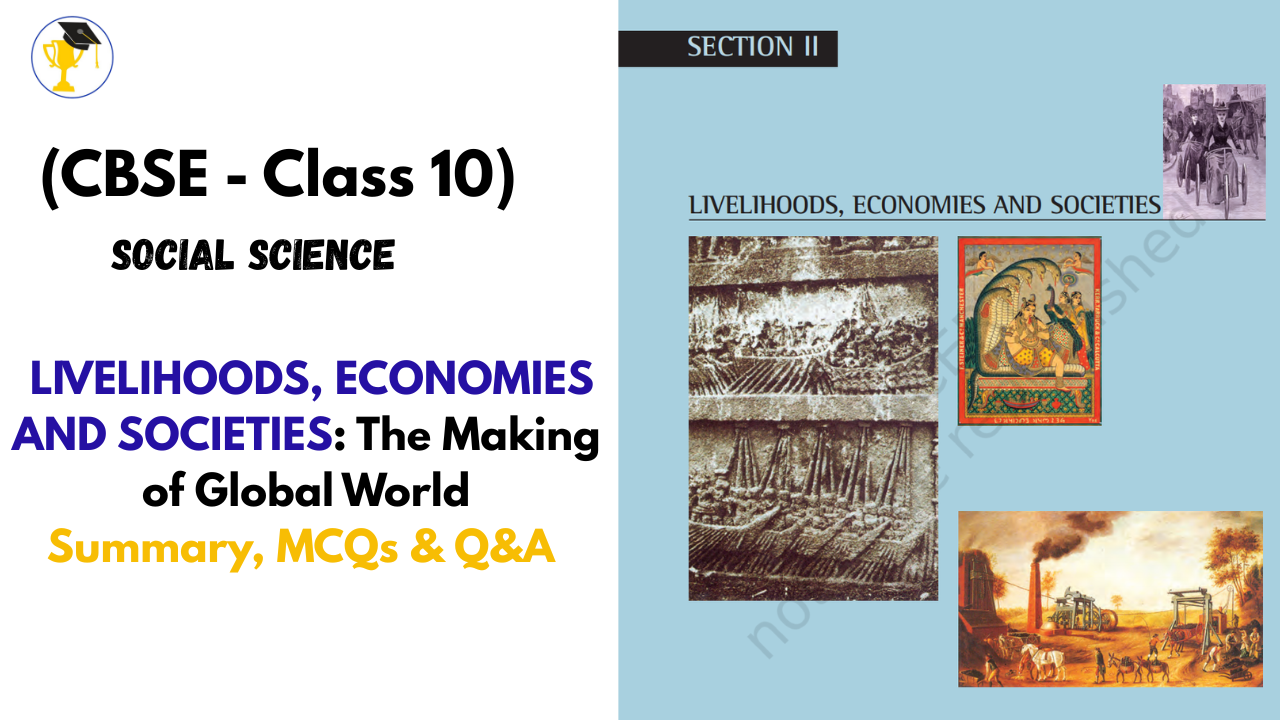
Class 10 Social Science – The Making of Global World (History: Chapter 3) Summary + MCQs + Q&A
CHAPTER SUMMARY: THE MAKING OF A GLOBAL WORLD
1. PRE-MODERN WORLD (Before 1600s)
⇒Increasing Interlinking of Societies
-
Traders, travellers, priests, pilgrims moved across regions.
-
Exchanged goods, ideas, skills, currency, diseases.
-
Cowries, silk, spices, pottery, metals moved across Asia, Europe, Africa.
⇒ Silk Routes
-
Connected Asia ↔ Europe ↔ Africa.
-
Transported Chinese silk, spices, Indian textiles, precious metals.
-
Spread religions like Buddhism, Christianity, Islam.
⇒ Food Travels
-
Crops like potato, maize, tomato, chillies came from Americas.
-
Potato revolutionized Europe; Irish Potato Famine (1840s) killed lakhs.
⇒ Conquest, Disease & Trade
-
Europeans reached America in 16th century.
-
Carried smallpox → killed 90% native population, easing conquest.
2. THE NINETEENTH CENTURY WORLD (1815–1914)
⇒ Three Types of Global Flows
-
Trade (food, cotton, minerals)
-
Labour (50 million Europeans migrated)
-
Capital (loans, investments)
⇒ Corn Laws & Migration
⇒ Role of Technology
-
Railways, steamships, telegraph revolutionized transport & trade.
-
Refrigerated ships enabled transport of frozen meat.
⇒ Late 19th Century Colonialism
-
Europe carved up Africa (Berlin Conference 1885).
-
Exploited land, minerals, labour.
⇒ Rinderpest (Cattle Plague)
⇒ Indentured Labour Migration from India
-
Indians sent under contracts to Caribbean, Fiji, Mauritius, Sri Lanka, Malaya.
-
Harsh conditions, low wages → called “new system of slavery.”
⇒ India in World Trade
3. THE INTER-WAR ECONOMY (1914–1945)
⇒ WWI (1914–18)
⇒ Post-War Recovery
⇒ Mass Production in US
⇒ The Great Depression (1929–mid 1930s)
-
Overproduction, falling prices, US loans withdrawn → global banking collapse.
-
110,000 companies + 4000 banks closed in US.
⇒ India & Depression
4. REBUILDING A WORLD ECONOMY (Post-1945)
⇒ Post-WWII Devastation
⇒ Bretton Woods System (1944)
⇒ G-77 & NIEO
⇒ End of Bretton Woods → Globalisation (1970s onwards)
MCQs
1. The silk routes linked Asia with:
a) Australia
b) Europe and Africa
c) America
d) Antarctica
Ans: b)
2. What caused the death of millions of native Americans?
a) War
b) Floods
c) Smallpox
d) Famines
Ans: c)
3. Which technology made transport of meat cheaper?
a) Steam engine
b) Refrigerated ships
c) Telegraph
d) Diesel engines
Ans: b)
4. Who pioneered the assembly line technique?
a) Alexander
b) Stalin
c) Henry Ford
d) Hitler
Ans: c)
ASSERTION–REASON QUESTIONS
Q1.
A: The Rinderpest cattle plague increased African wage labour.
R: It destroyed 90% cattle, ruining African livelihoods.
Ans: a) (R correctly explains A)
Q2.
A: The US became the largest creditor after WWI.
R: European nations borrowed heavily from the US during the war.
Ans: a)
Q3.
A: India became an exporter of gold during the Great Depression.
R: Indian peasants sold jewellery to meet expenses.
Ans: a)
CASE-BASED QUESTIONS
CASE 1: SILK ROUTES
FULL PASSAGE
For centuries before the beginning of the modern world, trade and cultural exchange connected distant societies. One of the most vibrant and long-lasting trade links was the Silk Route, which passed through vast regions of Asia and linked them with Europe and Africa. Along this network travelled Chinese silk, Indian textiles and spices, and West Asian precious stones. In return, traders carried back gold, silver, and ornaments. The Silk Routes were not only conduits for goods, but also for the spread of ideas, religious beliefs, artistic styles, and even diseases. Through these routes, Buddhism spread from India to China, Korea and Japan. Thus the pre-modern world witnessed extensive economic and cultural exchanges long before modern globalization began.
Q1. What travelled from China to Europe?
Ans: Silk.
Q2. What travelled from India?
Ans: Textiles and spices.
Q3. What flowed from Europe?
Ans: Precious metals like gold and silver.
CASE 2: GREAT DEPRESSION
FULL PASSAGE
The Great Depression, which began in 1929, affected almost every country across the world. Production declined sharply, factories closed down, and millions of workers lost their jobs. In the United States alone, over 110,000 companies had to shut down, and more than 4,000 banks collapsed. As US banks called back loans offered to other countries, the global financial system came under severe pressure. Agricultural prices fell dramatically, ruining farmers everywhere. The rural poor suffered greatly, while trade and investments nearly came to a halt. The Depression showed how deeply connected the world’s economies had become, and how a crisis in one country could quickly spread to others.
Q1. Which sector suffered most?
Ans: Agriculture.
Q2. Why did global banks collapse?
Ans: Because US withdrew overseas loans.
Q3. How did Depression affect India?
Ans: Indian exports collapsed, prices crashed, peasants fell into debt and began exporting gold.
CASE 3: INDENTURED LABOUR
FULL PASSAGE
During the nineteenth century, millions of Indian labourers were taken abroad under a system of indentured labour. Poor peasants from eastern Uttar Pradesh, Bihar, Central India and Tamil Nadu were recruited by agents who often used false promises to convince them. These workers were taken to plantations in Mauritius, Fiji, Guyana, Trinidad, Surinam and Malaya. Life on these plantations was extremely harsh. Workers faced long working hours, strict discipline, physical punishment and wage cuts. Many were unable to return home even after their contract ended, and this system came to be described as a ‘new system of slavery’. Despite these hardships, Indian labourers managed to preserve aspects of their culture by celebrating festivals, speaking their languages, and creating new cultural forms like chutney music.
Q1. What was indentured labour called?
Ans: A “new system of slavery.”
Q2. Why did they migrate?
Ans: Poverty, debt, loss of land and deception by agents.
Q3. How did they preserve culture?
Ans: By celebrating festivals like Hosay and creating cultural forms like chutney music.
CASE 4: RINDERPEST & AFRICA
FULL PASSAGE
In the 1890s, Africa experienced a devastating cattle disease known as rinderpest, which had recently arrived from Eastern Africa. Within a few years, the disease wiped out 90 percent of Africa’s cattle, destroying the livelihood of pastoral communities. As cattle perished, pastoralists lost not only their source of income but also their food supply, trade links and social security. Many were forced into wage labour on plantations and mines owned by European colonisers. Thus, the rinderpest epidemic helped the Europeans to subdue Africa more easily, as it shattered the economic independence of pastoral groups and made them dependent on colonial employers.
Q1. What caused rinderpest to spread so fast?
Ans: It spread through infected cattle brought by colonial armies and traders.
Q2. How did it affect Africans?
Ans: It destroyed 90% of cattle, ruining livelihoods.
Q3. Why did Europeans benefit from it?
Ans: Africans, left economically weak, were forced into wage labour on colonial plantations and mines.
CASE 5: MASS PRODUCTION (Henry Ford)
FULL PASSAGE
In the early twentieth century, the United States led a revolution in industrial production through mass manufacturing. Henry Ford introduced the assembly-line method in his car factory in Detroit in 1913. Instead of workers moving around the factory, parts of the car moved along the conveyor belt while each worker performed a single task repeatedly. This reduced the time to produce a car from twelve hours to just one hour and thirty-three minutes. Ford decided to double the daily wages of workers to keep them satisfied and reduce labour turnover. As cars became cheaper, demand increased and production rose even further. Soon, mass production extended to other industries, transforming the American economy and influencing industrial practices worldwide.
Q1. What did Henry Ford introduce?
Ans: The assembly-line system.
Q2. How did it change production?
Ans: It drastically reduced manufacturing time and increased output.
Q3. Why did Ford double workers’ wages?
Ans: To retain them, reduce conflicts, and create a stable, productive workforce.
CASE 6: BRETTON WOODS SYSTEM
FULL PASSAGE
After the Second World War, many countries realised the need for stable and regulated international economic systems. In 1944, delegates from 44 Allied nations met at Bretton Woods in New Hampshire, USA, to design a new monetary system. They established the International Monetary Fund (IMF) to regulate currency stability and the World Bank to assist in post-war reconstruction. Under the Bretton Woods system, exchange rates were fixed, and the US dollar was linked to gold, making it the most powerful currency. The system promoted world trade and economic stability for nearly three decades until its collapse in the early 1970s.
Q1. When was the Bretton Woods Conference held?
Ans: 1944.
Q2. What two institutions were created?
Ans: IMF and World Bank.
Q3. How were exchange rates maintained?
Ans: By fixing them relative to the US dollar, which was linked to gold.
VERY SHORT ANSWERS
-
Who introduced the assembly line?
Ans: Henry Ford
-
When was the Bretton Woods Conference held?
Ans: 1944
-
Which disease killed millions in America?
Ans: Smallpox
-
Which crop caused famine in Ireland?
Ans: Potato
-
What were the G-77 countries demanding?
Ans: A New International Economic Order (NIEO)
SHORT ANSWERS
Q1. Why was the nineteenth century called the age of globalisation?
Because of mass migration, faster transport (railways, steamships), greater trade, and rapid expansion of capital flows across continents.
Q2. How did rinderpest affect African livelihoods?
It killed 90% of cattle, destroying pastoral economies. Africans lost independence and were forced to work for European plantations and mines.
Q3. Explain the effects of the Great Depression on India.
Indian exports crashed by half, agricultural prices fell 50%, peasants sank into debt, and India exported gold as poor families sold jewellery.
LONG ANSWERS
Q1. Explain the role of technology in creating a global agricultural economy.
Technological innovations played a key role in building a global agricultural economy in the nineteenth century. Faster steamships, railways, and harbour expansions connected distant food-producing regions with world markets. The greatest breakthrough came with refrigerated ships, which allowed animals to be slaughtered in America and Australia and transported as frozen meat to Europe. This reduced shipping costs and enabled the European poor to consume a more varied diet. Thus, technology linked production, transport and consumption globally, creating an international network of trade.
Q2. Describe the impacts of European colonialism on Africa with examples.
European colonialism shattered African livelihoods. After 1885, European powers divided Africa using straight borders, exploiting its land and minerals. They introduced harsh taxes, restricted forest access, and forced Africans to become wage labourers in plantations and mines. The rinderpest plague (1890s) wiped out 90% cattle, destroying African pastoral life and pushing people into poverty, which colonisers exploited to control labour. Thus colonialism transformed Africa from a land-rich, labour-free society into a controlled economy serving European interests.
For full chapter click on: Livelihoods, Economic & Societies


 STUDY MATERIALS
 COURSES
 MORE
MORE
 SUCCESS STORY
 ADMISSION
 STORE
STORE