Can Average Students Crack NEET 2026? | Smart Achievers Strategy Guide
Smart Achievers Coaching Strategy & Success Blueprint
Every year, more than 20 lakh students appear for NEET (National Eligibility cum Entrance Test) with the dream of becoming a doctor. But among these aspirants, one question echoes in thousands of minds:
“Can an average student crack NEET?”
Many students believe NEET is only for toppers, genius minds, or students from elite coaching backgrounds. But the truth is very different.
The reality is:
⇒NEET is not an IQ test.
⇒NEET is not a talent competition.
⇒NEET is a syllabus-based, strategy-driven examination.
And yes — an average student can absolutely crack NEET with the right planning, consistency, and guidance.
In this blog, we will break down:
-
What “average” really means
-
Why average students can succeed
-
Smart Achievers coaching points
-
Practical study strategies
-
Important highlights for guaranteed improvement
Let’s begin.
What Does “Average Student” Actually Mean?
Before answering the main question, let’s redefine the word “average.”
An average student usually:
-
Scores between 50–70% in school exams
-
Understands concepts but lacks consistency
-
Struggles with time management
-
Feels underconfident during competitive exams
-
Gets distracted easily
But here’s the important part:
Being average today does NOT mean you will remain average forever.
Many NEET qualifiers were once average students who transformed through discipline and strategy.
Why NEET Is Crackable for Average Students
NEET is predictable in structure:
-
Based on Class 11 & 12 NCERT
-
Mostly conceptual and direct questions
-
Repetitive question patterns
-
Clear marking scheme
-
Defined syllabus
This means success does not require extraordinary intelligence — it requires:
1) Consistency
2) Smart revision
3) Mock test analysis
4) Strong NCERT foundation
NEET rewards hard work more than brilliance.
At Smart Achievers, we believe:
“Average students don’t lack ability — they lack structured direction.”
Our approach focuses on turning average performers into confident competitors through systematic preparation.
Let’s explore our core coaching philosophy.
1) Concept Clarity Over Rote Learning
Many average students memorize without understanding.
This leads to:
At Smart Achievers, we ensure:
1) Every Physics formula is derived and understood
2) Chemistry reactions are logically connected
3) Biology diagrams are conceptually explained
When students understand why something works, their confidence increases dramatically.
2) NCERT is the Bible for NEET
One of the biggest mistakes average students make is:
Ignoring NCERT and running behind multiple reference books.
Smart Achievers strongly emphasizes:
1) Read NCERT Biology line-by-line
2) Highlight important statements
3) Revise diagrams daily
4) Practice NCERT-based MCQs
Important Highlight:
More than 80–90% of NEET Biology questions are directly from NCERT.
Master NCERT first — then move to advanced materials.
3) Daily Revision Strategy (The Game Changer)
Average students usually study a topic once and forget it later.
At Smart Achievers, we follow the 3-7-21 Revision Rule:
-
Revise within 3 days
-
Revise again in 7 days
-
Revise again in 21 days
This repetition moves information into long-term memory.
Important Highlight:
Revision increases retention by 70%.
Without revision, hard work becomes wasted effort.
4) Smart Practice System (Level-Based Practice)
Instead of directly solving tough questions, we follow a step-by-step difficulty model:
Level 1 – Basic Concept Questions
Level 2 – Moderate Application
Level 3 – NEET Standard MCQs
Level 4 – High-Level Mixed Questions
This builds:
Confidence
Accuracy
Speed
Average students grow gradually without feeling overwhelmed.
5) Weekly Mock Test + Deep Analysis
Mock tests are not just about marks.
At Smart Achievers, we teach students to:
→Analyze wrong questions
→Identify weak chapters
→Re-solve incorrect problems
→Maintain an error notebook
Important Highlight:
Students who analyze tests improve 2x faster than those who only give tests.
Mock tests convert average students into exam-ready performers.
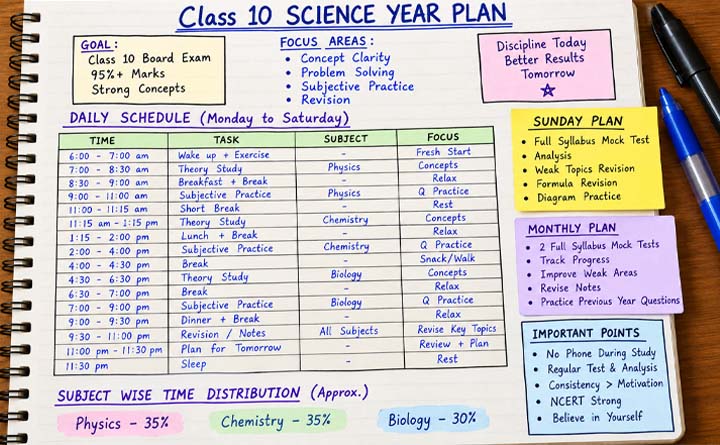
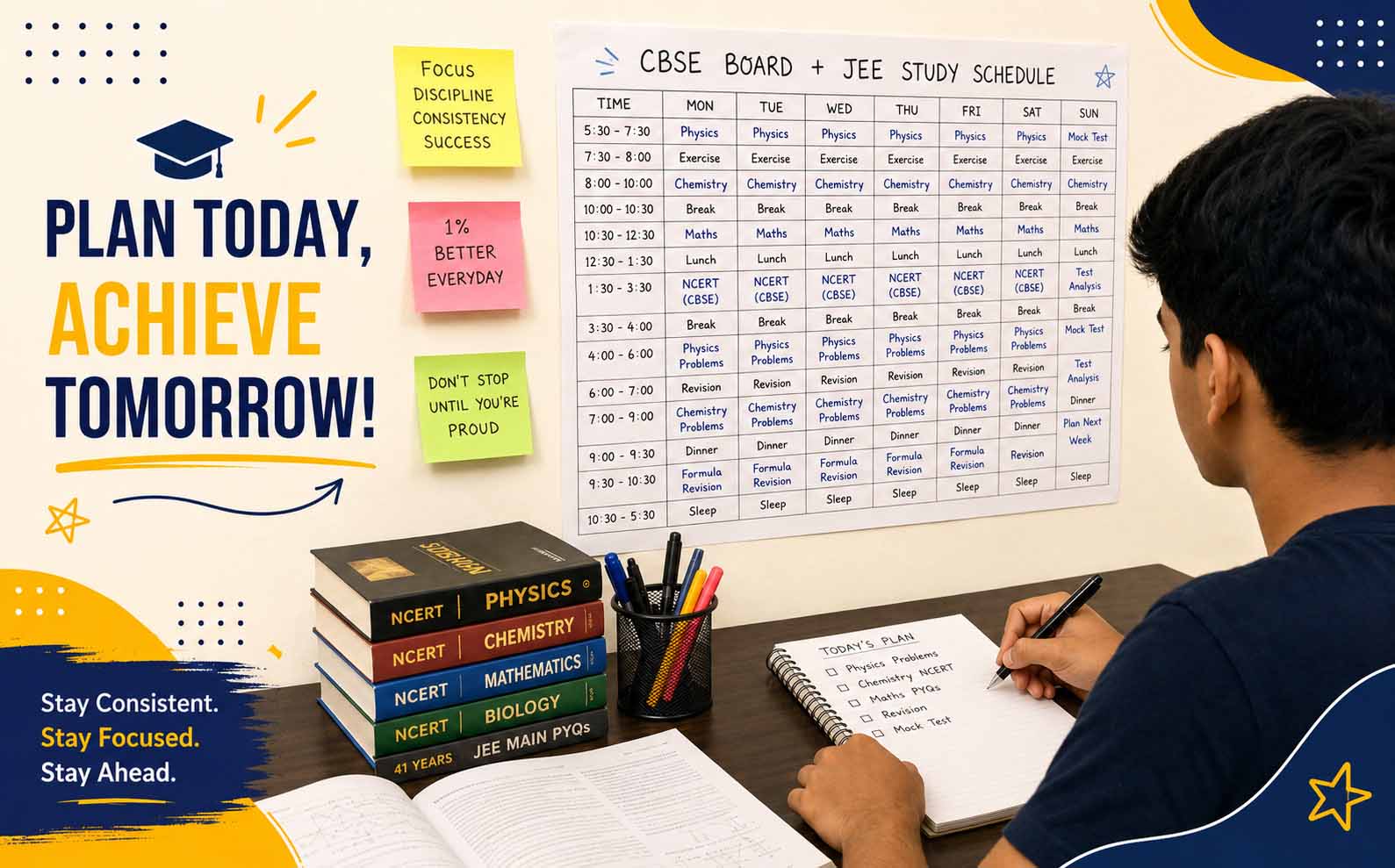
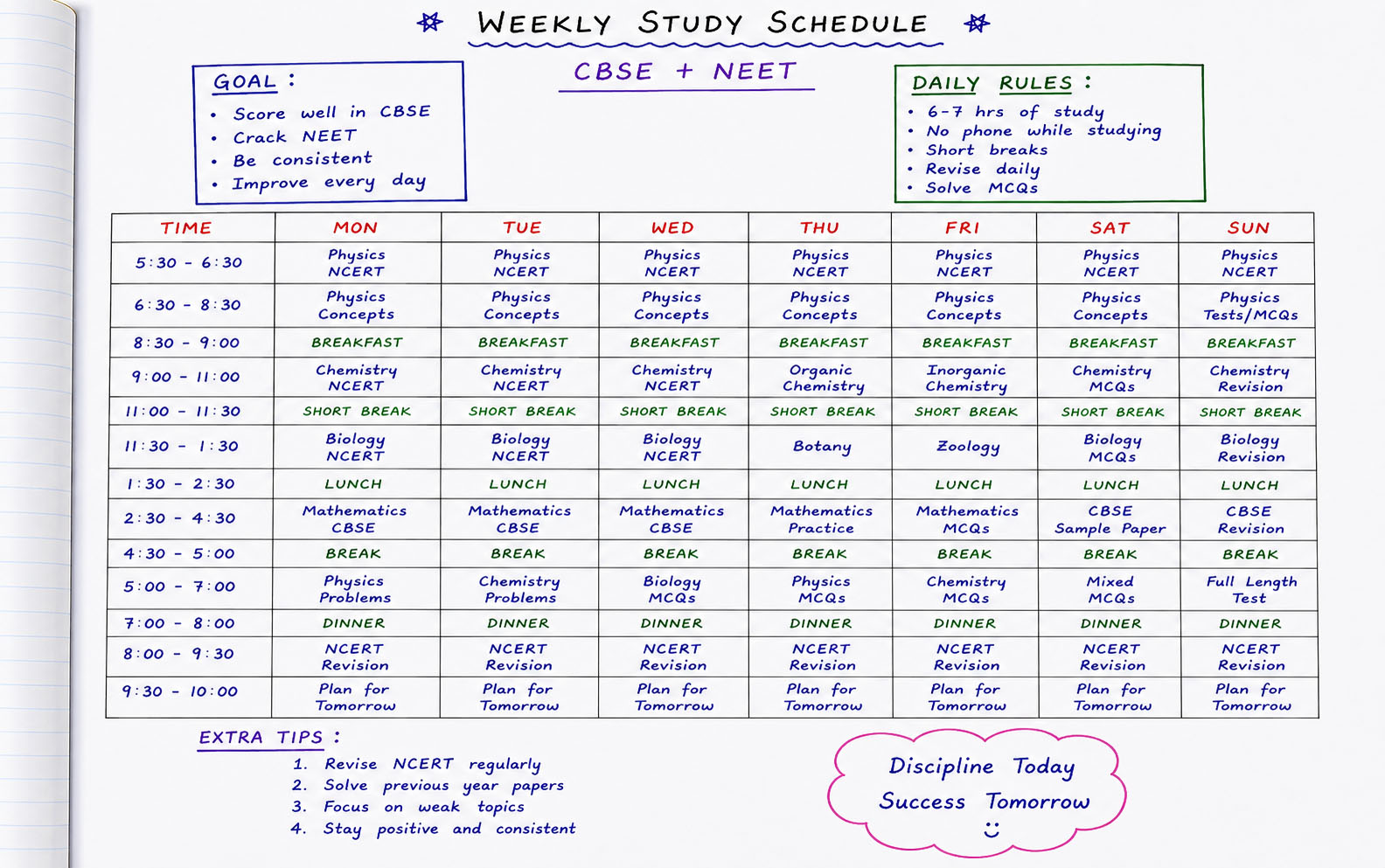
Study Plan for Average Students Preparing for NEET
Here is a practical daily structure:
Morning (High Focus Hours)
Biology – NCERT reading + diagrams (2 hours)
Midday
Physics – Concept building + 30 MCQs (2 hours)
Afternoon
Chemistry – Reaction understanding + 40 MCQs (2 hours)
Evening
Revision of previous topics (2 hours)
Night
Error analysis + short notes (1 hour)
Total: 8–9 productive hours are enough if focused.
Important Highlight:
Quality matters more than 14-hour exhausted study.
NEET 2026 Physics: Important Chapters & Expected Weightage
Physics usually contains 45 questions (180 marks). Certain chapters contribute more consistently than others.
| Physics Section |
Important Chapters |
Expected Questions (Approx.) |
Expected Marks (Approx.) |
| Mechanics |
Laws of Motion, Work Power Energy, Gravitation, Motion in 2D, Rotational Motion |
10–12 |
40–48 |
| Electrostatics & Current Electricity |
Electrostatics, Capacitors, Current Electricity |
6–8 |
24–32 |
| Magnetism & EMI |
Moving Charges & Magnetism, Electromagnetic Induction, AC |
5–6 |
20–24 |
| Optics |
Ray Optics, Wave Optics |
4–5 |
16–20 |
| Modern Physics |
Dual Nature, Atoms, Nuclei, Semiconductors |
4–6 |
16–24 |
| Thermodynamics & Kinetic Theory |
Thermodynamics, Kinetic Theory of Gases |
3–4 |
12–16 |
Important Highlight:
Mechanics + Electrodynamics together can contribute nearly 50–60% of Physics questions in NEET.
NEET 2026 Biology: Important Units & Expected Weightage
Biology carries the highest weightage in NEET — 90 questions (45 Botany + 45 Zoology) (360 marks). Mastering high-yield units can significantly boost your overall rank.
| Biology Unit |
Key Focus Areas |
Expected Questions (Approx.) |
Expected Marks (Approx.) |
| Human Physiology |
Digestion, Respiration, Circulation, Neural Control, Endocrine |
15–18 |
60–72 |
| Genetics & Evolution |
Mendelian Genetics, Molecular Basis, Evolution |
14–16 |
56–64 |
| Ecology & Environment |
Ecosystem, Biodiversity, Environmental Issues |
10–12 |
40–48 |
| Cell Structure & Function |
Cell Cycle, Biomolecules, Cell Organelles |
8–10 |
32–40 |
| Plant Physiology |
Photosynthesis, Respiration, Plant Growth |
8–10 |
32–40 |
| Reproduction |
Human Reproduction, Reproductive Health, Plant Reproduction |
8–10 |
32–40 |
| Plant Diversity & Morphology |
Plant Kingdom, Morphology of Flowering Plants |
6–8 |
24–32 |
Important Highlight:
Human Physiology + Genetics alone can contribute around 30–35% of total Biology marks.
NEET 2026 Chemistry: Important Chapters & Expected Weightage
Chemistry consists of 45 questions (180 marks) divided into Physical, Organic, and Inorganic Chemistry.
| Chemistry Section |
Important Chapters |
Expected Questions (Approx.) |
Expected Marks (Approx.) |
| Physical Chemistry |
Thermodynamics, Equilibrium, Electrochemistry, Chemical Kinetics |
12–14 |
48–56 |
| Organic Chemistry |
Hydrocarbons, Aldehydes & Ketones, Biomolecules, General Organic Chemistry |
10–12 |
40–48 |
| Inorganic Chemistry |
Chemical Bonding, Coordination Compounds, p-Block, d & f Block |
10–12 |
40–48 |
| Basic Concepts & Mole Concept |
Some Basic Concepts of Chemistry |
2–3 |
8–12 |
Important Highlight:
Chemical Bonding and Coordination Compounds are consistently high-scoring chapters in Inorganic Chemistry.
Why Focusing on High-Weightage Chapters Works
-
Improves score faster
-
Builds confidence early
-
Maximizes return on study time
-
Reduces exam anxiety
However, remember:
High-weightage focus does not mean skipping low-weightage chapters.
Complete syllabus coverage is essential for 650+ scores.
Final Expert Tip for NEET 2026
If you are an average student:
-
Target Biology for 320+
-
Aim Chemistry for 140+
-
Secure 120+ in Physics
This combination can place you safely above 580–600 marks range, increasing chances of government medical seats depending on category and cutoff trends.


 STUDY MATERIALS
 COURSES
 MORE
MORE
 SUCCESS STORY
 ADMISSION
 STORE
STORE