

For most students preparing for JEE Main, the biggest challenge is not the lack of effort, but the misuse of time. The syllabus is vast, the competition is intense, and even after studying 10–12 hours a day, many students fail to see proportional results. The reason is simple: hard work without direction often leads to burnout, not success.
With the right strategy, however, even the final months or weeks can bring remarkable improvement. In today’s competitive environment, the real keyword for JEE aspirants is not just hard work, but smart, focused, and time-efficient preparation.
From experience, JEE is not only a test of knowledge. It is an examination of planning, prioritisation, execution, and decision-making under pressure. Studying longer does not automatically mean studying better. What truly matters is where, how, and in what order you invest your time, and how effectively you revise what you have learned.
1. Understand the Syllabus by Weightage, Not Just Size
A common mistake students make is treating the entire syllabus equally. In reality, every chapter does not carry the same weight or return on effort.
High-yield topics consistently contribute a significant number of questions and help build confidence:
Physics: Newtonian Mechanics, Modern Physics
Chemistry: Chemical Bonding, Basic Organic Chemistry
Mathematics: Coordinate Geometry, Calculus
A smart JEE strategy focuses first on mastering these high-return topics, and then gradually expands to surrounding chapters. This approach ensures maximum marks for minimum time investment.
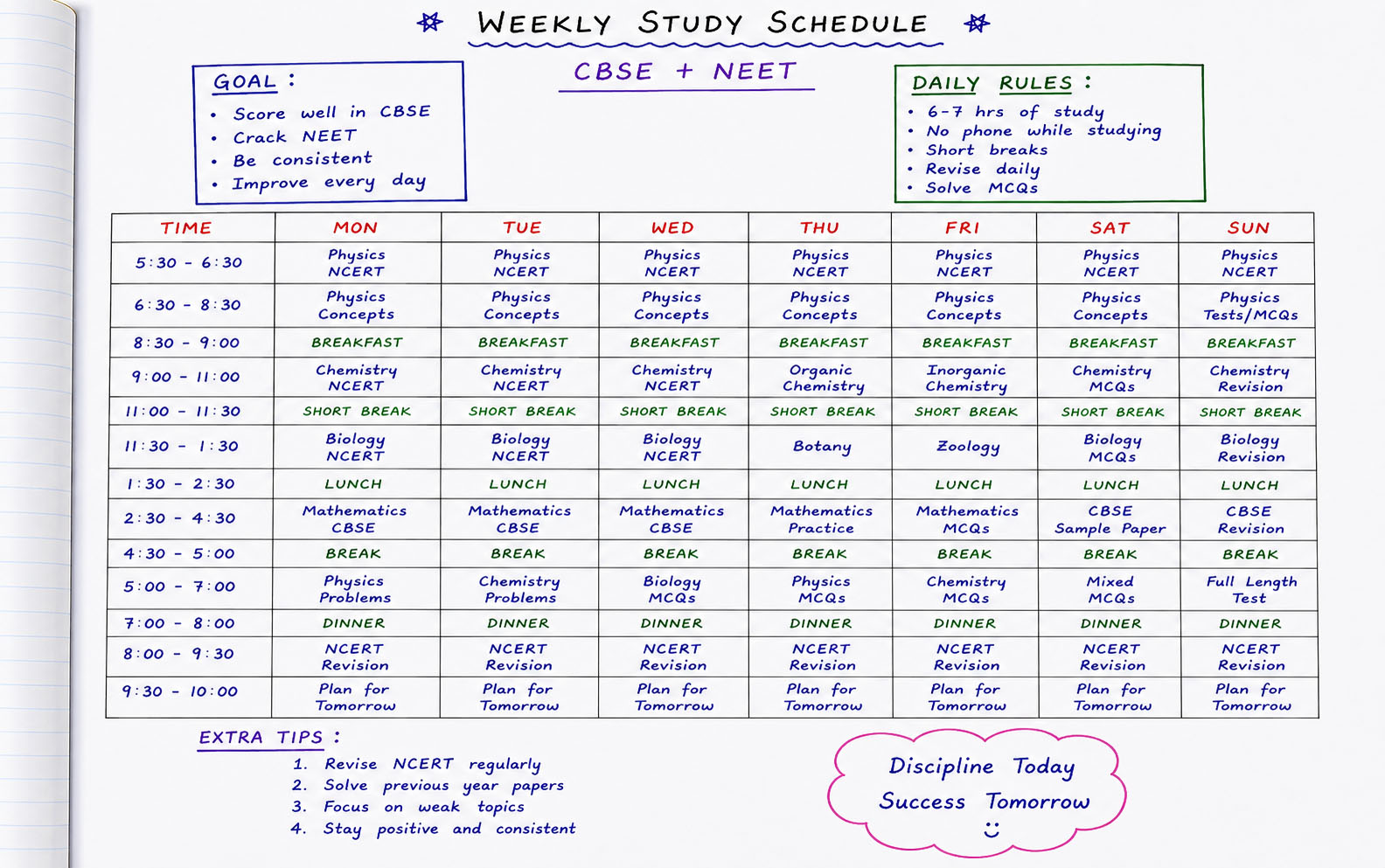
2. Micro-Planning: Win the Day to Win JEE
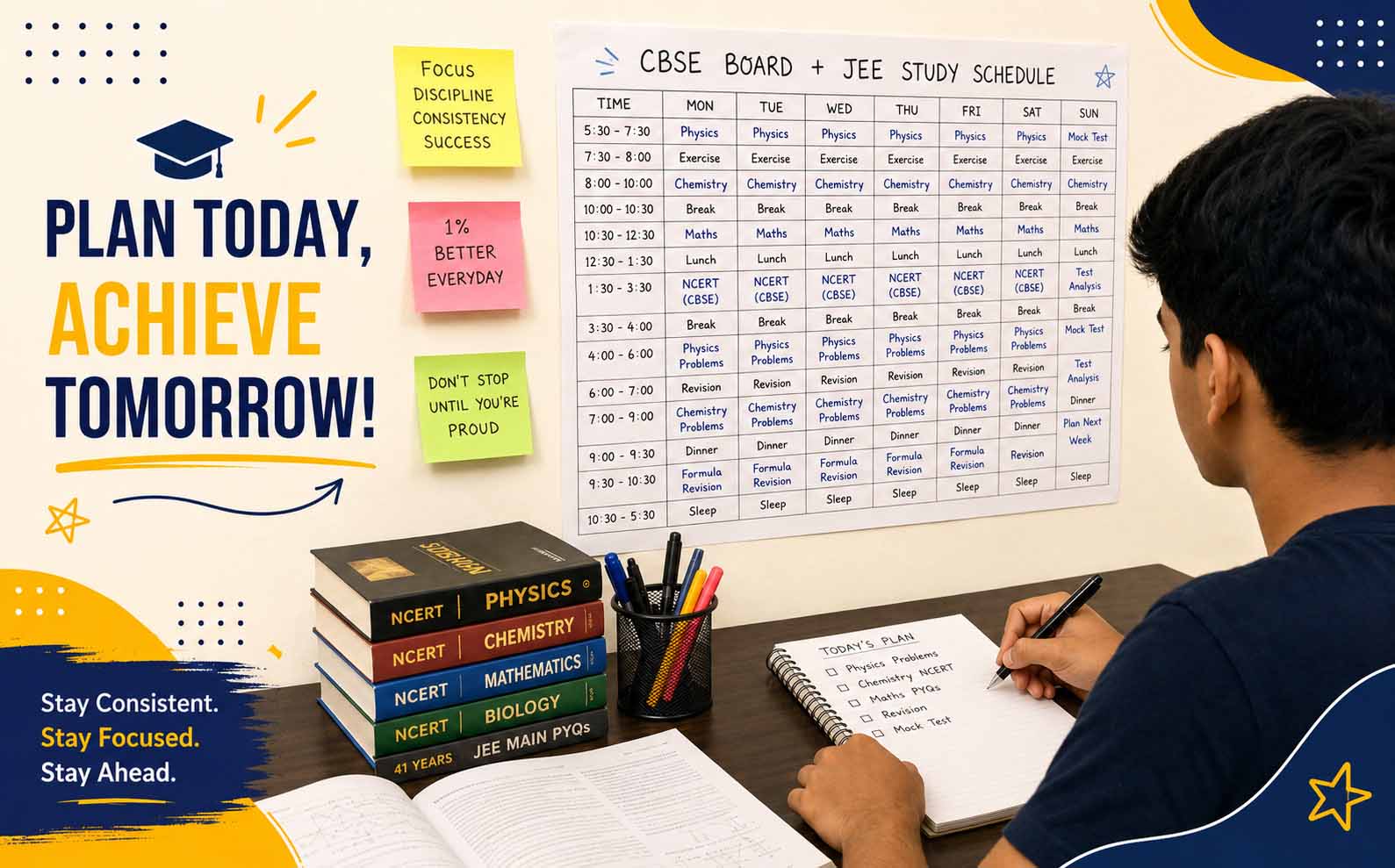
Planning should not remain limited to notebooks or long-term schedules. Your real battlefield is your daily 24-hour routine.
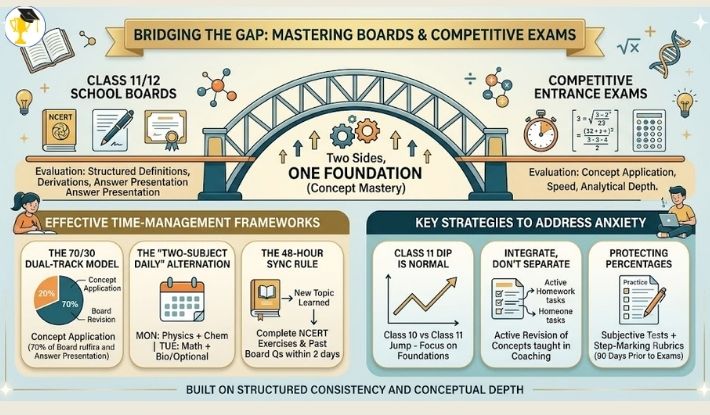
Divide each day into three essential parts:
Learning new concepts
Revising previously studied topics
Solving problems
Students who only chase new chapters often forget older ones. Those who only revise never complete the syllabus. Balance is the real intelligence in preparation. Day-level planning eventually decides your rank.
3. Shift from Passive Study to Active Learning
Watching lectures or reading notes alone is not real preparation. Active learning begins when you start solving problems.
After completing any chapter, solving 60–80 high-quality questions should be mandatory. Focus not on quantity alone, but on variety and difficulty.
Divide practice into three levels:
Basic (concept clarity)
Standard (exam-level confidence)
Advanced (selection-level challenge)
Easy questions build confidence, but JEE ranks are decided by tough and tricky ones.
4. Manage Energy, Not Just Study Hours
Time management is incomplete without energy management. Identify the hours when your mind works at peak efficiency.
Schedule Physics and Mathematics during high-energy hours
Keep revision, theory reading, or lighter Chemistry topics for low-energy periods
This simple adjustment separates smart preparation from mechanical preparation.
5. Mock Tests Are Part of Preparation, Not the Final Step
Many students delay mock tests until they feel “fully prepared.” This is one of the biggest mistakes.
Mock tests should begin early, starting with chapter-wise tests and gradually moving to full-length papers. The real improvement comes not from attempting the test, but from the 2–3 hours of detailed analysis afterward.
Ask yourself:
Why did I get this question wrong?
Was it a concept issue, calculation error, or time pressure?
Which questions should I have skipped?
This analysis upgrades preparation faster than additional study hours.
6. JEE Tests What You Can Leave, Not Just What You Know
A crucial but often ignored truth: you don’t need to solve every question to score high.
JEE Main rewards intelligent selection. Secure marks from easy and medium questions first, and avoid getting trapped in lengthy or deceptive problems. Train this habit during practice so that it becomes automatic in the exam hall.
7. Common Mistakes That Waste Maximum Time
Some errors silently destroy preparation efficiency:
Excessive social media and unplanned screen time
Frequently changing books, notes, and online material
Studying late nights and disturbing sleep cycles
Since JEE exams are held during the day, your body clock must align accordingly. Proper sleep, light physical activity, and mental calmness directly impact speed, accuracy, and retention.
8. Is Smart Work Alone Enough for JEE?
Smart work without consistency is incomplete. Smart strategy becomes powerful only when supported by disciplined hard work.
The JEE journey is long. Stress, self-doubt, fatigue, and boredom are inevitable. At such times, consistency, proper guidance, and family support play a decisive role.
Final Thoughts:
JEE preparation is a marathon, not a sprint. Students who respect time, understand their pace, and make small daily improvements eventually move ahead.
Books are your tools, tests are your training ground, and discipline is your greatest asset. If your strategy is smart and your effort is consistent, JEE will not just be an exam—it will become a life lesson on how big goals are achieved.
Smartachivers
Jan 08,2026
Smartachivers
Jan 08,2026
Smartachivers
Jan 08,2026
Smartachivers
Jan 07,2026
Smartachivers
Jan 07,2026
Smartachivers
Jan 07,2026
Smartachivers
Jan 07,2026
Smartachivers
Jan 07,2026
Smartachivers
Jan 06,2026
Smartachivers
Jan 06,2026
Smartachivers
Jan 06,2026
Smartachivers
Jan 05,2026
Smartachivers
Jan 05,2026
Smartachivers
Jan 05,2026
Smartachivers
Jan 02,2026
Smartachivers
Jan 02,2026
Smartachivers
Jan 02,2026
Smartachivers
Dec 31,2025
Smartachivers
Dec 31,2025
Smartachivers
Dec 30,2025