

Q 11 :

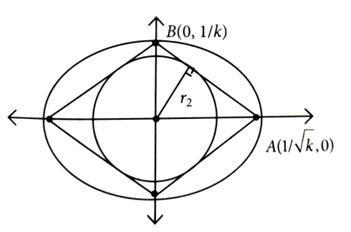
Consider ellipses Ek:kx2+k2y2=1, k=1,2,…,20. Let Ck be the circle which touches the four chords joining the end points (one on minor axis and another on major axis) of the ellipse Ek. If rk is the radius of the circle Ck, then the value of ∑k=1201rk2 is                 [2023]

  • 3080


  • 3210


  • 3320


  • 2870


(1)

kx2+k2y2=1

x21/k+y21/k2=1

Now, equation of line AB is

x1/k+y1/k=1 ⇒k x+ky=1

rk=⊥r distance of (0, 0) from line AB

rk=|(0+0-1)k+k2|=1k+k2

1rk2=k+k2⇒∑k=1201rk2=∑k=120(k+k2)=∑k=120k+∑k=120k2

=20·212+20·21·416=210+10×7×41

=210+2870=3080


Q 12 :

If the radius of the largest circle with centre (2, 0) inscribed in the ellipse x2+4y2=36 is r, then 12r2 is equal to             [2023]

  • 72


  • 69


  • 115


  • 92


(4)

Centre of the circle is (2, 0).

Ellipse : x2+4y2=36

            x236+y29=1                              ⋯(i)

The equation of the circle is, (x-2)2+y2=r2            ⋯(ii)

Solving (i) and (ii), we get

     (x-2)2+36-x24=r2⇒x2+4-4x+36-x24=r2

⇒4x2+16-16x+36-x2=4r2

⇒3x2-16x+52-4r2=0

Discriminant = 0

∴   (16)2-4×3×(52-4r2)=0

⇒52-4r2=25612⇒4r2=52-25612=36812

⇒12r2=3684=92


Q 13 :

Let P(237, 67), Q, R and S be four points on the ellipse 9x2+4y2=36. Let PQ and RS be mutually perpendicular and pass through the origin. If 1(PQ)2+1(RS)2=pq, where p and q are coprime, then p+q is equal to                [2023]

  • 157


  • 143


  • 137


  • 147


(1)


Q 14 :

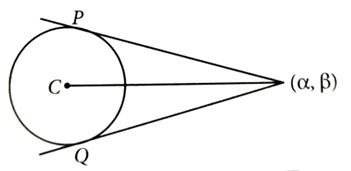
Let the tangent and normal at the point (33,1) on the ellipse x236+y24=1 meet the y-axis at the points A and B respectively. Let the circle C be drawn taking AB as a diameter and the line x=25 intersect C at the points P and Q. If the tangents at the points P and Q on the circle intersect at the point (α,β), then α2-β2 is equal to     [2023]

  • 3145


  • 61


  • 3045


  • 60


(3)

We have, x236+y24=1                            ...(i)

∴ The equation of tangent at point (33,1) on the given ellipse is given by

y-1=-33(436)(x-33) [∵ y-y1=-x1y1(b2a2)(x-x1)]

⇒  y-1=-x3+3                                        ...(i)

⇒  3y-3=-x+33 ⇒ x+3y=43                 ...(ii)

The equation of normal at point (33,1) on the given ellipse

y-1=133(364)(x-33)            [∵y-y1=(y1x1)(a2b2)(x-x1)]

⇒y-1=3(x-33)⇒y-1=3x-9⇒3x-y=8

Tangent meets y–axis at y = 4 and normal meets y–axis at y = - 8.

∴  A≡(0,4) and B≡(0,-8)

∴ Equation of circle with diameter end points A and B is x2+(y-4)(y+8)=0

[∵Equation of circle with diameter end points (x1,y1) is (x-x1)(x-x2)+(y-y1)(y-y2)=0]

⇒x2+y2+4y-32=0

∴ Centre of circle=(0,-2)

Equation of line passing through centre of circle, y=-2.

Now, the equation of chord of contact PQ of two tangents drawn from the point (α,β) is given by

αx+βy+2(y+β)-32=0

Since (25,0) lie on the chord of contact PQ

⇒α(25)+2(0-2)-32=0    [∵ β=-2]

⇒α(25)=36 ⇒ α=3625

∴   α2-β2=(3625)2-(-2)2=129620-4=121620=3045


Q 15 :

If the maximum distance of normal to the ellipse x24+y2b2=1,b<2, from the origin is 1, then the eccentricity of the ellipse is:             [2023]

  • 34


  • 32


  • 12


  • 12


(2)

We have, x222+y2b2=1; b<2

Equation of normal at (2cosθ, bsinθ) is

2xsecθ-bycosecθ=4-b2.

According to the question, |4-b24sec2θ+b2cosec2θ|max=1

For maximum distance, 4sec2θ+b2cosec2θ should be minimum.

∴  min(a2sec2θ+b2cosec2θ)=(a+b)2

∴   ⇒1=4-b2(2+b)2⇒1=4-b22+b

⇒ 2+b=4-b2⇒ b2+b-2=0

⇒ b2+2b-b-2=0 ⇒ b(b+2)-1(b+2)=0

⇒ (b+2)(b-1)=0    (∵ b<2)

⇒ b=1

Now, e=1-b2a2 =1-14=32


Q 16 :

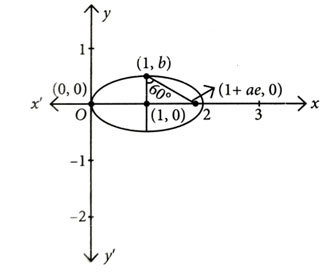
Let an ellipse with centre (1, 0) and latus rectum of length 12 have its major axis along the x-axis. If its minor axis subtends an angle 60° at the foci, then the square of the sum of the lengths of its minor and major axes is equal to ________.                [2023]


(9)

Length of latus rectum =12

and eccentricity (ae)=sinθ, where θ is the angle subtended by minor axis at focus.

⇒ae=sin60°=32

Now, 2b2a=12⇒b2=a4 and ae=32

Now,  b2=a2(1-e2)⇒b2=a2-(ae)2=a2-34

⇒a4=a2-34⇒4a2-a-3=0⇒(4a+3)(a-1)=0

⇒a=1⇒b=12

∴ (2a+2b)2=(2+2×12)2=(3)2=9


Q 17 :

The line x=8 is the directrix of the ellipse E:x2a2+y2b2=1 with the corresponding focus (2,0). If the tangent to E at the point P in the first quadrant passes through the point (0,43) and intersects the x-axis at Q, then (3PQ)2 is equal to __________ .          [2023]


(39)

Given, the line x=8 is the directrix of the ellipse

x2a2+y2b2=1, ae=8           ...(i) and focus, ae=2               ...(ii)

From (i) and (ii)

8e=2e⇒e2=14           ∴ e=12

and a=4,b2=a2(1-e2)⇒b2=16(34)=12

Now, equation of tangent at P(4cosθ, 23sinθ) is

xcosθ4+ysinθ23=1 and it passes through (0,43), so it satisfies the tangent equation.

0+43sinθ23=1⇒sinθ=12   ∴ θ=30°

∴  Point P=(23, 3) and Q(83,0)

PQ2=(23-83)2+(3-0)2=133

∴ (3PQ)2=9×PQ2=9×133=39


Q 18 :

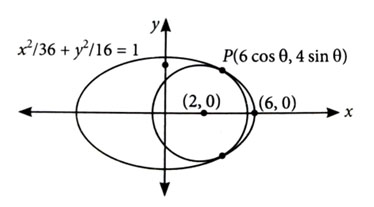
Let C be the largest circle centred at (2,0) and inscribed in the ellipse x236+y216=1. If (1,α) lies on C, then 10α2 is equal to _______ .        [2023]


(118)

Let P be the point where ellipse and circle touch each other.

Let P be (6cosθ, 4sinθ)

Equation of tangent to ellipse at point P is

xcosθ6+ysinθ4=1⇒y=4sinθ(-xcosθ6+1)

⇒y=-2cosθ3sinθx+4sinθ

Let m1=-2cosθ3sinθ

Slope of normal to circle at P=m2.

m2=(4sinθ-0)(6cosθ-0)    ∴ m1m2=-1⇒sinθ=45

So, P≡(185,165)

r2=(185-2)2+(165)2=(1-2)2+α2=6425+25625=1+α2

α2=32025-1=645-1=595

⇒10α2=59×2=118


Q 19 :

Let a tangent to the curve 9x2+16y2=144 intersect the coordinate axes at the points A and B. Then, the minimum length of the line segment AB is _______ .        [2023]


(7)

x216+y29=1

Let (4cosθ, 3sinθ) be the coordinates of the point at which the tangent is drawn.

Equation of tangent xcosθ4+ysinθ3=1

Let A=(4secθ,0)

       B=(0,3cosecθ)              (Tangent intersects coordinate axes at A and B)

AB2=16sec2θ+9cosec2θ=25+16tan2θ+9cot2θ

AB2≥25+2×16tan2θ×9cot2θ=49

AB≥7

∴  ABmin=7


Q 20 :

Let the line y-x=1 intersect the ellipse x22+y21=1 at the points A and B. Then the angle made by the line segment AB at the center of the ellipse is:             [2026]

  • π-tan-1(14)


  • π2+tan-1(14)


  • π2+2tan-1(14)


  • π2-tan-1(14)


(2)

By solving line & equation of ellipse we get x=0

& x=-43

∴ B(-43,-13)

mOB=tanθ=14

∵ ∠AOB=π2+θ=π2+tan-1(14)


Q 21 :

Let each of the two ellipses E1:x2a2+y2b2=1, (a>b) and E2:x2A2+y2B2=1, (A<B) have eccentricity 45. Let the lengths of the latus recta of E1 and E2 be l1 and l2, respectively, such that 2l1 2=9l2. If the distance between the foci of E1 is 8, then the distance between the foci of E2 is             [2026]

  • 85


  • 965


  • 165


  • 325


(4)

2ae=8⇒a=5

b2=a2(1-e2)

b2=a2×925⇒b2=9

E1: x225+y29=1

ℓ1: 2b2a=2×95=185

A2=B2(1-e2)⇒A2=925B2⇒A=35B

2ℓ2=9ℓ2⇒2(185)2=9ℓ2 ⇒ℓ2=4×1825

2A2B=7225⇒A2=3625B

925B2=3625B⇒B=4

Distance between foci =2Be=2×45×4=325


Q 22 :

An ellipse has its center at (1, −2), one focus at (3, −2) and one vertex at (5, −2). Then the length of its latus rectum is :   [2026]

  • 163


  • 63


  • 43


  • 6


(4)

CA1=a=4

CF1=ae=2

e=12

LR=2e(ae-ae)

=2×12(41/2-2)

= 6


Q 23 :

Let the length of the latus rectum of an ellipse x2a2+y2b2=1, (a>b), be 30. If its eccentricity is the maximum value of the function f(t)=-34+2t-t2, then (a2+b2) is equal to                    [2026]

  • 256


  • 516


  • 276


  • 496


(4)

f(t)=-34+2t-t2

f(t)|maximum=14=e⇒e2=116⇒a2-b2a2=116  ...(1)

∵ 2b2a=30⇒b2=15a  ...(2)

By (1) & (2)

16(a2-15a)=a2⇒15a2-16×15a=0

a=16

b2=240

a2+b2=256+240

=496


Q 24 :

If the points of intersection of the ellipses x2+2y2-6x-12y+23=0 and 4x2+2y2-20x-12y+35=0 lie on a circle of radius r and centre (a,b), then the value of ab+18r2 is.  [2026]

  • 53


  • 51


  • 52


  • 55


(4)

By family of curve equation of circle will be

⇒S1+λS2=0

⇒(x2+2y2-6x-12y+23)+λ(4x2+2y2-20x-12y+35)=0

⇒for circle coeff of x2=coeff of y2

⇒λ=12

So equation of circle is

⇒x2+y2-163x-6y+272=0

Centre (83,3),  Radius r=4718

∴ ab+18r2=8+47=55


Q 25 :

If the line ax+4y=7, where a∈R touches the ellipse 3x2+4y2=1 at the point P in the first quadrant, then one of the focal distances of P is :     [2026]

  • 13+127


  • 13+125


  • 13-1211


  • 13-125


(1)

αx+4y-7=0 touches 3x2+4y2=1

∴ c2=a2m2+b2

716=13×α216+14⇒α=3,-3

Tangent is 3x+4y-7=0

Let the point of contact be P(x1,y1)

∴ Tangent is 3xx1+4yy1=1

∴ 3x13=4y14=17             ∴ P(17,17)

e=1-34=12

PS=e(PM)

=e(ae-17)

=12(23-17)=13-127

PS'=e(PM')

=12(ae+17)=12(17+23)

=13+127


Q 26 :

Let S and S′ be the foci of the ellipse x225+y29=1 and P(α,β) be a point on the ellipse in the first quadrant. If (SP)2+(S'P)2-SP·S'P=37, then α2+β2 is equal to:    [2026]

  • 13


  • 15


  • 17


  • 11


(1)

∵  P lies on ellipse ⇒α225+β29=1

∵ PS+PS'=2a⇒PS+PS'=10

∴ (PS)2+(PS')2-PS·PS'=37

(PS+PS')2-3PS·PS'=37

100-3PS·PS'=37

3PS·PS'=63⇒PS·PS'=21

∵ PS & PS' are (5±45α)

∴ PS·PS'=25-1625α2=21

1625α2=4

α=52⇒α2=254

∴ β2=274

∴ α2+β2=524=13


Q 27 :

Let the foci of the Ellipse x216+y27=1 and Hyperbola x2144-y2α=125 coincide. Then the length of the latus rectum of the Hyperbola is:

  • 329


  • 2710


  • 185


  • 274


(2)

Foci of the Ellipse=(±3,0)

Foci of the Hyperbola=±15144+α    ∴ α=81

length of the latus rectum=2b2a=2710


Q 28 :

An ellipse E:x2a2+y2b2=1, (a<b) passes through the vertices of the hyperbola H:x249-y264=-1. Let the major and minor axes of the ellipse E coincide with the transverse and conjugate axes of the hyperbola H. Let the product of the eccentricities of E and H be 12. If l is the length of the latus rectum of the ellipse E, then the value of 113l is equal to

  • 1556


  • 1552


  • 1662


  • 776


(2)

Ellipse passes through (0,±8)

b2=64    eE=1-b2a2,    eH=1138,    λ=2b2a


Q 29 :

Let P(237,67), Q, R and S be four points on ellipse 9x2+4y2=36. Let PQ and RS be mutually perpendicular chords and pass through the centre of ellipse, then the value of [50PQ2+50RS2]=____ where [.] denotes GIF

  • 4


  • 5


  • 6


  • 7


(1)

Given ellipse:

                  9x2+4y2=36

and

                   P(237,67)

Since PQ passes through the centre, PQ is a diameter.

                 OP2=127+367=487

                  PQ2=4OP2=1927

Since RS⊥PQ, slope of OP=3, so slope of OR=-13.

Put  y=-x3 in the ellipse:

                       9x2+4x23=36

                        x2=10831

Hence,

                       OR2=x2+y2=14431

                       RS2=4OR2=57631

Therefore,

                      50PQ2+50RS2=350192+1550576=32572≈4.51

Thus,

                       [50PQ2+50RS2]=4


Q 30 :

If the length of the latus rectum of the ellipse x2+4y2+2x+8y-λ=0 is 4, and l is the length of its major axis, then λ+l is equal to:


(75)

We have x2+4y2+2x+8y-λ=0

⇒(x+1)2λ+5+(y+1)2λ+54=1

∵  2b2a=4

2(λ+5)4=4λ+5

On solving ⇒λ=59

λ=-5

l=2a=2λ+5=265=16

⇒λ+l=59+16=75


Q 31 :

Match the items of Column-I with Column-II

  Column-I   Column-II
(I) If the coordinates of a point are (4tanθ,3secθ) where 
θ(θ≠(2n+1)π2,n∈Z) is parameter then the points lies on a conic whose eccentricity is
P 3
(II) If an ellipse has the length of major axis 10 units and semi minor axis length 4 units, then this ellipse has eccentricity Q 45
(III) If AB is double ordinate of a hyperbola x2a2-y29=1 such that triangle OAB is an equilateral triangle of side '2' then eccentricity of hyperbola is (where O is centre of Hyperbola) R 53
(IV) If the foci of ellipse x2K2a2+y2a2=1 and hyperbol x2a2-y2a2=1 coincide then K can be S 35
    T 133


  • I-R; II-S; III-T; IV-P


  • I-S; II-P; III-Q; IV-T


  • I-P; II-T; III-S; IV-Q


  • I-Q; II-S; III-P; IV-T


(1)

I)  y29-x216=1    x216-y29=1    e=16+916=54     1e2+1e'2=1

        1e'2=1-1625=925    e'=53

II)  2a=10⇒a=5    b2=16, b=4    e=25-1625

III)  (asecθ,3tanθ)

         6tanθ=2    tanθ=13    13=3tanθasecθ

         a2sec2θ=27·19

         a2(1+19)=27·19               a2(10)=27

IV)  k2a2-a2=a2+a2

         k2-1=2⇒k2=3⇒3


Q 32 :

The length of focal chord AB of ellipse x24+y23=1 is (Given A=(85,335))

  • 45


  • 165


  • 325


  • 645


(2)

∵  2cosθ1=85⇒cosθ1=45⇒tanθ12=1-451+45=13  and  e=12

∵  tanθ22×13=-1232⇒θ22=3π4⇒θ2=3π2

B=(0,-3)⇒AB=2+2-12×85=4-45=165


Q 33 :

Let f(x)=x2+9, g(x)=xx-9 and a2=fog(10), b2=gof(3). If e and l denote the eccentricity and the length of the latus rectum of the ellipse x2a2+y2b2=1, then 8e2+l2 is equal to

  • 16


  • 12


  • 6


  • 8


(4)

Given f(x)=x2+9, g(x)=xx-9

a=f(g(10))=f(1010-9)=f(10)=109

b=g(f(3))=g(9+9)=g(18)=189=2

E:x2109+y22=1; e2=1-2109=107109; l=2(2)109=4109; 8e2+l2=8(107)109+16109=8


Q 34 :

Let L be a common tangent line to the curves x29+y24=1 and x2+y2=314. Then, the square of the slope of the line L is ________


(3)

Tangent to the curve x29+y24=1 is

y2=mx±a2m2+b2,  y=mx±9m2+4

And equation of tangent to the curve x2+y2=314 is

y=mx±a1+m2,  y=mx±314(1+m2)

For common tangent 9m2+4=314+314m2⇒54m2=154⇒m2=3