

Q 1 :

A radioactive nucleus n2 has 3 times the decay constant as compared to the decay constant of another radioactive nucleus n1. If initial number of both nuclei are the same, what is the ratio of number of nuclei of n2 to the number of nuclei of n1, after one half-life of n1?               [2025]

  • 1/4


  • 1/8


  • 4


  • 8


(1)

λ2=3λ

λ1=λ

N=N0e-λt

N1=N0e-λt

N2=N0e-3λt

N2N1=e-2λt
for t=ln2λN2N1=e-2λln2λ=14


Q 2 :

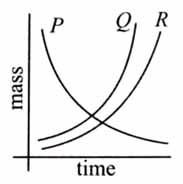
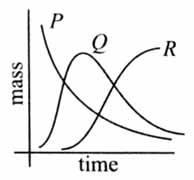
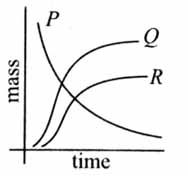
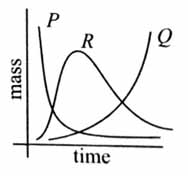
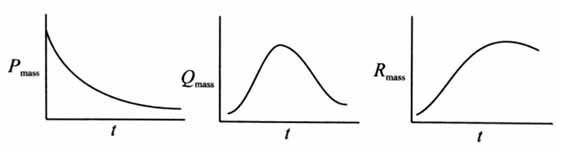
A radioactive material P first decays into Q and then Q decays to non-radioactive material R. Which of the following figure represents time dependent mass of P, Q and R?      [2025]

  •  

  •  

  •  

  •  

(2)

PQR

Final mass of R will be equal to initial mass of P and mass of P is continuously decreasing with time.


Q 3 :

Consider the following radioactive decay process:

A84218αA1β-A2γA3αA4β+A5γA6

The mass number and the atomic number of A6 are given by:              [2023]

  • 211 and 80


  • 210 and 80


  • 210 and 82


  • 210 and 84


(2)

A84218 αA182214 β-A283214 γ A383214

A383214 α A481214 β+ A580210 γ A680210


Q 4 :

If a radioactive element having half-life of 30 min is undergoing beta decay, the fraction of radioactive element remains undecayed after 90 min. will be:         [2023]

  • 18    


  • 116    


  • 14    


  • 12


(1)

NN0=(12)t/t12=(12)9030

NN0=(12)3=18


Q 5 :

Substance A has atomic mass number 16 and half-life of 1 day. Another substance B has atomic mass 1 number 32 and half-life of 12 day. If both A and B simultaneously start undergo radioactivity at the same time with initial mass 320 g each, how many total atoms of A and B combined would be left after 2 days.           [2023]

  • 3.38×1024


  • 6.76×1024


  • 6.76×10²³


  • 1.69×1024


(1)

(N0)A=32016=20 moles

(N0)B=32032=10 moles

NA=(N0)A(2)2/1=204=5

NB=(N0)B(2)2/5=1024=0.625

Total N=5.625

Number of atoms=5.625×6.023×1023=3.38×1024


Q 6 :

A free neutron decays into a proton but a free proton does not decay into neutron. This is because             [2023]

  • neutron is an uncharged particle


  • proton is a charged particle


  • neutron is a composite particle made of a proton and an electron


  • neutron has larger rest mass than proton


(4)

As neutron has more rest mass than proton it will require energy to decay proton into neutron.


Q 7 :

The half-life of a radioactive substance is T. The 7 time taken for disintegrating 78th part of its original mass will be             [2023]

  • 3T


  • 8T


  • T


  • 2T


(1)

t1/2=T

1T12T14T18

t7/8=3T


Q 8 :

Two radioactive elements A and B initially have same number of atoms. The half life of A is same as the average life of B. If λA and λB are decay constants of A and B respectively, then choose the correct relation from the given options.                           [2023]

  • λA=λB


  • λA=2λB


  • λA=λBln2


  • λAln2=λB


(3)

T1/2(A)=Tav(B)

ln2λA=1λB  λA=λBln2


Q 9 :

The half-life of a radioactive nucleus is 5 years. The fraction of the original sample that would decay in 15 years is                  [2023]

  • 18


  • 14


  • 78


  • 34


(3)

15 year=3 half lives

Number of active nuclei=N08

Number of decay=7N08


Q 10 :

A radioactive material is reduced to 1/8 of its original amount in 3 days. If 8×10⁻³ kg of the material is left after 5 days the initial amount of the material is             [2023]

  • 32 g


  • 256 g


  • 40 g


  • 64 g


(2)

N=N0(12)n

N08=N0(12)n  n=3

3 half lives=3 days

1 half life=1 day

5 days=5 half life

N=N0(12)n

8×10-3=N0(12)5

N0=256×10-3 kg

 N0=256 g