

Q 1 :

Given below are two statements :                                              [2025]

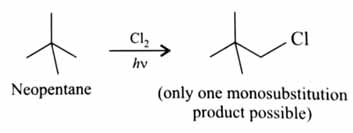
Statement (I): Neopentane forms only one monosubstituted derivative.

Statement (II): Melting point of neopentane is higher than n-pentane.

In the light of the above statements, choose the most appropriate answer from the options given below :

  • Statement I is correct but Statement II is incorrect


  • Both Statement I and Statement II are correct


  • Both Statement I and Statement II are incorrect


  • Statement I is incorrect but Statement II is correct


(2)

Statement I:

Statement II: Melting point of neopentane = –16.4°C, Melting point of n-pentane = –129.8°C


Q 2 :

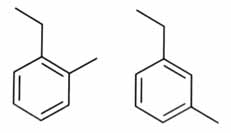
Isomeric hydrocarbons → negative Baeyer’s test (Molecular formula C9H12)

The total number of isomers from above with four different non-aliphatic substitution sites is _____.            [2025]


(2)


Q 3 :

80 mL of a hydrocarbon on mixing with 264 mL of oxygen in a closed U-tube undergoes complete combustion. The residual gases after cooling to 273 K occupy 224 mL. When the system is treated with KOH solution, the volume decreases to 64 mL. The formula of the hydrocarbon is:   [2026]

  • C4H10


  • C2H6


  • C2H2


  • C2H4


(3)

CxHy+(g)(x+y4)O2(g)xCO2+(g)y2H2O()

t=0802640-t=tfinal-264-80(x+y4)80x-

264-80(x+y4)+80x=224

264-80y4=224

40=80y4y=2

264-80(x+y4)=64

264-80(x+12)=64

264-80x-40=64

x=2


Q 4 :

Consider the following reaction sequence

The percentage of nitrogen in product ‘T’ formed is ______ %. (Nearest integer)
(Given molar mass in g mol-1: H : 1, C : 12, N : 14, O : 16)                            [2026]


(20)

Mol. wt=6×12+(6×1)+(2×14)+(2×16)=138

%N=28138×100=20.29%


Q 5 :

Consider the following reaction of benzene:

In compound (Q), the percentage of oxygen is ______ %. (Nearest integer)   [2026]


(10)

Molecular mass of Q is =157

% of oxygen in product 'Q' is =16157×100=10.19%


Q 6 :

3, 3-Dimethyl-2-butanol cannot be prepared by :

Choose the correct answer from the options given below :         [2026]

  • B Only


  • B and E Only


  • B and C Only


  • B, C and E Only


(2)


Q 7 :

Consider the following reaction sequence

Compound (y) develops characteristic colour with neutral FeCl3 solution.

Identify the INCORRECT statement from the following for the above sequence.  [2026]

  • Both compounds x and y will dissolve in NaOH.


  • Compound y will dissolve in NaHCO3 and evolve a gas.


  • Compound x is more acidic than compound y.


  • Both compounds x and y will burn with sooty flame.


(3)


Q 8 :

[IMAGE 16]

R is

  • Anisole


  • Phenol


  • Alcohol


  • Toludine


(1)

[IMAGE 17]


Q 9 :

x(C7H12)O3Zn-H2OA

[IMAGE 18]

Then x is?

  • [IMAGE 19]


  • [IMAGE 20]


  • [IMAGE 21]


  • [IMAGE 22]


(3)

[IMAGE 23]


Q 10 :

Consider the following statements about propyne:

A) It decolourises the colour of Baeyer’s reagent.

B) It liberates hydrogen gas on reaction with sodium.

C) On reaction with HgSO4 and dilute H2SO4 it forms propanal as major product.

The correct statements are

  • (A) and (B) only


  • (B) and (C) only


  • (A) and (C) only


  • (A), (B) and (C)


(1)


Q 11 :

Consider the following statements

A) Methane can be prepared by Kolbe’s electrolytic method

B) Ethane has infinite number of conformations

C) Magnitude of torsional strain in ethane depends upon the angle of rotation about C–C bond

D) n-Hexane undergoes isomerisation reaction in presence of anhyd. AlCl3 and HCl

The correct statements are

  • (A), (B) and (C) only


  • (A), (C) and (D) only


  • (A), (B), (C) and (D)


  • (B), (C) and (D) only


(4)


Q 12 :

[IMAGE 67]

Compound A and B respectively are :

  • o – bromo styrene, benzoic acid


  • p – bromo styrene, benzaldehyde


  • m – bromo styrene, benzaldehyde


  • styrene dibromide, benzoic acid


(4)


Q 13 :

The product P obtained through the following sequence of reactions

[IMAGE 88]

According to IUPAC nomenclature, what position will be assign to chlorine atom from 1 to 6 in product P


(3)

P = 1-Bromo 3-chloro Benezen