

Assertion (A): Two cubes each of edge length 10 cm are joined together. The total surface area of newly formed cuboid is 1200 .
Reason (R): Area of each surface of a cube of side 10 cm is 100 .
Both Assertion (A) and Reason (R) are true and Reason (R) is the correct explanation of Assertion (A)
Both assertion (A) and reason (R) are true and reason (R) is not the correct explanation of Assertion (A)
Assertion (A) is true but reason(R) is false.
Assertion (A) is false but reason(R) is true.
(4) Assertion (A) is false but reason(R) is true
Assertion (A): Length of diagonal of a cube of side 7 cm is
Reason (R): Length of diagonal of a cube of edge
Both Assertion (A) and Reason (R) are true and Reason (R) is the correct explanation of Assertion (A).
Both Assertion (A) and Reason (R) are true but Reason (R) is not the correct explanation of Assertion (A)
Assertion (A) is true but Reason (R) is false
Assertion (A) is false but Reason (R) is true.
(3)
We have side of a cube, a=7 cm.
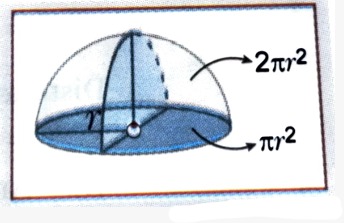
Assertion (A): Total surface area of a hemisphere of radius 2 cm is
Reason (R): Total surface area of a hemisphere of radius
Both Assertion (A) and Reason (R) are true and Reason (R) is the correct explanation of Assertion (A).
Both Assertion (A) and Reason (R) are true but Reason (R) is not the correct explanation of Assertion (A).
Assertion (A) is true but Reason (R) is false.
Assertion (A) is false but Reason (R) is true
(4)
We have,
Radius (r) of the hemisphere = 2 cm

Assertion (A): A solid hemisphere of radius 4 cm is to be painted. Then the total cost of painting at the rate of
Reason (R): Total surface area of a hemisphere
Both Assertion (A) and Reason (R) are true and Reason (R) is the correct explanation of Assertion (A).
Both Assertion (A) and Reason (R) are true but Reason (R) is not the correct explanation of Assertion (A).
Assertion (A) is true but Reason (R) is false
Assertion (A) is false but Reason (R) is true.
(1)
Radius of solid hemisphere, r = 4 cm
Assertion (A): If the areas of three adjacent faces of a cuboid are x,y,z respectively, then the volume of the cuboid is
Reason (R): Volume of a cuboid whose edges are cube units.
Both Assertion (A) and Reason (R) are true and Reason (R) is the correct explanation of Assertion (A).
Both Assertion (A) and Reason (R) are true but Reason (R) is not the correct explanation of Assertion (A).
Assertion (A) is true but Reason (R) is false
Assertion (A) is false but Reason (R) is true
(1)
The edges of cuboid are l,b,h units.
Assertion (A): If two metallic right circular cones of equal height and base radii 3 cm and 4 cm are melted and recast into a solid sphere of radius 5 cm, then the cones are of height 20 cm each.
Reason (R): If two right circular cones of same height h and base radii are melted and recast into a solid sphere of radius r, then
Both A and R are true, and R is the correct explanation of A.
Both A and R are true, but R is not the correct explanation of A.
A is true, but R is false.
A is false, but R is true
(3)
When one solid shape is converted into another, the volume remains the same.
Sum of the volumes of two cones = volume of the sphere
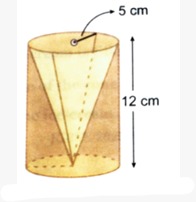
Assertion (A): From a solid cylinder whose height is 12 cm and diameter is 10 cm, a conical cavity of same height and same diameter is hollowed out. Volume of the cone is
Reason (R): If a conical cavity of same height and same diameter is hollowed out from a cylinder of height h and base radius r, then volume of the cone is equal to 1/2 of the volume of the cylinder.
Both, Assertion (A) and Reason (R) are true and Reason (R) is correct explanation of Assertion (A).
Both, Assertion (A) and Reason (R) are true but Reason (R) is not correct explanation for Assertion (A).
Assertion (A) is true but Reason (R) is false.
Assertion (A) is false but Reason (R) is true.
(3)