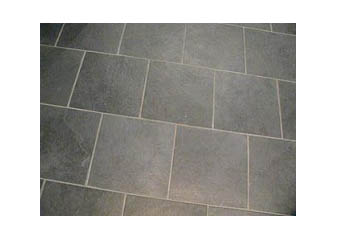


A rectangular floor area can be completely tiled with 200 square tiles. If the side length of each tile is increased by 1 unit, it would take only 128 tiles to cover the floor.

Q. Assuming the original length of each side of a tile be x units, make a quadratic equation from the above information
Let the original side length of each tile be x units.
The area of the rectangular floor using 200 tiles = 200
The area with increased side length (each side increased by 1 unit) using 128 tiles =
So, required quadratic equation is:
Rohan and Jayant are very close friends. They decided to go to Ranikhet with their families in separate cars. Rohan’s car travels at a speed of x km/h while Jayant’s car travels 10 km/h faster than Rohan’s car. Rohan took 2 hours more than Jayant to complete the journey of 300 km.

Based on the above information, answer the following questions:
(i) What is the distance covered by Jayant’s car in two hours in terms of x?
2(x + 10) km
2(x + 9) km
2(x + 11) km
2(x + 8) km
(1)
(i) Speed of Jayant’s car = (x + 10) km/h
Therefore, Distance covered in 2 hours = 2(x + 10) km.
Rohan and Jayant are very close friends. They decided to go to Ranikhet with their families in separate cars. Rohan’s car travels at a speed of x km/h while Jayant’s car travels 10 km/h faster than Rohan’s car. Rohan took 2 hours more than Jayant to complete the journey of 300 km.

Based on the above information, answer the following questions:
(ii) What is the quadratic equation describing the speed of Rohan’s car?
0
1
5
3
(1)
Time taken by Rohan’s car to cover 300 km = 300/x hours
Time taken by Jayant’s car to cover 300 km = 300/(x + 10) hours
Since Rohan takes 2 hours more than Jayant to cover 300 km:
300/x – 300/(x + 10) = 2
⇒ 300[(x + 10) – x] / [x(x + 10)] = 2
⇒ 3000 / [x(x + 10)] = 2
⇒ x(x + 10) = 1500
⇒ x² + 10x – 1500 = 0
Hence, the quadratic equation describing the speed of Rohan’s car is x² + 10x – 1500 = 0
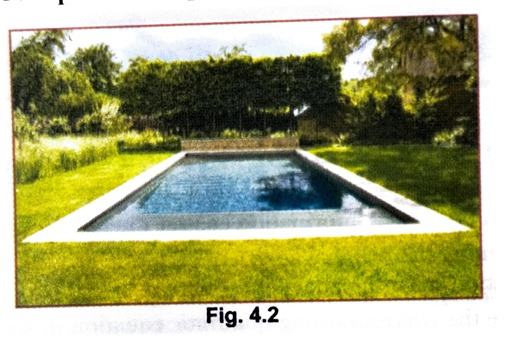
In the picture given, one can see a rectangular in-ground swimming pool. There is a concrete sidewalk of width x metres around the pool. The outside edges of the sidewalk measure 7 m and 12 m. The area of the pool is 36 m².

Answer the following:
(i) Based on the information above, form a quadratic equation in terms of x.
0
1
2
3
(1)
Let x be the uniform width of the sidewalk. Then the pool’s inside dimensions are:
Length of pool = 12 − 2x metres
Breadth of pool = 7 − 2x metres
Given: Area of pool = 36 m²
Therefore, (12 − 2x)(7 − 2x) = 36
This is the required quadratic equation in x.
In the picture given, one can see a rectangular in-ground swimming pool. There is a concrete sidewalk of width x metres around the pool. The outside edges of the sidewalk measure 7 m and 12 m. The area of the pool is 36 m².

Answer the following:
(ii) Find the width of the sidewalk around the pool.
3/2 m
3/1 m
2/2 m
-3/2 m
(1)
Solve :
⇒ (x − 8)(2x − 3) = 0
⇒ x = 8 or x = 3/2
Since x = 8 m would make the pool dimensions negative, we reject it. Hence,
Width of the sidewalk = 3/2 m.
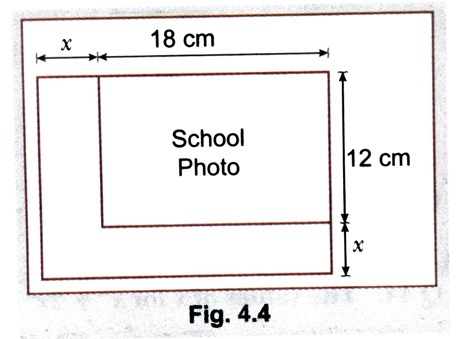
While designing the school yearbook, a teacher asked a student to increase both the length and width of a particular photo by x units each in order to double the photo’s area. The original photo is 18 cm long and 12 cm wide.

Based on the above information, answer the following questions
(i) Write an algebraic equation depicting the above information
214
216
212
210
(2)
Original area of the photo =
Area of the photo after increasing length and breadth each by x units =
It is given that the area of the photo is doubled after increasing length and width by x units.
While designing the school yearbook, a teacher asked a student to increase both the length and width of a particular photo by x units each in order to double the photo’s area. The original photo is 18 cm long and 12 cm wide.

Based on the above information, answer the following questions
(ii) Write the corresponding quadratic equation in standard form.
0
2
5
1
(1)
Simplifying equation (i), we obtain:
This is the required quadratic equation in standard form.
While designing the school yearbook, a teacher asked a student to increase both the length and width of a particular photo by x units each in order to double the photo’s area. The original photo is 18 cm long and 12 cm wide.

Based on the above information, answer the following questions:
(iii) (a) What should be the new dimensions of the enlarged photo?
Length = 24 cm, Breadth = 18 cm
Length = 18 cm, Breadth = 24 cm
Length = -23 cm, Breadth = 18 cm
Length = 24 cm, Breadth = -24 cm
(1)
While designing the school yearbook, a teacher asked a student to increase both the length and width of a particular photo by x units each in order to double the photo’s area. The original photo is 18 cm long and 12 cm wide.

Based on the above information, answer the following questions:
(iii) (b) Can any rational value of x make the new area equal to 220 cm²?
210 cm²
220 cm².
215 cm².
120 cm².
(2)