
Q 11 :

The distance of the point (-4,3) from y-axis is:

  • –4


  • 4


  • 3


  • 5


(2)

As we know that distance of the point P(x,y) from y-axis is magnitude of its x-coordinate.
∴ The distance of the point (-4,3) from y-axis is 4 units


Q 12 :

2 times the distance between (0,5) and (-5,0) is:

  • 8 units
     

  • 5 units


  • 10 units
     

  • none of them


(3)

Let given points be A (0,5) and B (-5,0).
Now, 

AB=(-5-0)2+(0-5)2=25+25=50=522AB=2×52=5×2=10 units


Q 13 :

The distance between the points (m,-n) and (-m,n) is

  • m2+n2


  • m+n


  • 2m2+n2


  • 2m2+2n2


(3)

Given points be A (m,-n)and B (-m,n).

Now, 

AB=(m+m)2+(-n-n)2=4m2+4n2=2m2+n2Required distance=2m2+n2


Q 14 :

A point (x,y) is at a distance of 5 units from the origin. How many such points lie in the third quadrant?

  • 0


  • 1


  • 2


  • Infinitely many


(4)

Point is on the circle with centre (0,0) and radius 5 units.
So, there are infinitely many points (lying on circumference) in third quadrant.


Q 15 :

The distance between the points Asinθ,cosθ and B cosθ,-sinθ is p. Identify the correct statements:

(i) The value of p  is 2.
(ii) The value of
p  depends on the value of θ
(iii) The value of p  is independent of θ.
(iv) The value of
p  is 2. .


Choose the correct option from the following:

  • (iii) and (iv)
     

  • (i) and (iii)


  • (ii) and (iv)
     

  • (ii) and (iii)


(1)

Distance between the points and :

p=(sinθ-cosθ)2+(cosθ+sinθ)2p=2sin2θ+2cos2θ-2sinθcosθ+2sinθcosθp=2sin2θ+cos2θ=2×1=2


Q 16 :

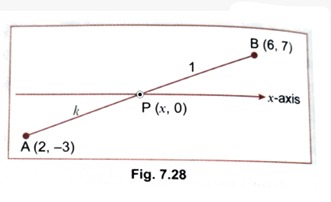
The ratio in which the x-axis divides the line segment joining the points (2, –3) and (6, 7) is:

  • 1 : 3


  • 3 : 7


  • 7 : 3


  • 1 : 2


(2)

Let P(x, 0) be a point on the x-axis such that it divides the line segment joining
A(2, –3) and B(6, 7) in the ratio k : 1.

Using the section formula, we get:

y=ky2+y1k+10=k×7+1×(-3)k+10=7k-3k=37So, the ratio is:37:1 i.e., 3:7


Q 17 :

Point P (a/8, 4) is the mid-point of the line segment joining the points A(–5, 2) and B(4, 6). The value of ‘a’ is:

  • –4


  • 4


  • –8


  • –2


(1)

Since P(a/8, 4) is the mid-point of the line segment joining points A(–5, 2) and B(4, 6),

a8=-5+42a8=-12a=-82a=-4


Q 18 :

The centre of a circle whose diameter’s end points are (–6, 3) and (6, 4) is:

  • (8, –1)


  • (4, 7)


  • (0, 7/2)


  • (4, 7/2)


(3)

We know that centre of a circle is the mid-point of the diameter.

Coordinates of the centre are:

(-6+62,3+42)=(0,72)


Q 19 :

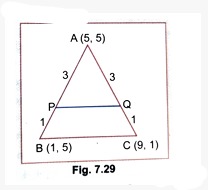
The vertices of a ΔABC are A(5, 5), B(1, 5), and C(9, 1). A line is drawn to intersect AB and AC at P and Q respectively, such that APAB=AQAC=34

Find the length of line segment PQ and coordinates of point P.

(i) Coordinates of P are (2, 5).

(ii) Length of PQ is 35 units.

(iii) Length of PQ is 65 units.

(iv) Coordinates of P are (5, 2).


Choose the correct option from the following:

  • (i) and (ii) are correct.


  • (ii) and (iv) are correct


  • (i) and (iii) are correct


  • (iii) and (iv) are correct


(1)

We have,

APAB=AQAC=34

APAP+PB=AQAQ+QC=34

AP+PBAP=43andAQ+QCAQ=43(Take reciprocal)

1+PBAP=43and1+QCAQ=43

PBAP=13andQCAQ=13

Again taking reciprocal, we get:

APPB=31andAQQC=31

So, P and Q divide AB and AC, respectively, in the same ratio 3 : 1. Thus, the coordinates of P and Q are

P3×1+1×53+1, p3×5+1×53+1=3+54, 15+54=2,5and

Q3×9+1×53+1, 3×1+1×53+1=27+54, 3+54=8,2

Now, PQ=(2-8)2+(5-2)2=36+9=45=35 units.


Q 20 :

If the coordinates of the midpoints of the sides of the triangle are (1, 2), (0, −1) and (2, −1), which of the following coordinates are the vertices of the triangle?

(i) (1, −4)  (ii) (−1, 2)  (iii) (3, 2)  (iv) (2, 3)  (v) (−4, 1)

Choose the correct option from the following:

  •  (i), (ii) and (iii)
     

  • (ii), (iii) and (iv)


  • (iii), (iv) and (v)


  • (i), (iii) and (iv)


(1)

Let A = (x, y), B = (x, y), C = (x, y)be the vertices of ΔABC.Let the midpoints be:D(1, 2) on BC, E(0, 1) on CA, F(2, 1) on ABSince D is the midpoint of BC:x2+x32=1 and y2+y32=2x2+x3=2, y2+y3=4...(i)Since E is the midpoint of AC:x1+x32=0andy1+y32=-1x1+x3=0, y1+y3=-2...(ii)Since F is the midpoint of AB:x1+x22=2andy1+y22=-1x1+x2=4, y1+y2=-2...(iii)Adding (i), (ii) and (iii):(x2+x3)+(x1+x3)+(x1+x2)=2+0+4x1+x2+x3=3Similarly for y-values:(y2+y3)+(y1+y3)+(y1+y2)=4-2-2y1+y2+y3=0...(iv)Finding coordinates of A