

Q 1 :

Assertion (A): The value of y is 3, if the distance between the points P(2, -3) and Q(10, y) is 10.

Reason (R): Distance between two points is given by (x2-x1)2+(y2-y1)2

  • Both Assertion (A) and Reason (R) are true and Reason (R) is the correct explanation of Assertion (A)


  • Both assertion (A) and reason (R) are true and reason (R) is not the correct explanation of Assertion (A)


  • Assertion (A) is true but reason (R) is false.


  • Assertion (A) is false but reason (R) is true.


(1)

Both Assertion (A) and Reason (R) are true and Reason (R) is the correct explanation of Assertion (A)


Q 2 :

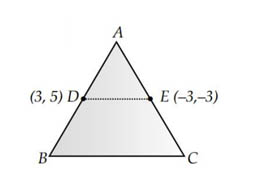
Assertion (A): If the co-ordinates of the mid-points of the sides AB and AC of ΔABC are D(3,5) and E(-3,-3) respectively, then BC = 20 units

Reason (R) : The line joining the mid points of two sides of a triangle is parallel to the third side and equal to half of it.

  • Both assertion (A) and reason (R) are true and reason (R) is the correct explanation of assertion (A)


  • Both assertion (A) and reason (R) are true and reason (R) is not the correct explanation of assertion (A)


  • Assertion (A) is true but reason (R) is false.


  • Assertion (A) is false but reason (R) is true.


(1)

For assertion : Distance between two points (x1,y1) and (x2,y2) =(x2-x1)2+(y2-y1)2

 Distance between DE=(-3-3)2+(-3-5)2

                                          =36+64=100=10 units

By midpoint theorem, distance between BC =2×distance between DE=2×10=20 units.

So, assertion is true.

For reason: By midpoint theorem, the line joining the mid points of two sides of a triangle is parallel to the third side and equal to half of it. So, reason is also true.

Both assertion (A) and reason (R) are true and reason (R) is the correct explanation of assertion (A)


Q 3 :

Assertion (A): Point P(0,2) is the point of intersection of y-axis with the line 3x + 2y = 4.

Reason (R): The distance of point P(0,2) from the x-axis is 2 units.

  • Both A and R are true, and R is the correct explanation of A.
     

  • Both A and R are true, but R is not the correct explanation of A


  • A is true, but R is false.


  • A is false, but R is true.


(2)

The line 3x+2y=4cuts the y-axis when x=0.3×0+2y=42y=4y=2 Point P(0,2)is the point of intersection of y-axis with the line 3x+2y=4.

Also, the distance of any point P(x,yfrom the x-axis is the magnitude of its y-coordinate.

Distance of the point P(0,2) from x-axis is 2 units

 Both Assertion (A) and Reason (R) are true but Reason (R) is not the correct explanation of Assertion (A).


Q 4 :

Assertion (A): The point on the x-axis which is equidistant from (2,-5) and (-2,9) is (8,0).

Reason (R): Points lying on the y-axis are always of the form (0,y).

  • Both A and R are true, and R is the correct explanation of A.


  • Both A and R are true, but R is not the correct explanation of A.
     

  • A is true, but R is false.


  • A is false, but R is true


(4)

PA=PB(x-2)2+(0+5)2=(x+2)2+(0-9)2

Squaring both sides:(x-2)2+25=(x+2)2+81

x2-4x+4+25=x2+4x+4+81

-8x=56x=56-8=-7

Thus, the point on x-axis is (-7,0), not (8,0)

So: Assertion (A) is false but Reason (R) is true


Q 5 :

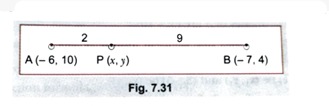
Assertion (A): The point (–4, 6) divides the line segment joining A(–6, 10) and B(–7, 4) in the ratio 2 : 9.

Reason (R): The coordinates of the point P(x,y) which divides the line segment joining A(x1,y1) and B(x2,y2) internally in the ratio m1:m2 are:

(m1x2+m2x1m1+m2, m1y2+m2y1m1+m2)

  • Both A and R are true, and R is the correct explanation of A


  • Both A and R are true, but R is not the correct explanation of A


  • A is true, but R is false.


  • A is false, but R is true


(4)

Let point P(x,y) divide AB in the ratio 2 : 9.

Using section formula:

x=2(-7)+9(-6)2+9=-14-5411=-6811y=2(4)+9(10)2+9=8+9011=9811Thus,Coordinates of point P are(-6811,9811).But the assertion claims P is (4, 6), which is incorrect.


Q 6 :

Assertion (A): If the points A(6, 1), B(8, 2), C(9, 4) and D(p, 3) are the vertices of a parallelogram (in order), then p = 7.

Reason (R): Diagonals of a parallelogram bisect each other, therefore midpoint of AC = midpoint of BD.

  • Both A and R are true, and R is the correct explanation of A.
     

  • Both A and R are true, but R is not the correct explanation of A


  • A is true, but R is false.


  • A is false, but R is true


(1)

Given ABCD is a parallelogra, Diagonals bisect each other, so

Midpoint of AC=Midpoint of BD(6+92,1+42)=(p+82,3+22)Simplifying:(152,52)=(p+82,52)Comparing x-coordinates:152=p+82p+8=15p=7