

Q 11 :

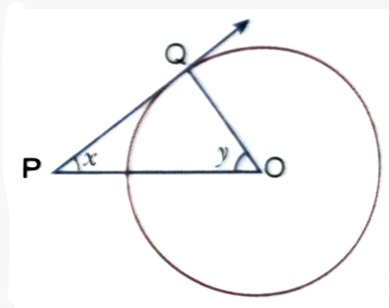
In Fig. PQ is a tangent to the circle with centre O. If ∠OPQ = x, ∠POQ = y, then x + y is:

  • 45°


  • 90°


  • 60°


  • 180°


(2)

Since PQ is tangent at Q to the circle and OQ is radius,
∴ OQ ? PQ ⇒ ∠OQP = 90°

In ΔPOQ, we have

∠OQP + ∠OPQ + ∠POQ = 180°  [Angle Sum Property of triangle]

⇒ 90° + x + y = 180°
⇒ x + y = 180° – 90° = 90°


Q 12 :

In Fig, TA is a tangent to the circle with centre O such that OT = 4 cm, ∠OTA = 30°, then length of TA is:

  • 23cm


  • 2 cm


  • 22cm


  • 3cm


(1)

Since TA is tangent at A and OA is radius of the circle,
OA  TA  OAT = 90°

 In right angled ΔOAT, we havecos30°=TAOT=32TA4=32TA=23 cm


Q 13 :

The length of tangent drawn to a circle of radius 9 cm from a point 41 cm from the centre is:

  • 40 cm


  • 9 cm


  • 41 cm


  • 50 cm


(1)

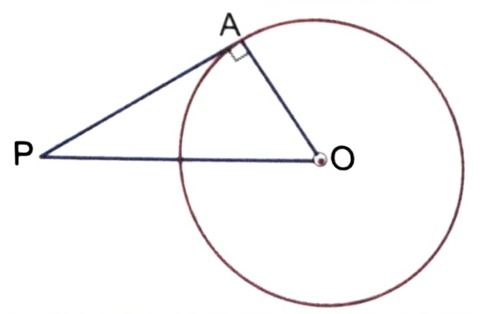
Let O be the centre of the circle and P be the external point and PA is tangent at A as shown in Fig.

 OA  PAGiven, OA = 9 cm and OP = 41 cmIn right ΔOAP, we haveOP2=OA2+PA2(Using Pythagoras theorem)(41)2=(9)2+(PA)21681-81=PA21600=PA2PA=40 cm


Q 14 :

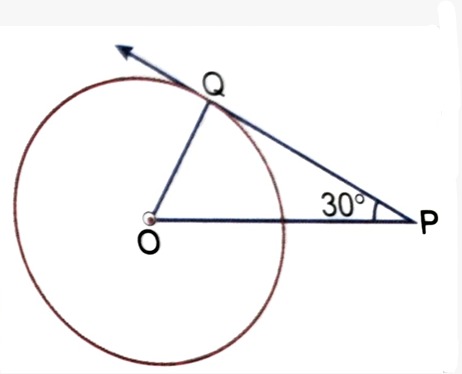
In Fig, PQ is tangent to a circle centered at O. If the radius of the circle is 5 cm, then the length of the tangent PQ is:

  • 53cm


  • 103cm


  • 10 cm


  • 53cm


(1)

Given, OQ = 5 cm

Since PQ is tangent to a circle with centre O, at point Q

 OQ  PQ OQP = 90°In right ΔOPQ, we havetan30°=OQPQ13=5PQPQ=53 cm


Q 15 :

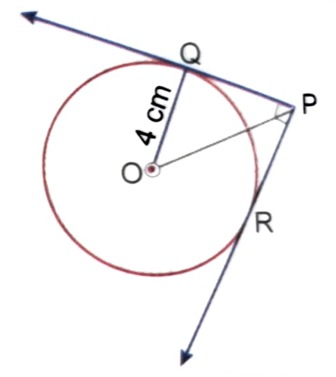
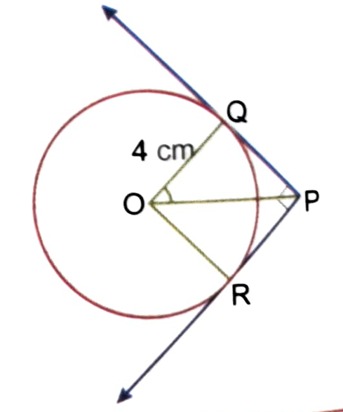
In Fig, from an external point P, two tangents PQ and PR are drawn to a circle of radius 4 cm with centre O. If ∠QPR = 90°, then length of PQ is:

  • 3 cm


  • 4 cm


  • 2 cm


  • 22cm


(2)

Construction: Join OR as shown in

We have, ΔOQP  ΔORP (by SSS congruency rule) OPQ = OPR = 45°(by CPCT) ( QPR = 90°)In ΔPOQ, OQP = 90°, OPQ = 45°POQ=180°-(90°+45°)=45° OPQ = POQ = 45° OPQ = POQ = 45°  OQ = PQ (Opposite sides of equal angles are equal)PQ=4 cm


Q 16 :

If an external point of a circle is at a distance equal to the diameter (2r) of the circle from the centre of the circle, then length of the tangent drawn from the external point is:

  • 3r units


  • 4r units


  • 5r units


  • 3 r units


(4)

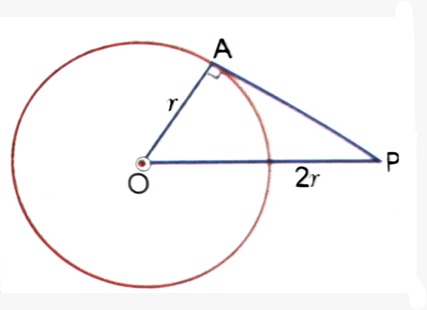
Let P be an external point and O be the centre of the circle, such that OP = 2r units where r is radius of the circle as shown in Fig
Let PA be the tangent at point A on circle.

 OA  PA and OA = r unitsNow, in right ΔOAP, we haveAP2+OA2=OP2AP2+r2=(2r)2AP2=4r2-r2=3r2AP=3 r units


Q 17 :

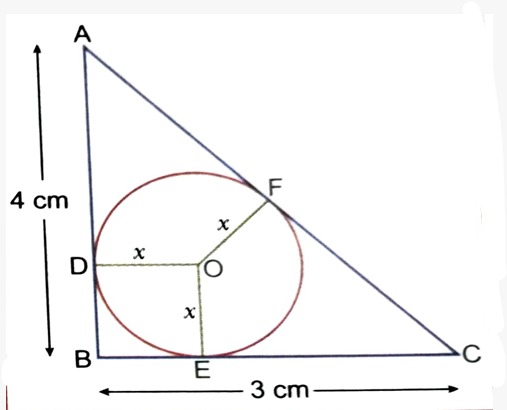
In Fig, ABC is a right triangle, right angled at B with BC = 3 cm and AB = 4 cm. A circle with centre O and radius x cm has been inscribed in ΔABC.

  • 1 cm


  • 2 cm


  • 3 cm


  • 4 cm


(1)

In right ΔABC, we have

AC2=AB2+BC2AC2=(4)2+(3)2=16+9AC2=25AC=5 cmNow, AD = AB  BD = (4  x) cmAF=AD=4-x cm(Tangents drawn from an external point A)Also,EC=BC{BE=3-xcmCF=EC=3-x cm(Tangents drawn from an external point C)AC=AF+CF=4-x+3-x5=7-2x2x=7-5=2x=1 cm


Q 18 :

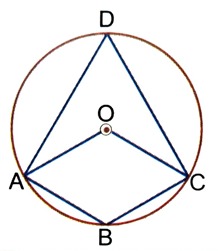
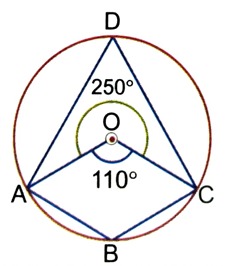
In Fig, if ∠AOC = 110° then which of the below statements are correct?

(i) Value of ∠D is 55°
(ii) Value of ∠D is 110°
(iii) Value of ∠B is 25°
(iv) Value of ∠B is 125°

Choose the correct option from the following:
 

  • (i) and (ii)


  • (iii) and (iv) 


  • (i) and (iv) 


  • (i) and (iii)


(3)

We know that the angle subtended by a chord at the centre is twice the angle subtended by it on the circumference.

AOC=2ADC110°=2ADCADC=55°D=55°

 AOC = 110° Reflex AOC = 360°  110° = 250° (As shown in Fig.)

Also, reflex AOC = 2ABC250°=2ABCABC=125°

 B = 125°  Statements (i) and (iv) are correct.


Q 19 :

Which of the following is/are a cyclic quadrilateral?

(i) Rhombus (ii) Rectangle (iii) Parallelogram (iv) Trapezium

Choose the correct option from the following:

  • (i), (ii) and (iii)


  • (i), (iii) and (iv)


  • (i), (ii) and (iv)


  • Only (ii)


(4)

In a cyclic quadrilateral, the sum of opposite angles is 180°. Only rectangle satisfies the condition of cyclic quadrilateral.