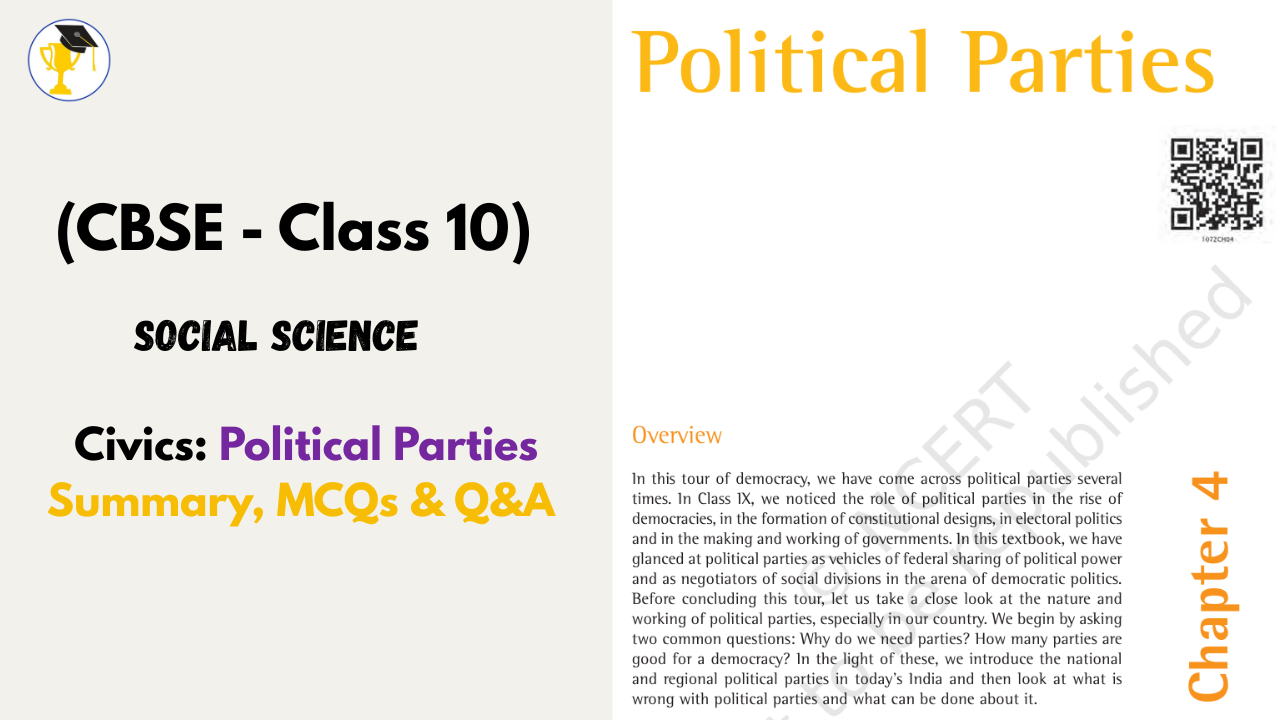
Class 10 Social Science-Political Parties (Civics: Chapter 4) Summary + MCQs + Q&A
CHAPTER SUMMARY-POLITICAL PARTIES
Introduction: Why Study Political Parties?
Political parties are the most visible institutions in a democracy. Even those who don’t know the Constitution know party names.
Yet, people often criticise parties — blaming them for corruption or conflicts.
But democracy cannot function without political parties. They act as a link between people and government.
2. What is a Political Party?
According to NCERT:
“A political party is a group of people who come together to contest elections and hold power in the government.”
They share:
A political party has three components (Page 48):
-
Leaders
-
Active members
-
Followers
3. Functions of Political Parties
According to Page 49–50, parties perform 7 major functions:
1. Contest Elections
Choose candidates; in India, top leaders usually select candidates.
2. Put Forward Policies & Programmes
Simplify public opinion into clear policies.
3. Make Laws
Laws are passed by Legislatures dominated by party leadership.
4. Form and Run Government
Ministers belong to ruling party/coalition.
5. Play Opposition Role
Criticise policies & highlight alternatives.
6. Shape Public Opinion
Use campaigns, posters, movements.
7. Provide Access to Government
Local party workers help citizens approach government schemes.
Without parties, representative democracy collapses.
4. Party Systems: One-Party, Two-Party & Multi-Party
(Page 51) Different countries have different systems:
One-Party System
e.g., China — Not democratic, no competition.
Two-Party System
e.g., USA, UK — Real competition between two major parties.
Multi-Party System
e.g., India — Many parties, coalition governments common.
NCERT states that party systems evolve naturally and depend on a country's social diversity.
5. National & State Parties in India
Criteria for National Parties (Page 53):
A party must:
As of 2023, India has 6 national parties (Page 54–55):
-
BJP
-
INC
-
BSP
-
CPI(M)
-
AAP
-
NPP
Each party's ideology is explained on pages 54–55.
State Parties (Page 55–56):
These are parties with influence limited to states, like:
State parties strengthen federalism by representing regional interests.
6. Challenges to Political Parties
According to Pages 57–59:
1. Lack of Internal Democracy
Power concentrated in few leaders; no regular meetings or internal elections.
2. Dynastic Succession
Leadership passes to family members.
3. Money & Muscle Power
Candidates selected based on wealth or criminal background.
4. No Meaningful Choice
Ideologies of major parties becoming similar; leaders switch parties often.
These weaken democratic values.
7. How Can Parties Be Reformed?
NCERT suggests reforms on pages 59–60:
Legal Reforms
-
Anti-defection law (1985) prevents party-hopping.
-
Mandatory affidavits of assets & criminal cases.
-
Parties must hold organisational elections & submit IT returns.
Suggested Reforms
-
Law to regulate internal democracy.
-
33% reservation for women in party tickets.
-
State funding of elections (in cash or kind).
Non-Legal Reforms
KEY TERMS
|
Term
|
Meaning
|
|
Political Party
|
Group aiming to contest elections & form govt
|
|
Ruling Party
|
Party that forms government
|
|
Opposition
|
Party not in power
|
|
Dynastic Succession
|
Passing leadership to family
|
|
Defection
|
Changing political party after election
|
|
Coalition
|
Alliance of political parties
|
ONE-WORD / ONE-LINE ANSWERS
1. Party that forms government → Ruling Party
2. Minimum vote % to become national party → 6%
3. Changing party after election → Defection
4. AAP founded in → 2012
5. BJP ideology → Hindutva / Integral Humanism
6. First national party from North-East → NPP
7. One-party system example → China
8. Multi-party system example → India
9. Who founded BSP? → Kanshi Ram
10. What does INC support? → Secularism & welfare state
MCQs
1. Who founded BSP?
Answer: Kanshi Ram
2. What percentage of votes is needed to be a national party?
Answer: 6%
3. Which is an example of a two-party system?
Answer: USA
4. Which law stops party-hopping?
Answer: Anti-defection law
5. A party must win ______ Lok Sabha seats to be a national party.
Answer: 4 seats
6. Which party believes in “Integral Humanism”?
Answer: BJP
7. A party active only in one state →
Answer: State Party
8. Party with oldest origin in India →
Answer: INC
9. System with coalition governments →
Answer: Multi-party
10. Lack of internal democracy means →
Answer: Power concentrated at top
CASE-BASED QUESTIONS
Case 1: National Parties
PASSAGE: National parties must secure 6% votes and 4 Lok Sabha seats. India has 6 national parties including BJP, INC, BSP, CPI(M), AAP, and NPP.
Questions:
1. How many national parties exist? → 6
2. Criteria for national party? → 6% vote + 4 Lok Sabha seats
3. Name two national parties. → BJP, INC
Case 2: Challenges
PASSAGE: Political parties face challenges of dynastic rule, money power, lack of internal democracy, ideological similarity, etc.
Questions:
1. What is dynastic succession?
→ Leadership inherited by family.
2. Why is money power a concern?
→ Influences candidate selection.
3. What challenge reduces meaningful choice?
→ Similar ideologies.
ASSERTION-REASON
Here are 10 assertion–reason questions with answers:
1. A: Parties are essential for democracy.
R: They link people to government.
Answer: A (Both true, R explains A)
2. A: India has a two-party system.
R: Only two parties dominate elections.
Answer: C (Both false)
3. A: Dynastic succession weakens democracy.
R: Leadership passes to family members.
Answer: A
4. A: Money power influences elections.
R: Rich candidates get more tickets.
Answer: A
5. A: Anti-defection law stops corruption.
R: It prevents MLAs/MPs from shifting parties.
Answer: A
6. A: Political parties offer meaningful choices.
R: All major parties have identical ideologies.
Answer: C
7. A: A party must win 2 seats to become state party.
R: It must secure 6% votes in State assembly.
Answer: A
8. A: Coalition governments occur in multi-party systems.
R: No single party wins majority.
Answer: A
9. A: Party leaders alone select candidates in India.
R: Parties lack internal democracy.
Answer: A
10. A: Citizens can help reform parties.
R: Public pressure forces parties to change.
Answer: A
LONG ANSWERS (5–6 MARKS)
Q1. Explain the functions of political parties.
Political parties contest elections, form governments, make laws, shape public opinion, and provide access to government machinery. They offer policy choices and link citizens to the state, making democracy workable. Without parties, elections and governance would collapse into chaos.
Q2. Describe major challenges faced by political parties.
Parties suffer from lack of internal democracy, dynastic rule, influence of money/muscle power, and lack of meaningful alternatives. These weaknesses reduce accountability and weaken democracy.
Q3. Suggest reforms to improve political parties.
Legal reforms: regulate internal elections, transparency in funding, affidavits of criminal records.
Non-legal reforms: public pressure, strengthening civil society, and increased political participation. State funding and 33% reservation for women can improve representation and fairness.
For full chapter click on: Political Parties
.


 STUDY MATERIALS
 COURSES
 MORE
MORE
 SUCCESS STORY
 ADMISSION
 STORE
STORE