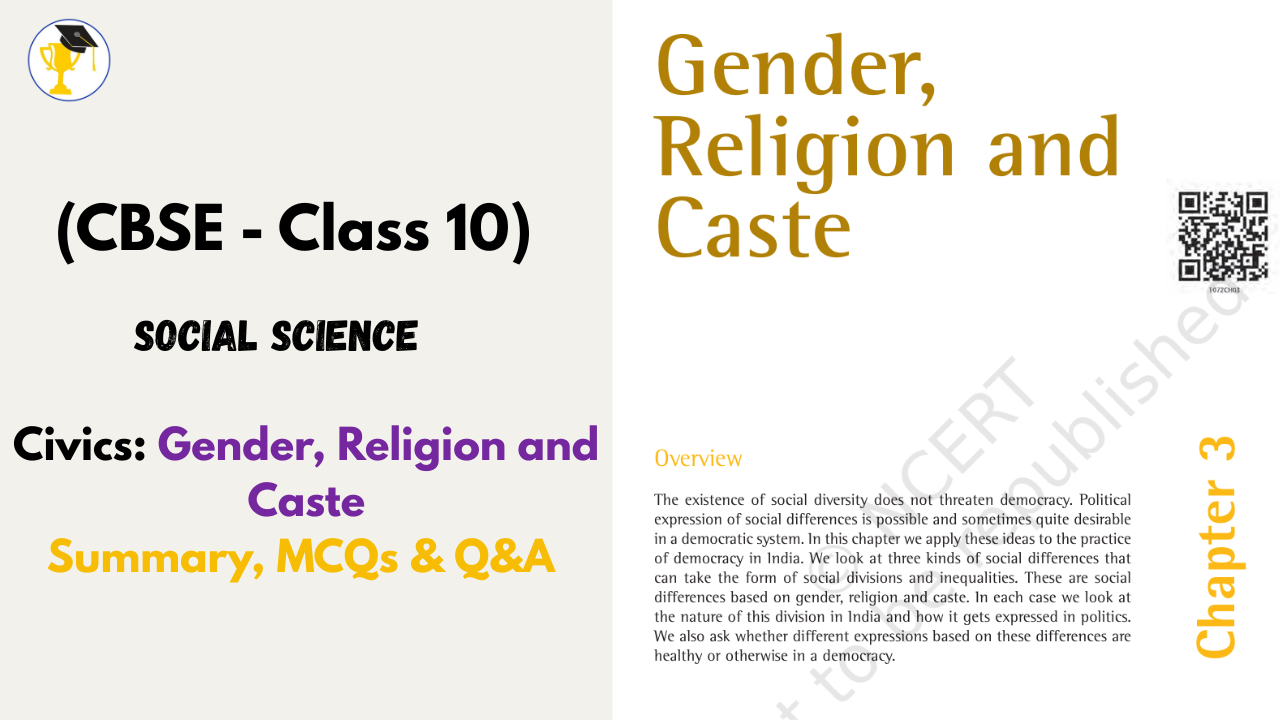
Class 10 Social Science- Gender, Religion and Caste (Civics: Chapter 3) Summary + MCQs + Q&A
CHAPTER SUMMARY-GENDER, RELIGION AND CASTE
1. Gender and Politics
Gender Division
Gender division is a form of social inequality based on social roles and expectations, not biology.
Women are often confined to domestic duties (housework, childcare), while men are seen as breadwinners — this is called sexual division of labour.
According to the Time Use Survey (page 32), women in India work on average 7.5 hours a day, compared to 6.5 hours for men, yet most of their work remains unpaid and unrecognised.
Feminist Movements
-
Women’s movements across the world fought for equal rights, voting rights, and representation.
-
These movements are known as feminist movements, aiming for equality in personal and public life.
Patriarchy and Inequality
India is still a male-dominated (patriarchal) society.
Key issues:
-
Female literacy (54%) is lower than male literacy (76%).
-
Women often paid less than men for the same work — despite the Equal Remuneration Act, 1976.
-
Child sex ratio dropped to 919 (2011 census).
-
Harassment and violence against women are still widespread.
Political Representation
-
Women in Lok Sabha: 14.36% (2019)
-
State Assemblies: <5%
-
Panchayati Raj: 33% reservation for women since 1992.
-
In 2023, the Women’s Reservation Act (Nari Shakti Vandan Adhiniyam) was passed — reserving 33% seats in Lok Sabha and State Assemblies for women.
Lesson: Women’s participation ensures equality, fairness, and a stronger democracy.
2. Religion, Communalism and Politics
Religion and Politics
Religion influences moral and ethical values in politics. Gandhiji believed that politics must be guided by values drawn from all religions — not by dominance of any one faith.
Communalism
Communalism is the belief that religion is the primary basis of a nation.
It divides people into exclusive groups, leading to discrimination, violence, and even demands for separate nations.
Forms of Communalism:
1. Everyday prejudices and stereotypes
2. Quest for political dominance by one religion
3. Religious mobilisation using emotional appeals
4. Communal riots and violence (e.g., Partition of 1947)
Secularism in India
India chose to be a secular state:
-
No official religion
-
Freedom to follow any faith (Article 25)
-
No discrimination based on religion
-
State can intervene to promote equality (e.g., abolishing untouchability)
Lesson: Communalism threatens democracy; secularism protects unity.
3. Caste and Politics
Caste Inequality
Caste system is unique to India — based on hereditary occupations and social hierarchy.
Lower castes faced untouchability, exclusion, and discrimination.
Social reformers like Phule, Ambedkar, Periyar, and Gandhiji fought for equality.
Constitution banned caste discrimination and provided reservations for Scheduled Castes (SCs), Scheduled Tribes (STs), and Other Backward Classes (OBCs).
Caste and Economic Inequality
Even today, economic inequality follows caste lines:
Caste in Politics
-
Political parties select candidates based on caste composition.
-
Voters often prefer candidates from their own caste.
-
However, no single caste dominates; elections are won through alliances and coalitions.
-
Caste influences politics, but politics also transforms caste — by encouraging unity and collective demands.
Lesson: Caste-based awareness can empower marginalised groups, but excessive caste politics can divide society.
KEY TERMS:
|
Term
|
Meaning
|
|
Patriarchy
|
System valuing men over women
|
|
Feminism
|
Movement for gender equality
|
|
Communalism
|
Mixing religion with politics for power
|
|
Secularism
|
Equal respect for all religions
|
|
Casteism
|
Discrimination based on caste
|
|
Sexual Division of Labour
|
Assignment of domestic work to women
|
|
Panchayati Raj
|
Local self-government system
|
|
Nari Shakti Vandan Act
|
33% reservation for women in legislatures (2023)
|
ONE WORD / ONE LINE ANSWERS
1. Rule by father → Patriarchy
2. Equal rights for both genders → Feminism
3. Unequal roles assigned by society → Gender division
4. System dividing society by birth → Caste system
5. India’s official religion → None (Secular)
6. 33% reservation for women → Panchayati Raj & Nari Shakti Vandan Act 2023
7. Practice of discrimination by religion → Communalism
8. Caste-based discrimination abolished by → Indian Constitution
9. Rights of all religions ensured by → Secularism
10. Act ensuring equal pay → Equal Remuneration Act, 1976
MCQs
1. Women’s Reservation Act passed in:
a) 1992 b) 2009 c) 2023 d) 2014
Answer: c
2. What is “sexual division of labour”?
Answer: Assignment of domestic work to women.
3. Communalism means:
Answer: Mixing religion with politics.
4. Secularism means:
Answer: Equal respect for all religions.
5. Percentage of SCs in India’s population:
Answer:16.6%
6. Equal Remuneration Act enacted in:
Answer: 1976
7. Which organisation ensures women’s local representation?
Answer: Panchayati Raj
8. Feminism refers to:
Answer: Equality of rights for men and women.
9. Scheduled Tribes population (2011):
Answer: 8.6%
10. Constitution abolished:
Answer: Untouchability
CASE-BASED QUESTIONS
Case 1: Women’s Political Participation
PASSAGE:
Women’s representation in Parliament is only 14.36%. The 2023 Nari Shakti Vandan Act provides 33% reservation for women in Lok Sabha and State Assemblies.
Questions:
1. What is the name of this Act? → Nari Shakti Vandan Adhiniyam
2. How much reservation is given? → 33%
3. Why is women’s representation important? → Ensures equality and justice.
Case 2: Religion and Secularism
PASSAGE:
India has no official religion and all citizens are free to follow any faith. State can intervene to promote equality, e.g., banning untouchability.
Questions:
1. What type of state is India? → Secular State
2. Example of religious reform by government? → Abolition of untouchability
3. Why is secularism important? → Ensures unity and peace.
Case 3: Caste and Politics
PASSAGE:
Caste still affects Indian politics as parties choose candidates based on caste. Yet, voters also consider performance and policies.
Questions:
1. What determines election results apart from caste? → Performance & leadership
2. Who worked against caste inequality? → Ambedkar, Phule, Periyar
3. What negative effect does caste politics cause? → Divisions and conflict
ASSERTION–REASON QUESTIONS (10 Sets)
1. A: Gender division is based on biology.
R: It is based on social expectations.
Answer: (A false, R true)
2. A: Feminism seeks equality for women.
R: It supports men’s dominance in society.
Answer: (A true, R false)
3. A: Communalism strengthens democracy.
R: It promotes one religion’s superiority.
Answer: (A false, R true)
4. A: India is a secular state.
R: There is no official religion in India.
Answer: A
5. A: Caste determines election results in India.
R: People vote based on caste only.
Answer: (A true, R false)
6. A: Women’s political representation in India is low.
R: Patriarchy limits their participation.
Answer: A
7. A: Caste inequalities have vanished.
R: Untouchability is still practised in some areas.
Answer: (A false, R true)
8. A: Communalism means separation of religion from politics.
R: It mixes religion with politics.
Answer: (A false, R true)
9. A: Constitution allows freedom of religion.
R: It bans discrimination on religious grounds.
Answer: A
10. A: Political awareness among lower castes led to empowerment.
R: Caste-based movements gave voice to the oppressed.
Answer: A
LONG ANSWERS (5–6 MARKS)
Q1. Explain the relationship between gender and politics.
Gender division refers to inequality between men and women in social and political life. In India, women face lower literacy, low pay, and limited representation. Movements for equality led to legal acts like the Equal Remuneration Act and reservation in Panchayati Raj. The 2023 Women’s Reservation Act promises 33% seats for women in legislatures, strengthening democracy.
Q2. What are the major forms of communalism?
Communalism appears as everyday prejudices, political dominance, religious mobilisation, and violence. It divides society and promotes hatred. The Indian Constitution prevents such misuse through secular principles, ensuring equality for all religions.
Q3. Describe the role of caste in Indian politics.
Caste influences voting patterns and political alliances. However, politics also modernises caste by bringing lower groups into power. Caste awareness has empowered Dalits and OBCs but excessive caste politics can cause division and distract from development issues.
For full chapter click on: Gender, Religion and Caste


 STUDY MATERIALS
 COURSES
 MORE
MORE
 SUCCESS STORY
 ADMISSION
 STORE
STORE