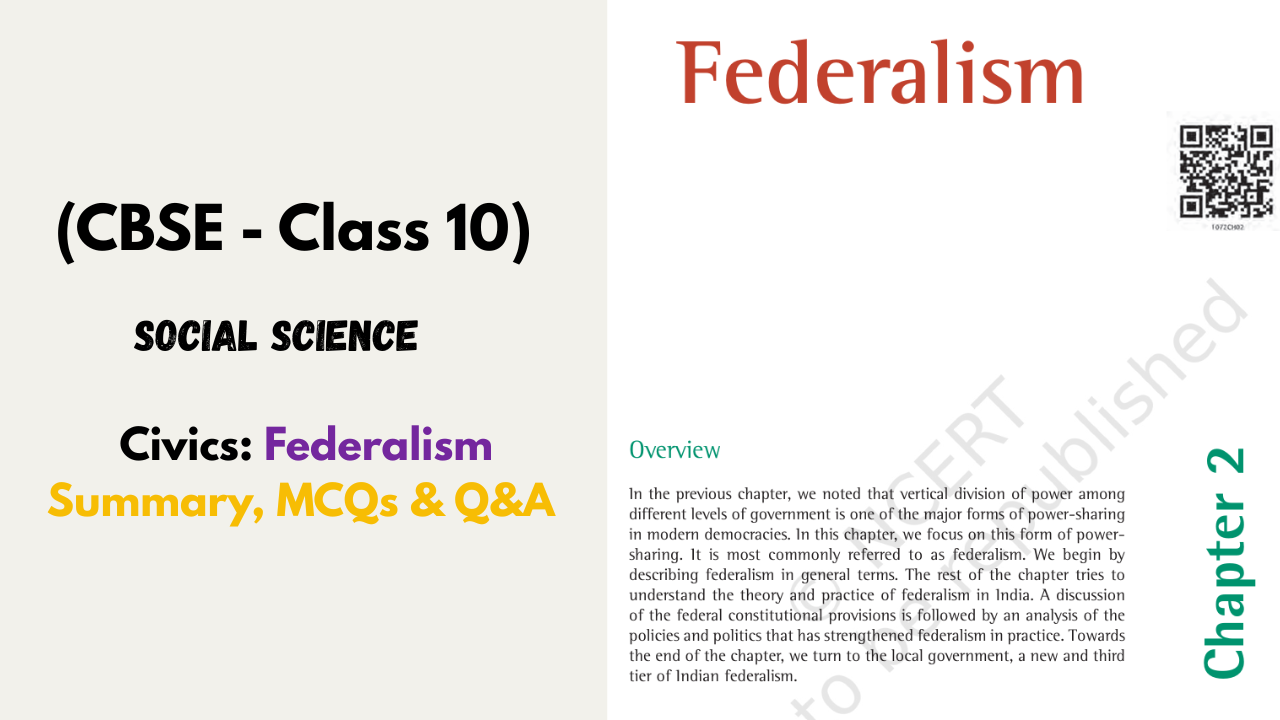
Class 10 Social Science- Federalism (Civics: Chapter 2) Summary + MCQs + Q&A
CHAPTER SUMMARY-FEDERALISM
1. What is Federalism?
Federalism is a system of government in which power is divided between a central authority and various constituent units (states) of the country.
Both levels of government — Union and State — enjoy independent powers and are answerable to the people in their own jurisdictions.
Objectives of Federalism
- Safeguard unity of the country.
- Accommodate regional diversity.
2. Types of Federations
| Type |
Description |
Examples |
| Coming Together |
Independent states form a union voluntarily, retaining identity but increasing strength. |
USA, Switzerland, Australia |
| Holding Together |
A large country divides powers between centre and states to maintain unity. |
India, Spain, Belgium |
3. Key Features of Federalism
- Two or more levels of government.
- Each level governs the same citizens but in different matters.
- Powers are clearly divided by the Constitution.
- Changes require consent of both Centre and States.
- Courts act as umpires in case of disputes.
- Each level has independent sources of revenue.
4. What Makes India a Federal Country
The Constitution of India divides power between Union and States through three lists:
| List |
Subjects |
Who Makes Laws |
| Union List |
Defence, foreign affairs, banking, currency |
Union Govt |
| State List |
Police, agriculture, trade, irrigation |
State Govt |
| Concurrent List |
Education, forests, marriage, trade unions |
Both (Union prevails in conflict) |
| Residuary Subjects |
E.g., IT, cyber laws |
Union Govt |
5. Special Features of Indian Federalism
- Union Territories directly controlled by Centre (e.g., Delhi, Chandigarh).
- Special provisions (Article 371) for states like Assam, Nagaland, Mizoram, etc.
- Constitutional protection: Changes in federal structure require 2/3rd Parliament approval + half of State legislatures’ consent.
- Judiciary acts as the guardian of federalism.
6. How Federalism is Practised in India
A. Linguistic States
- States reorganised on the basis of language (1956).
- Made administration easier and unity stronger.
B. Language Policy
- No national language declared.
- Hindi is official; 22 languages in the 8th Schedule.
- English continues for official work (post-1965 protests).
- Promotes inclusiveness unlike Sri Lanka.
C. Centre–State Relations
- Before 1990: One-party dominance at Centre.
- After 1990: Rise of regional parties and coalition governments → increased State autonomy.
- Supreme Court judgement prevented misuse of Article 356.
7. Decentralisation in India (Third Tier of Government)
To make governance more local and participative, 73rd and 74th Amendments (1992) introduced local self-government.
Structure:
- Rural areas: Gram Panchayat → Panchayat Samiti → Zila Parishad
- Urban areas: Municipality → Municipal Corporation
Features:
- Regular elections mandatory.
- 1/3rd seats reserved for women.
- State Election Commission created in each state.
- Funds & powers shared with local bodies.
Result: India now has 36 lakh elected representatives, making it the largest democracy in the world.
KEY TERMS:
| Term |
Definition |
| Federalism |
Division of power between central and state governments |
| Unitary System |
Power concentrated at one level |
| Jurisdiction |
Area under legal authority |
| Coalition Government |
Alliance of political parties sharing power |
| Decentralisation |
Power distributed to local levels |
| Panchayati Raj |
Rural local self-government system |
ONE WORD / ONE LINE ANSWERS
1. Smallest federal unit in India → Gram Panchayat
2. Article granting special status → Article 371
3. Number of Scheduled Languages → 22
4. Constitutional amendment for local govt. → 73rd & 74th (1992)
5. First linguistic state → Andhra Pradesh
6. Number of levels of government in India → Three
7. Union List subject → Defence
8. State List subject → Police
9. Concurrent List subject → Education
10. Head of a municipal corporation → Mayor
MCQs
1. Which country is an example of a “holding together” federation?
Ans: India
2. What is the official language of India?
Ans: Hindi
3. Which Article grants special powers to some states?
Ans: Article 371
4. What is the 3rd tier of government called?
Ans: Local Government
5. How many languages are in the Eighth Schedule?
Ans: 22
6. When were 73rd & 74th amendments passed?
Ans:1992
7. Which list includes “banking”?
Ans: Union List
8. Which is the largest state by population?
Ans: Uttar Pradesh
9. Head of district-level local government?
Ans: Zila Parishad Chairperson
10. Who acts as an umpire in case of disputes?
Ans: Supreme Court
CASE-BASED QUESTIONS
Case 1: Language Policy
PASSAGE:
Hindi was identified as the official language, but India has 22 Scheduled Languages. To prevent conflict, the use of English was allowed to continue.
Questions:
1. What is the official language of India?
Ans: Hindi
2. How many languages are recognised by the Constitution?
Ans: 22
3. Which language continued for official work along with Hindi?
Ans: English
4. What is the main objective of this policy?
Ans:To promote unity while respecting diversity.
Case 2: Decentralisation
PASSAGE:
After the 1992 Amendments, Panchayats and Municipalities became the third tier of government. Elections were made mandatory, and 1/3rd of seats were reserved for women.
Questions:
1. When were the 73rd and 74th Amendments passed?
Ans: 1992
2. What is the rural local government called?
Ans:Panchayati Raj
3. How much reservation for women?
Ans: One-third
4. Who conducts local elections?
Ans: State Election Commission
ASSERTION-REASON QUESTIONS
1. A: India is a federal country.
R: Powers are divided between Union and State governments by the Constitution.
Answer: A
2. A: Hindi is India’s national language.
R: Constitution recognises 22 official languages.
Answer: (A false, R true)
3. A: India follows “coming together” federalism.
R: Independent states joined voluntarily.
Answer: (A false, R true)
4. A: Decentralisation increases public participation.
R: Local people can decide and manage local affairs.
Answer: A
5. A: The Supreme Court acts as a referee in disputes.
R: It interprets the Constitution.
Answer: A
6. A: Panchayati Raj was introduced in 1972.
R: It was introduced through 73rd & 74th Amendments in 1992.
Answer: (A false, R true)
7. A: All states in India have equal powers.
R: Some have special status under Article 371.
Answer: (A false, R true)
8. A: The Constitution allows only two levels of government.
R: India added a third tier through amendments.
Answer: (A false, R true)
9. A: Linguistic reorganisation weakened India’s unity.
R: It actually strengthened unity and made administration easier.
Answer: (A false, R true)
10. A: Coalition governments increased respect for state autonomy.
R: Regional parties gained importance after 1990.
Answer: A
LONG ANSWERS (5–6 MARKS)
Q1. Explain the key features of federalism.
Federalism divides power between central and state governments. Each level governs the same citizens but in different matters, both are constitutionally protected, and judiciary resolves disputes. This system ensures unity with diversity and promotes democratic participation.
Q2. How has federalism strengthened democracy in India?
India’s federal system accommodates regional diversity through linguistic states, language policy, and decentralisation. Coalition governments and Supreme Court decisions after 1990 have strengthened cooperation between Centre and States, promoting unity and equal representation.
Q3. Describe the structure and importance of local self-government in India.
Local governments (rural and urban) were constitutionally recognised in 1992. Regular elections, reservation for women, and transfer of powers enhanced grassroots democracy. It deepens participation, ensures accountability, and promotes local development effectively.
For full chapter click on: Federalism


 STUDY MATERIALS
 COURSES
 MORE
MORE
 SUCCESS STORY
 ADMISSION
 STORE
STORE