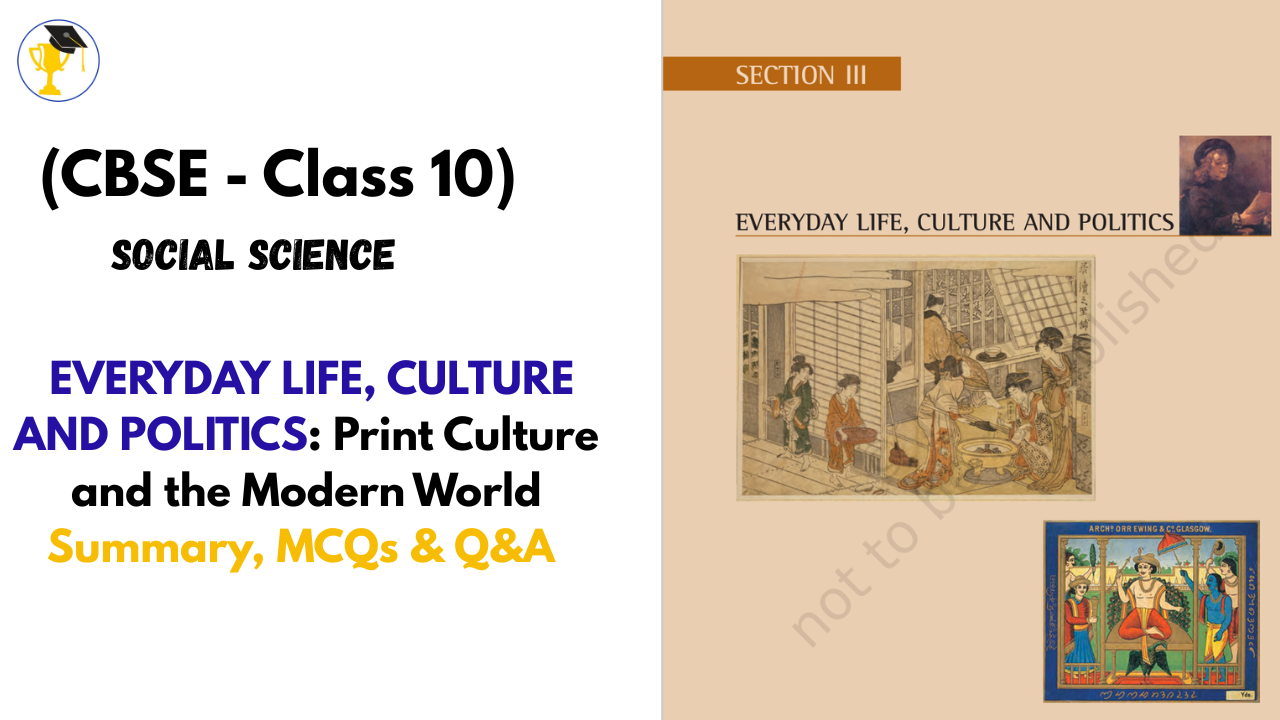
Class 10 Social Science – Print Culture and the Modern World (History: Chapter 5) Summary + MCQs + Q&A
CHAPTER SUMMARY - Print Culture and the Modern World
1. The First Printed Books (China, Japan, Korea)
-
Earliest print technology began in East Asia.
-
China: Hand printing → books printed by rubbing paper on woodblocks (from AD 594).
-
Used accordion-style books; beautiful calligraphy.
-
Civil service exams increased demand for printed texts.
-
Japan: Printing introduced by Buddhist monks; oldest Japanese book = Diamond Sutra (868 AD).
-
Edo (Tokyo) became a hub of rich print culture (books on tea ceremony, etiquette, women, music).
2. Print Comes to Europe
-
Chinese paper reached Europe via Silk Route.
-
Marco Polo brought woodblock printing ideas to Europe (1295).
-
Demand for books increased → woodblock printing spread.
-
But hand-written manuscripts were expensive.
Gutenberg’s Printing Press (1430s)
-
Gutenberg designed moveable-type printing press.
-
First printed book: Gutenberg Bible (~1455).
-
Books resembled manuscripts → hand-coloured borders.
-
Printing revolution:
3. Print Revolution and Its Impact
A New Reading Public
-
Books became cheaper → literacy increased.
-
Illustrated ballads, folktales made print accessible to non-readers.
Religious Debates & Fear of Print
-
Print circulated new ideas → authorities feared rebellion.
-
Martin Luther (1517) posted 95 Theses → Protestant Reformation began.
-
Church created Index of Prohibited Books (1558).
Print & Dissent
Reading Mania
-
17th–18th centuries: literacy rose → huge demand for books.
-
Chapbooks, penny magazines, periodicals flourished.
4. Print Culture & The French Revolution
Historians link print culture with revolution:
-
Enlightenment ideas spread (Voltaire, Rousseau).
-
New culture of debate and questioning.
-
Cartoons & underground literature attacked monarchy.
5. Nineteenth Century: Children, Women & Workers
Children
Women
-
Women became readers & writers.
-
Autobiographies like Amar Jiban by Rashsundari Debi.
-
Reformers advocated women’s education; conservatives feared it.
Workers
6. Further Innovations
-
19th century: power-driven presses, offset printing, color printing.
-
20th century: automatic paper reels, new techniques.
-
Serialised novels, cheap books, paperbacks became popular.
7. India and Print
Handwritten Manuscripts
Printing Comes to India
-
First printing press: Goa (Portuguese, mid-1500s).
-
1579: First Tamil book.
-
1780: Hickey’s Bengal Gazette (first English weekly).
Religious Debates
-
Reformers like Rammohun Roy used print for reform.
-
Deoband seminarians printed fatwas.
-
Religious texts flooded in vernacular languages.
8. New Forms of Publication
-
Novels, short stories, poetry, essays expanded.
-
Painters like Raja Ravi Varma produced mass prints.
-
Caricatures and cartoons addressed social/political issues.
Women & Print
Print & Poor People
-
Cheap books sold at crossroads.
-
Libraries set up for workers.
-
Anti-caste writings by Phule, Ambedkar, Periyar.
9. Print & Censorship
-
Early censorship targeted Englishmen criticizing Company rule.
-
1835: Press Act liberalized.
-
After 1857, censorship increased.
-
Vernacular Press Act (1878) imposed restrictions on Indian-language press.
-
Nationalist press resisted censorship and spread anti-colonial ideas.
MCQs
1. The earliest print technology started in:
a) Europe
b) East Asia
c) India
d) Africa
Ans: b
2. The oldest Japanese printed book is:
a) Jikji
b) Diamond Sutra
c) Tripitaka
d) Rigveda
Ans: b
3. Who developed the first moveable-type printing press?
a) Richard Hoe
b) Gutenberg
c) Martin Luther
d) Marco Polo
Ans: b
4. Martin Luther’s Ninety Five Theses criticised:
a) British government
b) Catholic Church practices
c) French monarchy
d) Roman emperors
Ans: b
5. Menocchio was:
a) A German soldier
b) A miller who questioned religion
c) A French king
d) A monk
Ans: b
6. The Vernacular Press Act was passed in:
a) 1765
b) 1878
c) 1919
d) 1942
Ans: b
7. The first English newspaper in India was:
a) The Hindu
b) Bengal Gazette
c) Bombay Samachar
d) Samachar Darpan
Ans: b
8. Raja Ravi Varma was known for:
a) Novels
b) Mass-produced mythological prints
c) Religious tracts
d) Lithographic design
Ans: b
ASSERTION–REASON (A–R)
Q1
A: Printing promoted questioning and critical thinking among people.
R: Print made books cheaper and more accessible.
Ans: A and R both true; R explains A
Q2
A: The Catholic Church feared printing.
R: It feared the spread of rebellious and irreligious ideas.
Ans: A and R true; R explains A
Q3
A: Vernacular Press Act was introduced in 1878.
R: The British wanted to control nationalist writings.
Ans: A and R true; R explains A
Q4
A: Women secretly learned to read in many households.
R: Conservative families believed women would be corrupted by reading.
Ans: A and R true; R explains A
CASE–BASED QUESTIONS
CASE 1: Print & Reformation
Passage:
Luther criticised Catholic practices and circulated his ideas widely through printed pamphlets. Within weeks, thousands of copies spread across Europe, leading to widespread debates and eventually the Protestant Reformation.
Q1. What helped Luther spread his ideas?
→ Printed pamphlets.
Q2. What impact did print have on religious debates?
→ Encouraged questioning and division.
Q3. Which movement did this lead to?
→ Protestant Reformation.
CASE 2: Reading Mania
Passage:
With rising literacy in Europe, people developed huge appetite for reading. Chapbooks, penny magazines, and folk tales became popular. Even the poor accessed reading material.
Q1. Why did reading culture expand?
→ Rise in literacy + cheaper printed books.
Q2. What were chapbooks?
→ Pocket-sized cheap books.
Q3. Who were chapmen?
→ Pedlars selling chapbooks.
CASE 3: Print in India
Passage:
The first printing press came to India through Goa. Later, English newspapers like Bengal Gazette and vernacular press flourished. Religious and social reformers used print to spread ideas.
Q1. Where did printing first begin in India?
→ Goa.
Q2. Who started Bengal Gazette?
→ James Hickey.
Q3. Name one reformer who used print.
→ Rammohun Roy.
VERY SHORT (1 MARK)
-
Who invented moveable-type printing?
→ Gutenberg
-
What is a chapbook?
→ Cheap pocket-sized book.
-
First English newspaper in India?
→ Bengal Gazette
-
What did the Vernacular Press Act permit?
→ Government censorship & seizure
-
Who wrote Amar Jiban?
→ Rashsundari Debi
SHORT ANSWERS (3 MARKS)
Q1. Why did the Catholic Church oppose printing?
-
Feared spread of irreligious ideas.
-
Loss of control over interpretation of Bible.
-
People could read and question Church authority.
Q2. How did women benefit from print culture?
-
Women became readers and writers.
-
Autobiographies and journals encouraged education.
-
Social debates on women’s rights increased.
Q3. Describe any three new printing innovations of the 19th century.
-
Power-driven cylindrical press (Richard Hoe).
-
Offset printing (multi-color).
-
Electrically operated presses & automatic paper feeds.
LONG ANSWERS (5–6 MARKS)
1. Explain the impact of the print revolution in Europe.
The print revolution in Europe brought about far-reaching changes in society, culture and politics. With the invention of Gutenberg’s printing press, books became cheaper, faster to produce and available to a much wider audience. This allowed literacy rates to rise rapidly, creating a new reading public that no longer depended solely on oral traditions. Print spread the ideas of humanism, rationality and scientific thinking, and played a crucial role in the Protestant Reformation by circulating Martin Luther’s criticisms of the Catholic Church. It encouraged debate, discussion and the questioning of authority, weakening the grip of the Church and monarchies over people’s minds. Printed pamphlets, ballads and images shaped public opinion and exposed injustices. By making knowledge accessible to the masses, print helped create conditions that contributed to major historical changes such as the Enlightenment and the French Revolution. Thus, the print revolution transformed Europe into a more informed, literate and politically conscious society.
2. How did print culture contribute to the French Revolution?
Print culture played a significant role in creating the intellectual atmosphere that led to the French Revolution. Enlightenment thinkers like Voltaire, Rousseau and Montesquieu used print to criticise the Church, monarchy and social inequalities, spreading ideas of equality, liberty and reason among the people. Their writings reached thousands of readers and encouraged them to question long-established traditions and privileges. Print also created a new culture of debate where people discussed governmental reforms and criticised despotism. By the 1780s, cheap pamphlets and underground literature mocked the royalty and highlighted the miserable conditions of the common people, spreading anger and distrust against the ruling classes. Caricatures and cartoons portrayed the French monarchy as corrupt, wasteful and indifferent to public suffering. Although not everyone interpreted the literature in the same way, print undeniably widened public awareness, encouraged collective thinking and prepared the ground for revolutionary action. Thus, print acted as a catalyst for spreading revolutionary ideas across France.
3. How did print culture help in the growth of nationalism in India?
Print culture played a vital role in the rise of nationalism in India by spreading political awareness, exposing colonial injustices and uniting people across regions. Indian language newspapers like Kesari, Amrita Bazar Patrika, Bombay Samachar and Samachar Darpan reported on British exploitation, economic drain and repressive laws, making common people aware of national issues. Print provided a platform for reformers like Rammohun Roy, Tilak, Gandhi and others to criticise discriminatory practices and mobilise public opinion. During the Swadeshi Movement, posters, calendars and journal advertisements promoted Indian goods and encouraged people to boycott foreign products. Despite censorship laws like the 1878 Vernacular Press Act, nationalist writers courageously continued publishing articles that inspired resistance. Print also helped create a shared national identity by carrying news, speeches and ideas across linguistic and regional boundaries. In this way, print culture became a weapon against colonial rule and helped lay the foundation for the Indian freedom struggle.
4. Describe the impact of print culture on women in the 19th century.
Print culture had a transformative impact on women in the 19th century as it opened new avenues for education, self-expression and social awareness. With the spread of schools and literacy, women increasingly gained access to books, journals and magazines written specifically for them. Many periodicals encouraged women’s education, discussed child-rearing, domestic responsibilities and also highlighted the problems faced by women in patriarchal society. Women like Rashsundari Debi, Tarabai Shinde and Pandita Ramabai began writing autobiographies, essays and novels that voiced their struggles, ambitions and demand for equality. Conservative families feared that reading would corrupt women, yet many women secretly learned to read and write, breaking social restrictions. Cheap printed books from places like Battala in Bengal became widely accessible to women in urban and rural areas. Print allowed women to challenge stereotypes, participate in reform movements and become active contributors to literary culture. Thus, print culture played a major role in empowering women and expanding their role in society.
5. Explain the role of print culture in religious and social reform in India.
Print culture became a powerful medium for religious and social reform in India during the 19th century. Reformers like Raja Rammohun Roy used newspapers, journals and pamphlets to question orthodox practices such as sati, child marriage and caste discrimination, encouraging people to think rationally. Religious groups used print to promote their beliefs: Hindu reformists published the Sambad Kaumudi, while conservatives responded with the Samachar Chandrika. Muslim scholars of the Deoband movement printed fatwas and religious texts in Urdu to guide the community. Cheap lithographic editions of texts like the Ramcharitmanas made sacred literature accessible to ordinary people, creating widespread debates on faith and rituals. Print enabled various reform groups to reach a large audience, inspiring public discussions, counter-arguments and new interpretations of religion. It also provided a platform for anti-caste leaders like Jyotiba Phule and Ambedkar, who exposed social injustices and mobilised oppressed communities. Hence, print culture stimulated reform, encouraged critical thinking and reshaped Indian society.
For Full Chaper Click on: Everyday Life, Culture and Politics


 STUDY MATERIALS
 COURSES
 MORE
MORE
 SUCCESS STORY
 ADMISSION
 STORE
STORE