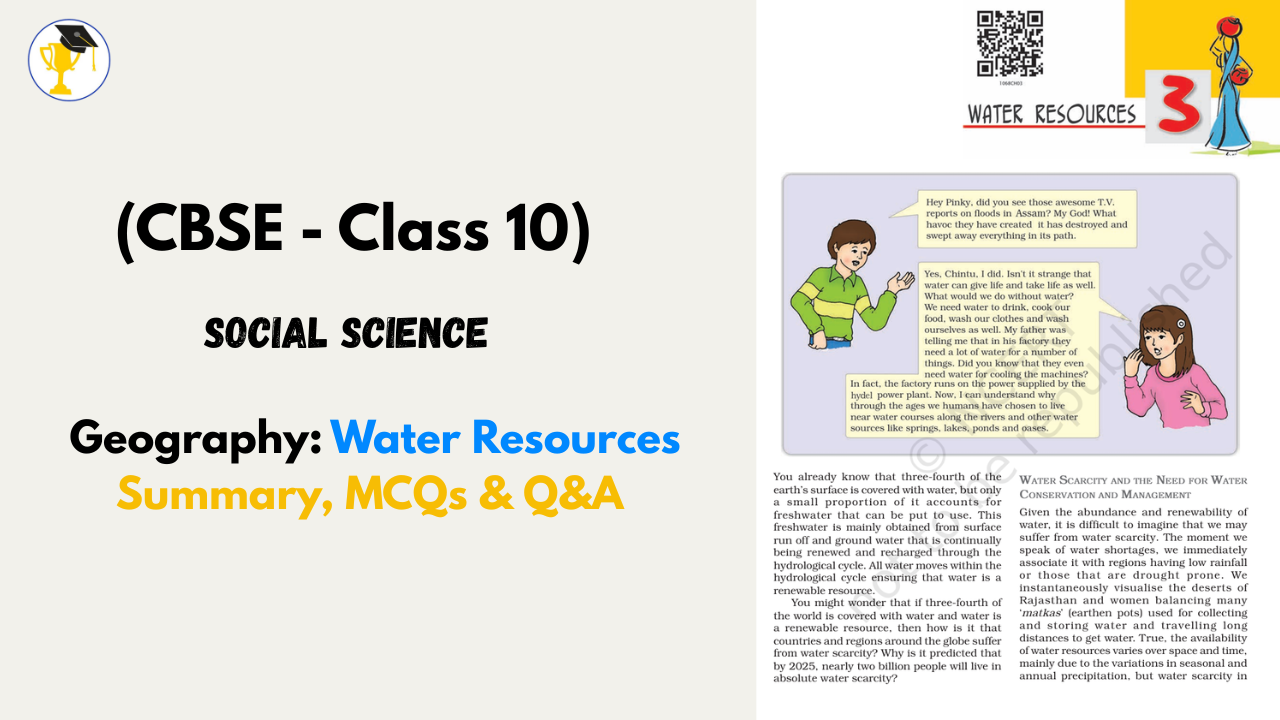
Class 10 Social Science – Water Resources (Geography: Chapter 3) Summary + MCQs + Q&A
CHAPTER SUMMARY - WATER RESOURCES
1. Introduction
Although about three-fourths of Earth’s surface is covered with water, only a small fraction is freshwater — suitable for human use.
This freshwater comes mainly from surface runoff and groundwater, continuously renewed through the hydrological cycle.
Despite being renewable, water scarcity has become a serious global concern — and it is predicted that by 2025, two billion people will live under absolute water scarcity.
2. Water Scarcity and the Need for Conservation
Water scarcity does not always mean the absence of water, but unequal access and overuse.
Main Causes of Water Scarcity
-
Unequal distribution of rainfall
-
Over-exploitation and depletion of groundwater
-
Pollution from industries and agriculture
-
Rising population and food demand
-
Urbanization and industrialization
-
Poor water management
In many cities, people face scarcity even with adequate rainfall — due to overuse, pollution, and waste.
3. Major Government Initiatives
Jal Jeevan Mission (JJM)
Aims to provide every rural household with piped drinking water — 55 litres per person per day.
Atal Bhujal Yojana (Atal Jal)
Implemented in seven states (Gujarat, Haryana, Karnataka, MP, Maharashtra, Rajasthan, UP) to promote groundwater conservation through community participation.
4. Multi-purpose River Projects and Integrated Water Management
From ancient times, India built dams, tanks, canals, and lakes for water storage and irrigation.
Today, multi-purpose river valley projects combine multiple uses — irrigation, hydropower, flood control, navigation, and drinking water.
Examples
|
Project
|
River
|
Purpose/States Covered
|
|
Bhakra-Nangal
|
Sutlej-Beas
|
Irrigation, power
|
|
Hirakud
|
Mahanadi
|
Flood control, irrigation
|
|
Sardar Sarovar
|
Narmada
|
Irrigation, drinking water in Gujarat, Rajasthan
|
|
Damodar Valley Project
|
Damodar
|
Flood control, power generation
|
|
Nagarjuna Sagar
|
Krishna
|
Irrigation
|
Dams: The ‘Temples of Modern India’
As Jawaharlal Nehru once said, dams were seen as symbols of progress — integrating agriculture with industrial development.
However, large dams have faced criticism due to environmental and social impacts.
Advantages
-
Irrigation and flood control
-
Hydroelectric power generation
-
Water supply for domestic and industrial use
-
Navigation and fish breeding
Disadvantages
-
Submergence of land and forests
-
Displacement of people
-
Sedimentation and reduced fertility of floodplains
-
Risk of earthquakes, water-borne diseases, and soil salinity
6. Inter-State Water Disputes
Water-sharing conflicts often arise between states:
-
Krishna–Godavari dispute – Karnataka, Maharashtra, Andhra Pradesh
-
Cauvery dispute – Karnataka and Tamil Nadu
-
Satluj–Yamuna link issue – Punjab and Haryana
7. Rainwater Harvesting
Given the environmental cost of big dams, rainwater harvesting has emerged as a sustainable alternative.
Traditional Systems in India
|
Region
|
Method
|
Description
|
|
Western Himalayas
|
Guls or Kuls
|
Small channels for irrigation
|
|
Rajasthan
|
Khadins & Johads
|
Rain-fed storage structures
|
|
Eastern India (Bengal)
|
Inundation channels
|
For irrigation in floodplains
|
|
Hilly Meghalaya
|
Bamboo drip irrigation
|
Water diverted through bamboo pipes
|
|
Rajasthan
|
Tankas
|
Underground water storage tanks in houses
|
|
Urban Areas
|
Rooftop harvesting
|
Pipes direct rainwater into underground sumps or wells
|
Tamil Nadu is the first state to make rooftop rainwater harvesting compulsory by law.
Gendathur village (Karnataka) — model of success: 200 houses collectively harvest 1,00,000 litres of rainwater annually.
8. Bamboo Drip Irrigation (Meghalaya)
-
200-year-old eco-friendly technique.
-
Uses bamboo pipes to divert water from hilltop streams to plantations.
-
Prevents water wastage and provides slow, steady irrigation (20–80 drops/minute).
(See Fig. 3.7 on page 28 for detailed illustrations.)
KEY TERMS
|
Term
|
Meaning
|
|
Hydrological Cycle
|
Continuous movement of water on Earth
|
|
Water Scarcity
|
Shortage due to overuse or pollution
|
|
Multi-purpose Project
|
Dams serving several functions
|
|
Rainwater Harvesting
|
Collection and storage of rainwater
|
|
Tankas
|
Underground water tanks in Rajasthan
|
|
JJM
|
Jal Jeevan Mission
|
|
Atal Jal
|
Groundwater conservation programme
|
|
Bamboo Drip Irrigation
|
Traditional irrigation system of Meghalaya
|
|
Khadin/Johad
|
Traditional rain-fed structures in Rajasthan
|
|
Water Pollution
|
Contamination due to domestic or industrial waste
|
Multiple Choice Questions (MCQs)
1. Water scarcity occurs due to:
a) Low rainfall only
b) Over-exploitation and pollution
c) Plenty of water sources
d) Glacier melting
Answer: b) Over-exploitation and pollution
2. Which river is associated with the Hirakud Dam?
a) Mahanadi
b) Godavari
c) Narmada
d) Ganga
Answer: a) Mahanadi
3. Who described dams as the ‘temples of modern India’?
a) Mahatma Gandhi
b) Sardar Patel
c) Jawaharlal Nehru
d) Dr. B.R. Ambedkar
Answer: c) Jawaharlal Nehru
4. Which state made rooftop rainwater harvesting compulsory?
a) Gujarat
b) Tamil Nadu
c) Rajasthan
d) Assam
Answer: b) Tamil Nadu
5. The practice of rooftop rainwater harvesting is most common in:
a) Meghalaya
b) Kerala
c) Maharashtra
d) Haryana
Answer: a) Meghalaya
6. Bamboo drip irrigation is practiced in:
a) Punjab
b) Meghalaya
c) Rajasthan
d) Gujarat
Answer: b) Meghalaya
7. Which mission aims to provide safe piped drinking water to rural households?
a) Swachh Bharat Mission
b) Jal Jeevan Mission
c) Atal Bhujal Yojana
d) Pradhan Mantri Sinchayee Yojana
Answer: b) Jal Jeevan Mission
8. Atal Bhujal Yojana focuses on:
a) Flood control
b) River cleaning
c) Groundwater management
d) Water transportation
Answer: c) Groundwater management
9. The Sardar Sarovar Project is built on which river?
a) Krishna
b) Narmada
c) Yamuna
d) Sutlej
Answer: b) Narmada
10. In which region are ‘Khadins’ and ‘Johads’ found?
a) Bengal
b) Rajasthan
c) Odisha
d) Tamil Nadu
Answer: b) Rajasthan
VERY SHORT ANSWERS
-
What is water scarcity? → When water is insufficient or polluted.
-
Define hydrological cycle. → Continuous movement and recycling of water.
-
What is a multi-purpose river project? → Dams serving irrigation, power, and flood control.
-
Name any two traditional water harvesting systems. → Khadin and Kuls.
-
Which mission aims to provide piped drinking water? → Jal Jeevan Mission.
-
What is Atal Jal? → Scheme for groundwater conservation.
-
Who called dams the ‘temples of modern India’? → Jawaharlal Nehru.
SHORT ANSWERS (3–4 MARKS)
1. What are the main causes of water scarcity in India?
-
Rapid population growth
-
Overuse and unequal access
-
Industrial and agricultural pollution
-
Urbanization and falling groundwater levels
2. What are the advantages and disadvantages of multi-purpose river projects?
Advantages: Irrigation, flood control, power generation.
Disadvantages: Displacement, deforestation, siltation, soil salinity.
3. Explain rainwater harvesting in Rajasthan.
People build tankas — underground storage tanks connected to rooftops to collect rainwater, called palar pani. It’s the purest form of water and used during dry months.
CASE-BASED QUESTIONS
CASE 1: Water Scarcity and Overuse
PASSAGE:
India receives abundant rainfall during the monsoon, yet many regions face severe water scarcity. In cities, groundwater is over-exploited to meet the rising demand of households, industries, and agriculture. Water tables are falling rapidly, and the quality of groundwater is deteriorating due to industrial pollution and excessive use of chemical fertilizers. Rural areas also face scarcity during dry seasons, forcing women to travel long distances to collect water. The government has launched programmes like Jal Jeevan Mission and Atal Bhujal Yojana to promote conservation and equitable distribution of water resources.
Questions:
1. What are the two main reasons for water scarcity in India?
Over-exploitation and pollution of water resources.
2. How does industrialization contribute to water scarcity?
Industries use large quantities of freshwater and release toxic waste into water bodies.
3. Mention one initiative started by the government to provide safe drinking water in rural areas.
Jal Jeevan Mission (JJM).
4. Suggest one measure to reduce groundwater depletion.
Rainwater harvesting or controlled irrigation methods.
CASE 2: Multipurpose River Projects
PASSAGE:
After independence, India constructed several large dams such as Bhakra-Nangal, Hirakud, and Sardar Sarovar to fulfill irrigation, power generation, and flood control needs. These projects were once seen as the “temples of modern India.” However, over the years, many of these dams have faced criticism. Sedimentation, deforestation, submergence of villages, and displacement of local people are some of the major issues. Moreover, regulating river flow has led to reduced fertility of floodplains. States often fight over the sharing of river waters, as seen in the Krishna–Godavari and Cauvery disputes.
Questions:
1. What are multipurpose river projects?
Dams built for multiple uses like irrigation, power generation, flood control, and drinking water.
2. Why did Jawaharlal Nehru call dams the “temples of modern India”?
Because they symbolized economic progress and national development.
3. Name one major disadvantage of multipurpose river projects.
Displacement of local people and submergence of land and forests.
4. Mention one inter-state water dispute in India.
Krishna–Godavari dispute or Cauvery dispute.
CASE 3: Rainwater Harvesting in Rajasthan
PASSAGE:
Rajasthan, an arid state, has a long tradition of rainwater harvesting. People built tankas—underground storage tanks connected to rooftops that collected rainwater during the monsoon. This palar pani (rainwater) was used for drinking during summer when all other sources dried up. Despite modern supply systems like the Indira Gandhi Canal, many families in rural areas still maintain these tanks due to the purity and taste of the stored water. Similarly, in Karnataka, the Gendathur village has become famous for its successful rooftop rainwater harvesting model, where 200 households collect and store over 1 lakh litres annually.
Questions:
1. What is a tanka?
An underground water storage tank for collecting rainwater.
2. Why is rainwater considered the purest form of water?
Because it is free from salts and pollutants found in surface or groundwater.
3. How does rainwater harvesting help in groundwater recharge?
It allows rainwater to percolate through the soil, replenishing underground aquifers.
4. Which state has made rooftop rainwater harvesting compulsory?
Tamil Nadu.
ASSERTION–REASON QUESTIONS
Set 1
Assertion (A): Water scarcity occurs only in regions of low rainfall.
Reason (R): India’s water scarcity is caused mainly by uneven distribution, overuse, and pollution.
Answer: Assertion is false, Reason is true.
Set 2
A: Multi-purpose river valley projects help in flood control and irrigation.
R: Dams store and regulate river water for multiple uses.
Answer: Both A and R are true, and R correctly explains A.
Set 3
A: Construction of dams leads to submergence of forests and displacement of people.
R: Dams require large areas of land, which often include villages and forests.
Answer: Both A and R are true, and R correctly explains A.
Set 4
A: Bamboo drip irrigation is an eco-friendly water management system.
R: It uses bamboo pipes to deliver water drop by drop to plant roots.
Answer: Both statements are true and related.
Set 5
A: Rooftop rainwater harvesting is declining in Rajasthan.
R: People now depend on water from the Indira Gandhi Canal.
Answer: Both A and R are true, and R is the correct explanation.
Set 6
A: Sedimentation in reservoirs reduces their capacity to store water.
R: Damming rivers slows down their natural flow, causing silt to settle.
Answer: Both A and R are true, and R explains A.
Set 7
A: Jal Jeevan Mission aims to provide 55 litres of water per person per day.
R: It focuses on rural households to ensure access to safe drinking water.
Answer: Both A and R are true and related.
Set 8
A: In Meghalaya, bamboo drip irrigation wastes a large quantity of water.
R: It allows water to flow freely without control.
Answer: Both A and R are false (it saves water efficiently).
Set 9
A: Rainwater harvesting helps reduce urban flooding.
R: It collects and stores rooftop rainwater instead of allowing runoff.
Answer: Both A and R are true, and R correctly explains A.
Set 10
A: The construction of large dams has always benefited local communities.
R: They have led to displacement and environmental loss.
Answer: Assertion is false, Reason is true.
LONG ANSWERS
Q1. Why is water scarcity a growing problem in India?
Water scarcity in India is caused by multiple factors such as over-exploitation, pollution, and unequal distribution of water. Although India receives rainfall through the monsoon, its uneven distribution across different regions leads to shortages in several states. The growing population has increased the demand for water for domestic, industrial, and agricultural uses. Intensive irrigation and the use of groundwater for farming have led to a sharp fall in water tables. Industrialisation has also polluted freshwater sources by releasing toxic waste into rivers and lakes. Urbanisation further worsens the problem as cities overdraw groundwater for domestic and industrial needs. Poor water management, wastage, and deforestation have all contributed to this crisis, making water scarcity one of the most serious environmental issues facing India today.
Q2. Describe the advantages and disadvantages of multi-purpose river valley projects.
Multi-purpose river valley projects are built to serve several purposes such as irrigation, electricity generation, flood control, navigation, fish breeding, and providing drinking water. These projects play a major role in agricultural development, industrial growth, and overall economic progress. However, they also have some serious disadvantages. Large dams often submerge vast forest and agricultural lands, leading to displacement of people and loss of biodiversity. Sedimentation in reservoirs reduces their capacity, and the change in natural flow of rivers affects aquatic life. Sometimes, these dams trigger floods instead of preventing them and cause soil salinity due to over-irrigation. Hence, while multi-purpose projects contribute to development, they must be planned carefully to minimize ecological and social damage.
Q3. Explain the various traditional methods of rainwater harvesting practiced in India.
India has a long history of water conservation through traditional methods that vary by region and climate. In the Western Himalayas, people built small diversion channels called guls or kuls for irrigation. In Rajasthan, people constructed khadins and johads to store rainwater and recharge groundwater. Almost every house in arid areas like Bikaner and Phalodi had underground tanks known as tankas to store drinking water, considered the purest form of natural water. In Meghalaya, the unique bamboo drip irrigation system is used to channel spring water to fields, ensuring minimum wastage. In Bengal, inundation channels were developed for irrigation. These methods were eco-friendly, cost-effective, and perfectly suited to local conditions, proving that India’s traditional wisdom remains relevant even today.
Q4. What are the negative impacts of large dams on the environment and society?
Large dams, though useful for irrigation and power generation, often have adverse effects on both the environment and people. The construction of dams leads to the submergence of vast forests, wildlife habitats, and fertile agricultural land. Thousands of people, especially tribal communities, are displaced and lose their homes and livelihoods. Dams disrupt the natural flow of rivers, reduce sediment flow, and affect aquatic ecosystems, making it difficult for fish and other species to survive. In some cases, the accumulation of water causes earthquakes and increases water-borne diseases. Flooding due to poor dam management and soil salinisation from over-irrigation are also major issues. Therefore, while dams are necessary for development, they must be constructed with careful environmental planning and proper rehabilitation measures.
Q5. Describe how rainwater harvesting helps in conserving water.
Rainwater harvesting is a simple and effective method of conserving water by collecting and storing rainwater for future use. In this process, rainwater is gathered from rooftops, courtyards, or open areas and directed into storage tanks, sumps, or recharge wells. It helps replenish groundwater levels and reduces dependence on surface water sources. This method is especially useful in arid and semi-arid regions where rainfall is scarce. For example, in Rajasthan, underground tankas are used to store palar pani (rainwater), which is the purest form of natural water. Tamil Nadu has made rooftop rainwater harvesting compulsory by law. In urban areas, it reduces flooding and prevents waterlogging. Overall, rainwater harvesting ensures water availability, improves groundwater quality, and promotes sustainable development.
For full chapter click on: Water Resources


 STUDY MATERIALS
 COURSES
 MORE
MORE
 SUCCESS STORY
 ADMISSION
 STORE
STORE