Class 10 Social Science – Resources and Development (Geography: Chapter 1) Summary + MCQs + Q&A
CHAPTER SUMMARY - RESOURCES AND DEVELOPMENT
1. Meaning of Resources
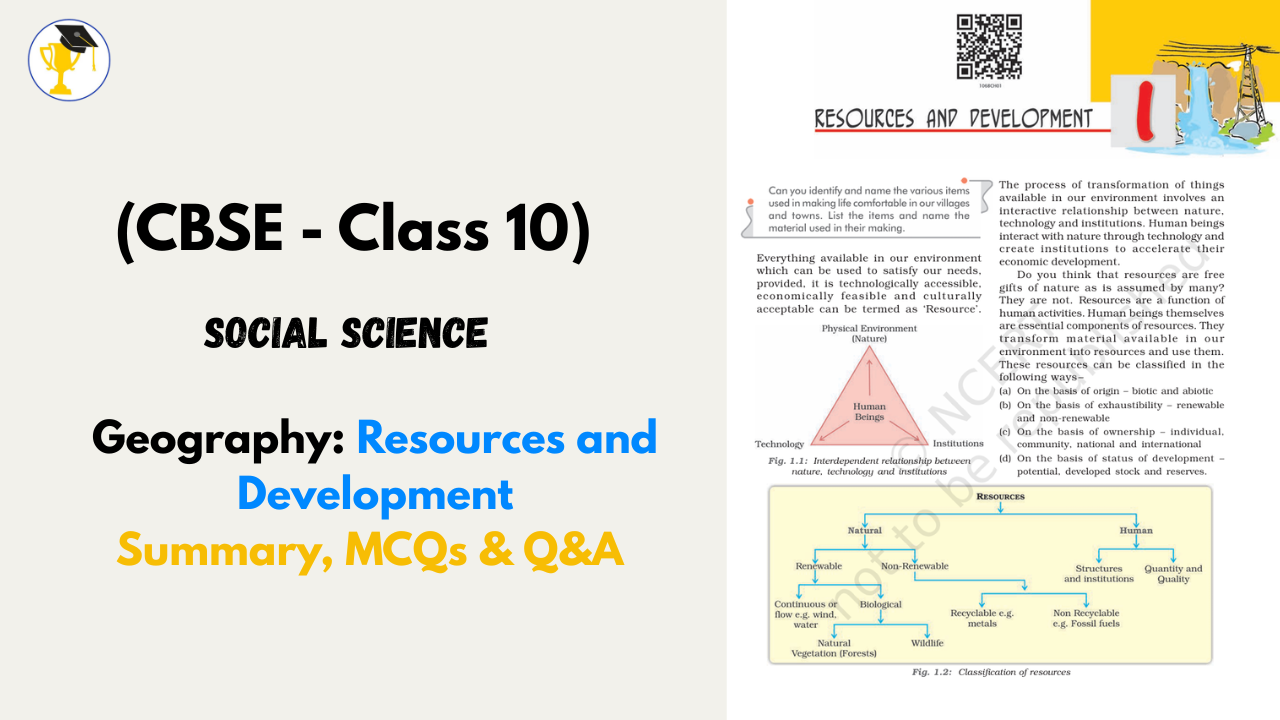
Resource: Everything available in our environment that can be used to satisfy our needs, provided it is technologically accessible, economically feasible, and culturally acceptable.
Resources are not free gifts of nature — they are created through the interaction between nature, technology, and institutions.
(See Fig. 1.1 in textbook – triangle showing interdependence among these three elements)
Classification of Resources (Fig. 1.2)
|
Basis
|
Types
|
|
Origin
|
Biotic, Abiotic
|
|
Exhaustibility
|
Renewable, Non-Renewable
|
|
Ownership
|
Individual, Community, National, International
|
|
Development Status
|
Potential, Developed, Stock, Reserves
|
2. Development of Resources
Uncontrolled exploitation of resources leads to:
-
Depletion for future generations
-
Unequal distribution (rich vs. poor)
-
Environmental damage – global warming, pollution, land degradation
Sustainable Development
Development that meets the needs of the present without compromising future generations.
Rio Earth Summit (1992) – attended by 100+ countries, focused on environmental protection.
Agenda 21 – a global action plan promoting sustainable development through local-level efforts.
3. Resource Planning in India
India’s resources are unevenly distributed.
Examples:
-
Jharkhand, Chhattisgarh → rich in minerals
-
Rajasthan → rich in solar/wind energy but poor in water
-
Arunachal Pradesh → abundant water but lacks infrastructure
-
Ladakh → rich in culture but lacks resources
Steps in Resource Planning
-
Identification and inventory of resources (mapping, surveying, measurement)
-
Evolving planning structures with proper technology and institutions
-
Matching resource development plans with national development goals
Gandhiji’s View
“There is enough for everyone’s need but not for anyone’s greed.”
He promoted resource conservation through production by the masses, not mass production.
4. Land Resources
Land is a natural resource that supports life, vegetation, and human activities.
Distribution by Relief (Fig. 1.3)
-
Plains – 43% → agriculture, industries
-
Mountains – 30% → forests, water, tourism
-
Plateaus – 27% → minerals, fossil fuels, forests
5. Land Utilisation
Land Use Categories
-
Forests
-
Land not available for cultivation (barren land, built-up areas)
-
Other uncultivated land (pastures, tree crops, culturable waste)
-
Fallow lands (temporarily uncultivated)
-
Net sown area (land under cultivation)
Land Use Pattern (1960–61 vs 2019–20)
(Refer to pie chart in textbook, Fig. 1.4)
-
Forest area is below desired 33%
-
Net sown area and forest cover changed marginally
-
Pasture land decreased despite high cattle population
6. Land Degradation and Conservation
Causes:
Conservation Measures:
7. Soil as a Resource
Soil – top layer of earth, supports plant growth. Formed by natural processes like weathering, decomposition, and erosion.
(See Fig. 1.5: Soil Profile – topsoil, subsoil, substratum, bedrock)
Factors Affecting Soil Formation:
-
Relief
-
Parent rock
-
Climate
-
Vegetation & organisms
-
Time
8. Types of Soils in India (See Map, Fig. 1.8)
|
Type
|
Features
|
Regions
|
|
Alluvial Soil
|
Very fertile, rich in potash & lime, ideal for crops like rice & wheat
|
Northern Plains, coastal deltas
|
|
Black Soil
|
Black in colour, moisture-retentive, ideal for cotton
|
Maharashtra, MP, Chhattisgarh
|
|
Red & Yellow Soil
|
Formed from crystalline rocks, poor in nutrients
|
Odisha, Chhattisgarh, Deccan Plateau
|
|
Laterite Soil
|
Leached, acidic, low fertility; grows tea, coffee, cashew
|
Karnataka, Kerala, Tamil Nadu
|
|
Arid Soil
|
Sandy, saline, poor in moisture
|
Rajasthan, Gujarat
|
|
Forest Soil
|
Loamy & fertile in valleys, poor in higher slopes
|
Himalayan & forest regions
|
9. Soil Erosion and Conservation
Soil Erosion:
Removal of topsoil by water or wind.
Types:
-
Gully erosion (deep cuts – Chambal ravines)
-
Sheet erosion (top layer removed)
-
Wind erosion (blowing away of soil)
Prevention Methods:
-
Contour ploughing
-
Terrace farming (Uttarakhand, Himachal)
-
Strip cropping
-
Shelter belts (tree rows to block wind, used in Rajasthan)
KEY TERMS
|
Term
|
Definition
|
|
Resource
|
Anything used to satisfy human needs
|
|
Sustainable Development
|
Development without harming environment
|
|
Resource Planning
|
Strategy for judicious use of resources
|
|
Land Degradation
|
Decline in land productivity
|
|
Soil Erosion
|
Removal of topsoil by wind or water
|
|
Alluvial Soil
|
Fertile soil from river deposits
|
|
Laterite Soil
|
Leached soil found in wet regions
|
|
Contour Ploughing
|
Ploughing across slopes to prevent erosion
|
|
Afforestation
|
Planting trees to prevent degradation
|
|
Agenda 21
|
UN action plan for sustainable development
|
MCQs
1. Which one of the following is a biotic resource?
a) Coal
b) Iron ore
c) Forests
d) Water
Answer: c
2. Which type of resource is renewable?
a) Coal
b) Petroleum
c) Forests
d) Minerals
Answer: c
3. Agenda 21 was adopted at:
a) Stockholm Conference
b) Rio de Janeiro Earth Summit
c) Geneva Convention
d) Kyoto Protocol
Answer: b
4. Land degradation in Punjab is mainly due to:
a) Deforestation
b) Overgrazing
c) Over-irrigation
d) Mining
Answer: c
5. Which soil is known as Regur soil?
a) Alluvial
b) Black
c) Laterite
d) Arid
Answer: b
6. Which soil is suitable for tea and coffee?
a) Red
b) Black
c) Laterite
d) Arid
Answer: c
7. The process of cutting steps on hills for cultivation is called:
a) Strip cropping
b) Terrace farming
c) Contour ploughing
d) Afforestation
Answer: b
8. What percentage of India’s land is plains?
a) 20%
b) 30%
c) 43%
d) 50%
Answer: c
9. Which is not a renewable resource?
a) Water
b) Soil
c) Minerals
d) Forests
Answer: c
10. Which layer of soil is richest in humus?
a) Subsoil
b) Topsoil
c) Bedrock
d) Substratum
Answer: b
VERY SHORT ANSWERS
-
Define resource. → Anything that satisfies human needs if technologically, economically, and culturally usable.
-
What is sustainable development? → Development that meets present needs without harming future generations.
-
Name the resource planning steps. → Identification, planning structure, and matching plans with development goals.
-
What is land degradation? → Decline in land productivity due to human and natural causes.
-
Name two causes of land degradation. → Overgrazing, mining.
-
Which soil is ideal for cotton? → Black soil.
-
Which soil is found in the Ganga plains? → Alluvial soil.
-
What is contour ploughing? → Ploughing along contour lines to prevent erosion.
-
Name the UN conference that adopted Agenda 21. → Rio Earth Summit, 1992.
-
Who said, “There is enough for everyone’s need but not for anyone’s greed”? → Mahatma Gandhi.
SHORT ANSWERS (3–4 MARKS)
1. Why is resource planning essential in India?
-
Resources are unevenly distributed.
-
Some regions are rich, others poor.
-
Prevents misuse and ensures equitable distribution.
-
Helps achieve sustainable development.
2. What are the main causes of land degradation?
-
Deforestation, mining, overgrazing.
-
Over-irrigation causing salinity.
-
Industrial waste disposal.
-
Faulty agricultural practices.
3. What are the different types of resources based on ownership?
-
Individual resources (owned by private individuals).
-
Community resources (parks, grazing grounds).
-
National resources (roads, railways).
-
International resources (oceans, atmosphere).
LONG ANSWERS (5–6 MARKS)
Q1. Describe the steps involved in resource planning in India.
Resource planning involves three key steps:
-
Identification and inventory of resources through mapping, surveying, and measurement.
-
Developing a planning structure with skilled manpower, technology, and institutions.
-
Matching resource development with overall national goals.
India began resource planning during the First Five-Year Plan after independence. Balanced resource use ensures economic growth and environmental sustainability.
Q2. Explain land degradation and suggest measures to control it.
Causes:
-
Deforestation, overgrazing, mining, over-irrigation, and industrial pollution.
Conservation Measures:
-
Afforestation and reforestation
-
Controlled grazing
-
Planting shelter belts and thorny bushes
-
Proper disposal of waste and treatment of effluents
-
Regulation of mining activities
Proper management of land can restore productivity and maintain ecological balance.
Q3. Explain the classification of resources based on origin and exhaustibility.
Origin:
-
Biotic – obtained from living organisms (forests, animals).
-
Abiotic – obtained from non-living things (minerals, metals, water).
Exhaustibility:
-
Renewable – can be replenished (solar, wind, forests).
-
Non-renewable – limited reserves, take millions of years to form (coal, petroleum).
Q4. Describe the types of soils found in India.
-
Alluvial Soil: Fertile, found in plains, supports rice and wheat.
-
Black Soil: Moisture-retaining, ideal for cotton.
-
Red & Yellow Soil: Poor in nutrients, needs fertilisers.
-
Laterite Soil: Leached soil, good for tea and coffee.
-
Arid Soil: Sandy, saline, low moisture.
-
Forest Soil: Fertile in valleys, less fertile on slopes.
Q5. Explain the concept and importance of sustainable development.
Sustainable development means growth without damaging the environment. It aims to meet present needs without endangering future generations. Overuse of resources causes global warming, pollution, and inequality. Sustainable practices like recycling, afforestation, efficient energy use, and waste reduction ensure long-term prosperity for all.
CASE-BASED QUESTION
PASSAGE:
A village in Rajasthan faces soil erosion due to strong winds and overgrazing. The government launched an afforestation programme and constructed shelter belts to stop the movement of sand dunes.
Questions:
- What type of land degradation was occurring? → Wind erosion.
- Name two measures taken. → Afforestation and shelter belts.
- Which region of India faces this problem? → Western Rajasthan.
- What is the long-term benefit of such programmes? → Prevents desertification and improves soil fertility.
ASSERTION–REASON QUESTIONS
1. A: Black soil is also called Regur soil.
R: It is ideal for cotton cultivation.
Answer: A
2. A: Over-irrigation causes salinity in soil.
R: Excess water brings salt to the surface.
Answer: A
3. A: Laterite soil is rich in humus.
R: It forms in heavy rainfall areas with high leaching.
Answer: C (R is true, A is false)
4. A: Land degradation can be controlled by afforestation.
R: Trees prevent soil erosion and improve fertility.
Answer: A
5. A: Resource planning ensures equitable use.
R: Some regions are resource-rich while others are poor.
Answer: A
For full chapter click on: Resources and Development


 STUDY MATERIALS
 COURSES
 MORE
MORE
 SUCCESS STORY
 ADMISSION
 STORE
STORE